

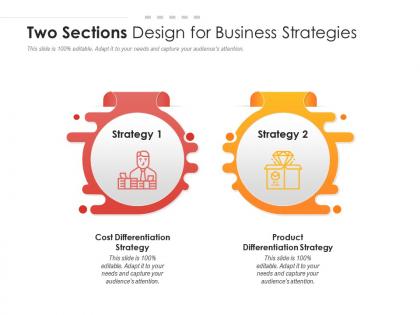
Two sections design for business strategies




Try Before you Buy Download Free Sample Product
 Impress Your
Audience
 100%
Editable
 Save Hours
of Time


Our Two Sections Design For Business Strategies are topically designed to provide an attractive backdrop to any subject. Use them to look like a presentation pro.
People who downloaded this PowerPoint presentation also viewed the following :
Two sections design for business strategies with all 2 slides:
Use our Two Sections Design For Business Strategies to effectively help you save your valuable time. They are readymade to fit into any presentation structure.


FAQs for Two sections design
Key components of successful business strategy design include clear vision and mission statements, comprehensive market analysis, competitive positioning, resource allocation frameworks, and measurable performance metrics. These elements work together by aligning organizational goals with market opportunities, optimizing operational efficiency, and enabling data-driven decision making, with many companies finding that strategic integration ultimately delivers sustainable competitive advantage and accelerated growth.
Organizations align business strategy with mission and vision by establishing clear strategic objectives, cascading goals throughout departments, implementing performance metrics that reflect core values, and regularly reviewing alignment through strategic planning sessions. This strategic combination enables companies to maintain consistent decision-making, enhance operational efficiency, and deliver measurable outcomes that reinforce their foundational purpose, ultimately creating competitive advantage through authentic organizational coherence.
Market analysis plays a foundational role in business strategy design by identifying customer needs, competitive landscapes, market trends, growth opportunities, and potential threats. Through comprehensive market research, organizations can make informed strategic decisions about product development, pricing strategies, and market positioning, while minimizing risks and maximizing competitive advantage in an increasingly dynamic business environment.
Companies effectively identify their target audience through comprehensive market research, customer data analysis, demographic and psychographic profiling, competitor analysis, and direct customer feedback collection. These strategic approaches enable organizations to segment markets precisely, understand customer pain points and preferences, and develop targeted value propositions, ultimately delivering more personalized experiences and competitive advantage in increasingly crowded marketplaces.
Common business strategy frameworks include Porter's Five Forces, SWOT analysis, Blue Ocean Strategy, BCG Matrix, and Value Chain Analysis. These frameworks differ in focus and application, with Porter's examining competitive forces, SWOT assessing internal capabilities against external opportunities, and Blue Ocean identifying uncontested market spaces, ultimately enabling organizations to streamline strategic planning and enhance competitive positioning.
Internal factors like organizational capabilities, resources, culture, and leadership priorities combine with external elements including market conditions, competitive landscape, regulatory requirements, and customer demands to shape strategic direction. These interconnected influences enable companies to identify opportunities, assess risks, and develop competitive positioning strategies, with many organizations finding that balancing internal strengths with external market realities ultimately delivers sustainable growth and operational efficiency.
Business strategy effectiveness can be evaluated through financial metrics like ROI and revenue growth, operational indicators such as market share and customer retention, balanced scorecards, and competitive analysis benchmarking. These assessment methods enable organizations to measure strategic progress by tracking performance gaps, identifying improvement opportunities, and adjusting tactics accordingly, with many companies finding that regular evaluation cycles ultimately deliver enhanced decision-making and sustained competitive advantage.
Adaptability is essential in business strategy design, particularly in volatile markets where customer demands, competitive landscapes, and economic conditions shift rapidly. Organizations with adaptive strategies can pivot operations, reallocate resources, and adjust market approaches more effectively, with many companies finding that flexible strategic frameworks enable sustained growth while competitors struggle to respond to changing conditions.
Common pitfalls include lack of market research, unclear objectives, ignoring competitive landscape, overestimating resources, and failing to align teams with strategic goals. These missteps often lead organizations to pursue unrealistic targets, misallocate budgets, and lose market position, with many companies finding that thorough planning and stakeholder alignment ultimately delivers sustainable competitive advantage.
Businesses can incorporate sustainability by integrating environmental and social considerations into core operations, supply chain management, product development, resource allocation, and stakeholder engagement processes. This strategic combination enables companies to reduce operational costs, enhance brand reputation, and meet increasingly conscious consumer demands, with many organizations finding that sustainable practices ultimately deliver competitive advantage and long-term resilience.
Technology innovations fundamentally reshape business strategy creation by enabling data-driven decision making, predictive analytics, real-time market insights, automated competitive analysis, and enhanced customer behavior tracking. These capabilities allow organizations to develop more agile, responsive strategies while identifying new revenue streams, with many companies finding that AI-powered strategic planning delivers faster adaptation and sustainable competitive advantage.
Organizations can foster collaboration during strategy design through cross-functional workshops, stakeholder mapping exercises, collaborative planning sessions, structured brainstorming frameworks, and transparent communication channels. These approaches streamline alignment by breaking down silos, encouraging diverse perspectives, and ensuring buy-in across departments, with many companies finding that inclusive strategy development ultimately delivers stronger implementation and sustainable competitive advantage.
Data analytics enhances strategic decision-making by providing comprehensive market insights, competitive intelligence, customer behavior patterns, and performance metrics that inform strategic choices. Through predictive modeling and real-time dashboards, organizations can identify emerging opportunities, assess strategic risks, and optimize resource allocation, with many companies finding that data-driven strategies deliver significantly higher ROI and competitive advantage.
Competitive advantage is fundamental to business strategy development because it defines how organizations differentiate themselves, capture market share, and sustain profitability over time. It enables companies to deliver superior value through cost leadership, product innovation, or specialized expertise, with many businesses finding that sustainable competitive advantages ultimately drive long-term growth and market positioning.
Businesses measure long-term strategic success through key performance indicators like revenue growth, market share expansion, customer retention rates, operational efficiency improvements, and return on investment metrics. These measurements, tracked quarterly and annually across departments, enable organizations to assess strategic alignment, identify performance gaps, and make data-driven adjustments that sustain competitive advantage.
-
Great designs, Easily Editable.
-
Content of slide is easy to understand and edit.
-
Great quality slides in rapid time.
-
Presentation Design is very nice, good work with the content as well.
-
Excellent products for quick understanding.