

Types Of Franchise Arrangements For Global Market Assessment And Entry Strategy For Business Expansion




Try Before you Buy Download Free Sample Product
 Impress Your
 Audience
 100%
100% Editable
 Save Hours
 of Time


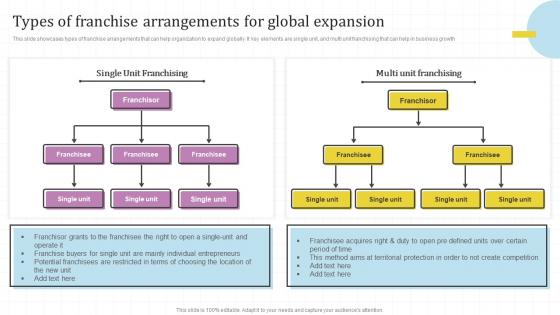
This slide showcases types of franchise arrangements that can help organization to expand globally. It key elements are single unit, and multi unit franchising that can help in business growth
People who downloaded this PowerPoint presentation also viewed the following :
Types Of Franchise Arrangements For Global Market Assessment And Entry Strategy For Business Expansion with all 7 slides:
Use our Types Of Franchise Arrangements For Global Market Assessment And Entry Strategy For Business Expansion to effectively help you save your valuable time. They are readymade to fit into any presentation structure.





FAQs for Types Of Franchise Arrangements For Global Market Assessment And Entry Strategy
Key components of a successful franchise arrangement include a comprehensive franchise agreement, proven business model, ongoing training and support systems, territorial rights protection, and standardized operational procedures. These elements work together by ensuring brand consistency, reducing operational risks, and providing franchisees with established marketing strategies, ultimately delivering sustainable revenue growth and competitive market positioning for both parties.
Franchisors determine fee structures by evaluating brand value, operational support costs, territory exclusivity, training requirements, and ongoing assistance levels. These calculations balance initial franchise fees with royalty percentages, considering market positioning and competitor pricing, with many franchisors finding that transparent, value-based pricing attracts quality franchisees while ensuring sustainable business growth.
Prospective franchisees should review the Franchise Disclosure Document, territorial rights, fee structures, termination clauses, and ongoing operational requirements before signing agreements. These legal elements significantly impact profitability and operational freedom, with many franchisees finding that thorough due diligence on trademark usage, renewal terms, and dispute resolution ultimately delivers better long-term business outcomes.
Territory selection significantly impacts franchise success by determining customer demographics, competition levels, market saturation, and growth potential within the designated area. Strategic location analysis enables franchisees to optimize foot traffic, target appropriate consumer segments, and establish sustainable revenue streams, with many retail and food service franchises finding that thorough market research ultimately delivers higher profitability and operational efficiency.
Common challenges include selecting qualified franchisees, establishing consistent operational standards, managing cash flow during expansion, ensuring brand compliance across locations, and providing adequate training and support systems. These hurdles often strain resources and require careful planning, with many franchisors finding that investing in robust training programs, clear communication protocols, and financial reserves ultimately delivers smoother expansion and stronger franchisee relationships.
Franchisees can effectively maintain brand standards through comprehensive training programs, regular compliance audits, standardized operating procedures, ongoing communication with franchisors, and consistent quality control measures. These approaches streamline operations by ensuring uniform customer experiences, maintaining brand integrity, and facilitating seamless scaling, with many retail and restaurant franchisees finding that structured compliance systems ultimately deliver competitive advantage and sustained growth.
Training serves as the foundation of franchise success by ensuring brand consistency, operational excellence, and franchisee competence across all locations. Comprehensive training programs enable franchisees to deliver standardized customer experiences, minimize operational errors, and accelerate profitability, with many franchise systems finding that robust initial and ongoing training significantly reduces failure rates while enhancing overall brand reputation.
Technology enhances franchisor-franchisee communication through cloud-based management platforms, real-time messaging systems, video conferencing tools, mobile applications, and centralized data dashboards. These solutions streamline operations by enabling instant updates, standardized training delivery, and performance tracking, with many franchise networks finding that digital communication platforms ultimately reduce operational costs while improving brand consistency and franchisee satisfaction.
Effective franchise marketing strategies include local digital advertising, community engagement initiatives, social media marketing, referral programs, and grand opening promotions. These approaches work by building brand recognition, fostering customer loyalty, and driving foot traffic, with many franchisees finding that combining corporate brand guidelines with localized outreach delivers sustained growth and competitive advantage in their markets.
International franchising laws differ significantly through varying disclosure requirements, registration processes, relationship regulations, and territorial restrictions across jurisdictions. While domestic arrangements typically follow single-country frameworks, international franchisors navigate complex multi-jurisdictional compliance, with many global brands finding that strategic legal adaptation and localized operational models ultimately deliver market access and sustainable growth advantages.
Franchisees should evaluate potential opportunities using criteria including brand reputation, financial requirements, training quality, ongoing support systems, and territory exclusivity. Successful franchisees in sectors like food service, retail, and healthcare typically prioritize proven business models with comprehensive operational guidance, strong marketing support, and realistic ROI projections, ultimately ensuring sustainable growth and competitive market positioning.
Franchise agreements can be renegotiated through mutual consent clauses, scheduled review periods, material change provisions, and performance-based modifications that address market shifts, operational costs, or regulatory updates. Many franchisors and franchisees find that proactive renegotiation discussions, especially during economic disruptions or industry evolution, ultimately strengthen partnerships while ensuring sustainable operations and competitive positioning in changing markets.
Multi-unit franchising offers greater revenue potential, operational efficiencies, market dominance, and economies of scale, while single-unit franchising provides lower initial investment, simplified management, reduced risk, and easier quality control. While multi-unit operators can leverage shared resources and bulk purchasing power across locations, single-unit franchisees often achieve better local market focus and hands-on oversight, with many finding that their choice ultimately depends on available capital and growth objectives.
Ongoing support is crucial for franchise success, as it ensures consistent brand standards, operational efficiency, and franchisee profitability across all locations. Strong support systems including training, marketing assistance, and operational guidance help franchisees navigate challenges while maintaining quality, with many franchise networks finding that comprehensive support significantly reduces failure rates and enhances overall system performance.
Franchisee feedback significantly influences franchise brand development by identifying operational inefficiencies, revealing market opportunities, and highlighting customer preferences across diverse locations. This strategic input enables franchisors to refine business models, enhance support systems, and adapt marketing strategies, with many successful franchise systems finding that systematic feedback collection ultimately drives brand consistency, competitive positioning, and scalable growth initiatives.
-
Nothing beats the well-formatted and professionally designed templates offered. Kudos to SlideTeam for their amazing collection of PPT slides.
-
This PowerPoint layout is very helpful from a business point of view, and it's visually stunning too! I'm so happy with this product because it has helped me understand and deliver great presentations.