


Ukraine and russia cyber warfare it powerpoint presentation slides




Try Before you Buy Download Free Sample Product
 Impress Your
 Audience
 100%
100% Editable
 Save Hours
 of Time


This PowerPoint presentation gives a brief idea about the string of Russias cyber-attacks Against Ukraine 2022, including their impact on Ukraine and western countries. In this Ukraine and Russia Cyber Warfare Presentation, we have covered the various Russian cyber-attacks such as WhisperGate, Hermetic Wiper, Cyclops Blink, website defacement, DDoS attacks, and website clones. Furthermore, this Cyber Attacks on Ukraine template caters to the technical analysis of DDoS attacks against Ukrainian websites, the impact of Ukraine Russia warfare on Ukraine and western countries such as the United States, United Kingdom, and Estonia. In addition, this Wiper Malware Attack PPT contains the impact of defacement attacks and fake news on internet providers, banks, social media users, etc. Lastly, this Cyber Attacks on Ukraine deck talks about if people should worry about these cyberattacks, steps to prepare for cyberattacks by Russia, if any international laws are established for cyber warfare, and the weaknesses of Russian Cyber cells. Download our 100 Percent editable and customizable template, which is also compatible with Google Slides.
People who downloaded this PowerPoint presentation also viewed the following :
Content of this Powerpoint Presentation
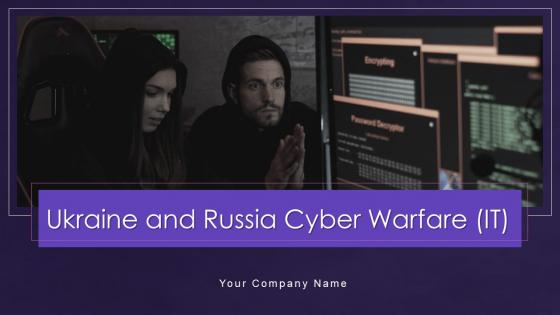
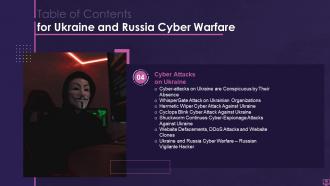
Slide 1: This slide introduces Ukraine and Russia Cyber Warfare (IT). State Your Company Name and begin.
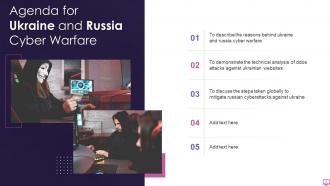
Slide 2: This slide shows Agenda for Ukraine and Russia Cyber Warfare.
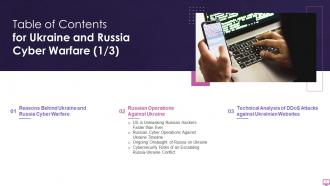
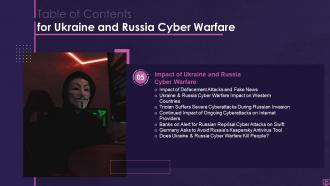
Slide 3: This slide presents Table of Content for the presentation.
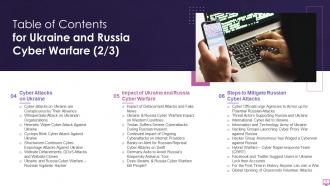
Slide 4: This is another slide continuing Table of Content for the presentation.
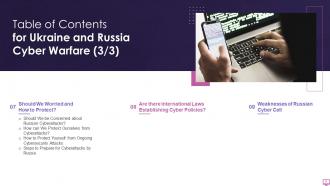
Slide 5: This is another slide continuing Table of Content for the presentation.
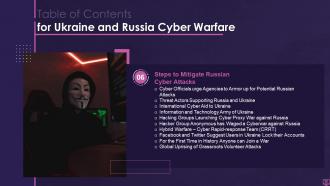
Slide 6: This slide highlights title for topics that are to be covered next in the template.
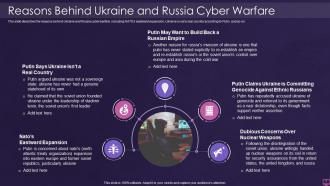
Slide 7: This slide shows Reasons Behind Ukraine and Russia Cyber Warfare.
Slide 8: This slide highlights title for topics that are to be covered next in the template.
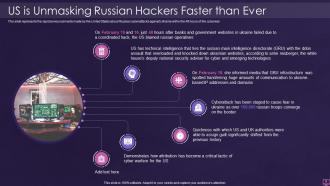
Slide 9: This slide presents US is Unmasking Russian Hackers Faster than Ever.
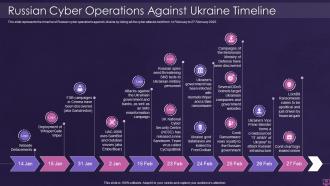
Slide 10: This slide displays Russian Cyber Operations Against Ukraine Timeline.
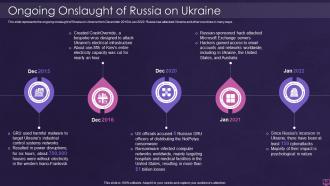
Slide 11: This slide represents the ongoing onslaught of Russia on Ukraine from December 2015 to Jan 2022.
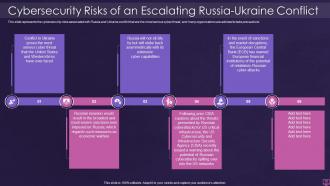
Slide 12: This slide showcases Cybersecurity Risks of an Escalating Russia-Ukraine Conflict.
Slide 13: This slide highlights title for topics that are to be covered next in the template.
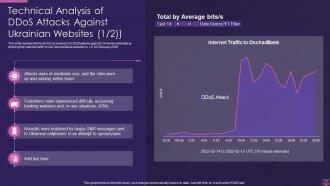
Slide 14: This slide represents the technical analysis of DDoS attacks against Ukrainian websites.
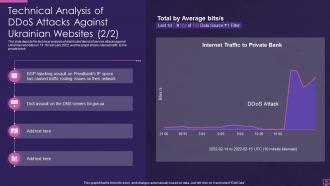
Slide 15: This slide depicts the technical analysis of distributed denial of service attacks against Ukrainian websites.
Slide 16: This slide highlights title for topics that are to be covered next in the template.
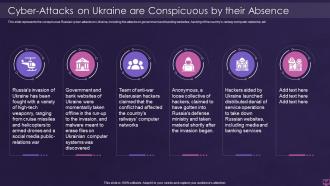
Slide 17: This slide represents the conspicuous Russian cyber-attacks on Ukraine.
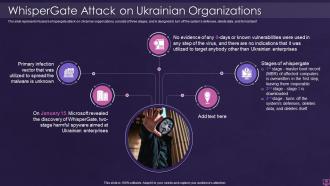
Slide 18: This slide showcases WhisperGate Attack on Ukrainian Organizations.
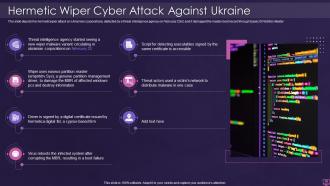
Slide 19: This slide depicts the hermeticwiper attack on Ukrainian corporations, detected by a threat intelligence agency.
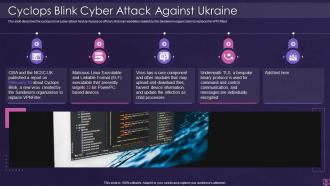
Slide 20: This slide describes the cyclops blink cyber-attack held by Russia on official Ukrainian websites.
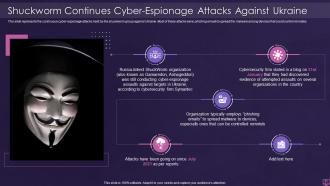
Slide 21: This slide represents the continuous cyber-espionage attacks held by the shuckworm group against Ukraine.
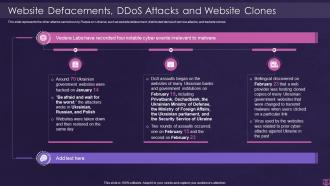
Slide 22: This slide showcases Website Defacements, DDoS Attacks and Website Clones.
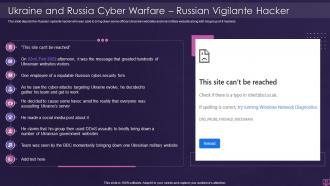
Slide 23: This slide shows Ukraine and Russia Cyber Warfare Russian Vigilante Hacker.
Slide 24: This slide highlights title for topics that are to be covered next in the template.
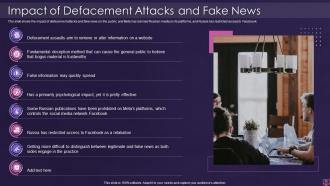
Slide 25: This slide presents Impact of Defacement Attacks and Fake News.
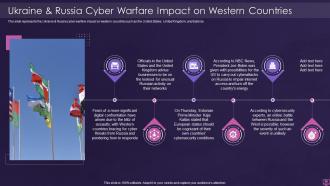
Slide 26: This slide represents the Ukraine & Russia cyber warfare impact on western countries.
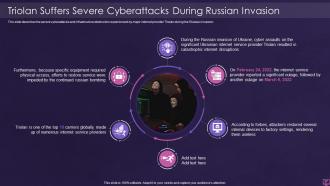
Slide 27: This slide describes the severe cyberattacks and infrastructure destruction experienced by major internet provider.
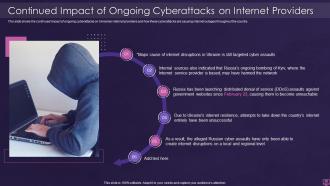
Slide 28: This slide represents Continued Impact of Ongoing Cyberattacks on Internet Providers.
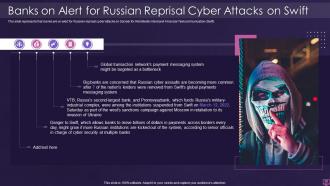
Slide 29: This slide represents that banks are on alert for Russian reprisal cyber attacks.
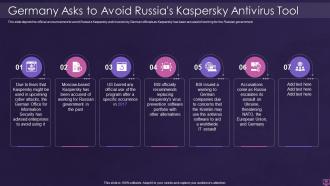
Slide 30: This slide depicts the official announcement to avoid Russia’s Kaspersky antivirus tool.
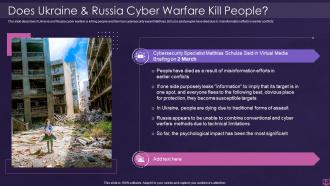
Slide 31: This slide describes if Ukraine and Russia cyber warfare is killing people and German cybersecurity.
Slide 32: This slide highlights title for topics that are to be covered next in the template.
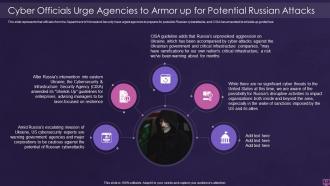
Slide 33: This slide displays Cyber Officials Urge Agencies to Armor up for Potential Russian Attacks.
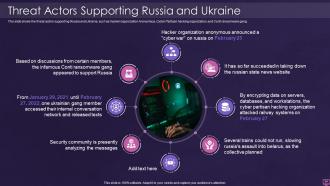
Slide 34: This slide represents Threat Actors Supporting Russia and Ukraine.
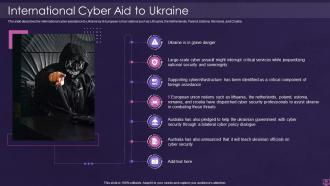
Slide 35: This slide describes the international cyber assistance to Ukraine by 6 European Union nations.
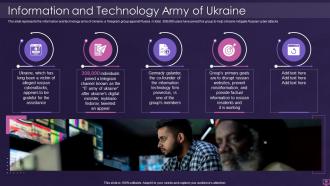
Slide 36: This slide represents the information and technology army of Ukraine, a Telegram group against Russia.
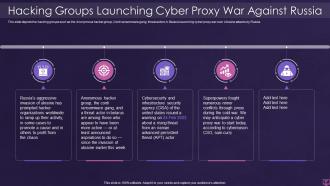
Slide 37: This slide depicts the hacking groups such as the Anonymous hacker group, Conti ransomware gang, etc.
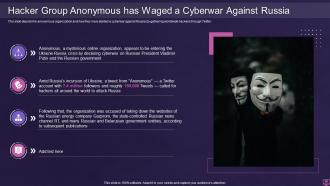
Slide 38: This slide represents anonymous organization and how they have started a cyberwar against Russia.
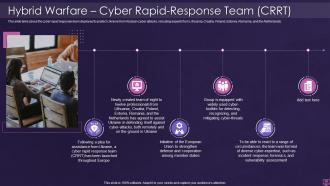
Slide 39: This slide talks about the cyber rapid response team deployed to protect Ukraine from Russian cyber attacks.
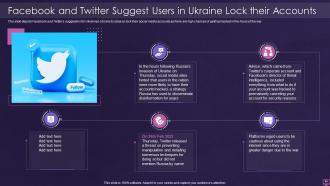
Slide 40: This slide showcases Facebook and Twitter Suggest Users in Ukraine Lock their Accounts
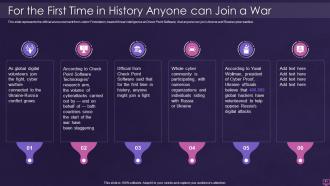
Slide 41: This slide represents the official announcement from Lotem Finkelstein, head of threat intelligence at Check Point Software.
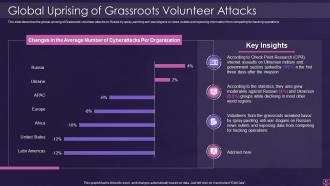
Slide 42: This slide showcases Global Uprising of Grassroots Volunteer Attacks.
Slide 43: This slide highlights title for topics that are to be covered next in the template.
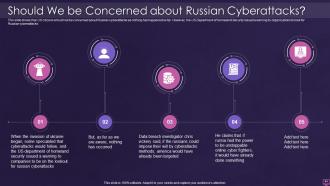
Slide 44: This slide shows that US citizens should not be concerned about Russian cyberattacks as nothing has happened so far.
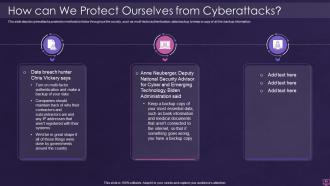
Slide 45: This slide depicts cyberattacks protection methods to follow throughout the country.
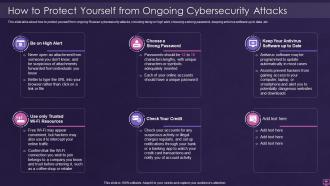
Slide 46: This slide showcases How to Protect Yourself from Ongoing Cybersecurity Attacks.
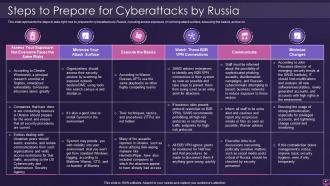
Slide 47: This slide shows Steps to Prepare for Cyberattacks by Russia.
Slide 48: This slide highlights title for topics that are to be covered next in the template.
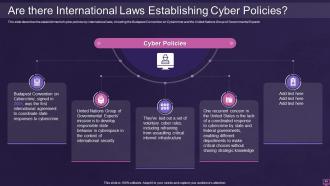
Slide 49: This slide describes the establishment of cyber policies by international laws.
Slide 50: This slide highlights title for topics that are to be covered next in the template.
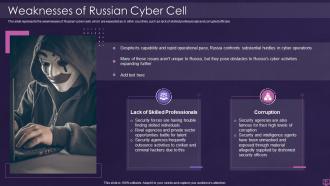
Slide 51: This slide represents the weaknesses of Russian cyber cells, which are expected as in other countries.
Slide 52: This slide displays Icons for Ukraine and Russia Cyber Warfare (IT).
Slide 53: This slide is titled as Additional Slides for moving forward.
Slide 54: This is Our Mission slide with related imagery and text.
Slide 55: This is Our Target slide. State your targets here.
Slide 56: This is About Us slide to show company specifications etc.
Slide 57: This is a Timeline slide. Show data related to time intervals here.
Slide 58: This is an Idea Generation slide to state a new idea or highlight information, specifications etc.
Slide 59: This slide contains Puzzle with related icons and text.
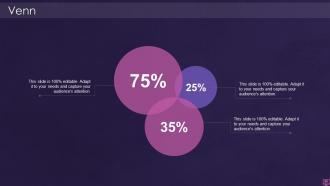
Slide 60: This slide depicts Venn diagram with text boxes.
Slide 61: This slide displays Mind Map with related imagery.
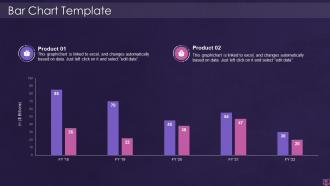
Slide 62: This slide presents Bar chart with two products comparison.
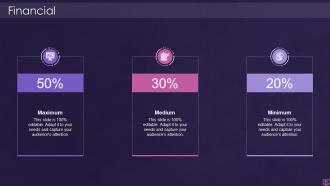
Slide 63: This is a Financial slide. Show your finance related stuff here.
Slide 64: This is a Thank You slide with address, contact numbers and email address.
Ukraine and russia cyber warfare it powerpoint presentation slides with all 69 slides:
Use our Ukraine And Russia Cyber Warfare IT Powerpoint Presentation Slides to effectively help you save your valuable time. They are readymade to fit into any presentation structure.








FAQs for Ukraine and russia cyber warfare it
Russia's hitting the big stuff - power grids, water systems, all that infrastructure nonsense plus their usual propaganda machine. Ukraine's been way more creative though, working with hacktivists and absolutely nailing the psychological warfare game online. Honestly didn't expect them to get this good at it. What's crazy is both sides are just buying regular commercial hacking tools instead of building fancy government malware. Social media's become their main coordination hub too. Oh and ransomware's everywhere obviously. You following any particular security researchers on this? Some have really solid breakdowns.
Dude, this whole Ukraine thing has made cyber attacks way more real and scary. Nation-state hackers are going nuts with wiper malware and hitting infrastructure left and right. What's really messed up is they're not just targeting military stuff anymore - regular companies are getting hit too. Like, your business could randomly become collateral damage in some international beef. The disinformation campaigns are wild too, honestly didn't expect them to be this coordinated. But yeah, you need to get your incident response plan sorted ASAP and just assume someone's already trying to break in.
So hacktivist groups are basically acting like unofficial cyber armies now - it's pretty crazy to watch. Anonymous and IT Army of Ukraine go after Russian infrastructure and government sites, while pro-Russian groups hit back at Ukrainian targets and Western companies supporting them. These "volunteer" hackers are surprisingly organized too. They recruit members, coordinate attacks, share hacking tools like they're running actual military ops. Makes me wonder how many are really just volunteers vs state-backed, you know? The whole attribution thing gets messy when groups claim responsibility for major attacks.
Honestly, social media's turned into the main battleground for Ukraine-Russia info wars - way more intense than anything we've seen. Both sides are running massive bot networks and deepfakes, though Ukraine's actually crushing it with memes and viral stuff to win over global audiences. Russia's still doing their usual disinformation thing but targeting Western users hard. The pace is crazy - narratives completely flip in like hours now. Telegram and Twitter are basically weaponized at this point. Oh, and there's some decent bot detection tools popping up if you're trying to track what's real vs manufactured.
BlackEnergy hit Ukraine's power grid in 2015, then Industroyer did it again in 2016 - both caused massive blackouts for hundreds of thousands of people. Pretty crazy stuff since they went after industrial control systems, not just regular IT networks. NotPetya from 2017 was brutal too, completely destroyed infrastructure way beyond Ukraine's borders. Oh, and right before the 2022 invasion they hacked Viasat satellites which knocked out communications across Europe. Honestly, if you're doing threat modeling, look at how these attacks bridged IT and operational tech systems. That's probably where you're most vulnerable.
Dude, the cyber stuff happening there is honestly terrifying. Power grids get knocked out, people lose internet so they can't reach family, banking crashes and suddenly nobody can get their money. Hospitals go dark, heating fails during winter - imagine dealing with that during actual bombs going off. Russia's basically weaponizing the fact that we're all glued to our phones and dependent on tech these days. They hit civilian infrastructure on purpose to mess with people's heads and make survival impossible. It's crazy how devastating hacking can be compared to physical attacks. Worth paying attention to if you're following the war.
So there's actually some solid progress happening with infrastructure security right now. Network segmentation and zero-trust setups are becoming standard, plus they've got these monitoring systems running 24/7 to catch weird stuff. Ukraine's been like an unfortunate real-world test lab for all this tech. Backup power systems are everywhere now, and there's way more intelligence sharing between NATO countries than before. The EU and US just mandated new cybersecurity rules for energy and telecom - honestly about time. Oh, and check out those new CISA guidelines if you're working in this space, they're actually useful for once.
Actually, attribution's been pretty solid in this whole mess. Sandworm and APT28 keep leaving the same technical fingerprints everywhere - code signatures, infrastructure setups, even their timing patterns. Having thousands of incidents helps since you start seeing the same tricks over and over. What's crazy is how obvious they're being about it now, like they just stopped caring if we know it's them. Oh, and here's the thing - whatever techniques they're using against Ukraine will definitely pop up elsewhere later. Your team should really focus on learning to spot these patterns early.
So the main takeaway? You absolutely need solid cyber defenses plus fast coordination with allies when shit hits the fan. Ukraine's decentralized networks and cloud backups literally saved them - kept government stuff running even with infrastructure getting destroyed. Russia went pretty brute force about it, but honestly it showed how cyber attacks work way better when combined with physical warfare. For your planning though - backup systems that work offline are crucial. Set up those communication channels with partners ahead of time. Oh, and public-private cooperation during crises? Don't sleep on that.
So basically when hackers mess with infrastructure or dump data, there's usually this whole misinformation thing that follows. They'll flood social media with fake stories - like blaming the wrong people or making the damage seem way less serious than it actually is. Pretty wild how coordinated it gets. All that confusion buys the attackers more time since everyone's trying to sort out what's even real. I always check Twitter after big cyber attacks happen, you can literally watch the narrative get twisted in real-time. It's honestly scary how good they've gotten at controlling how people see these incidents.
So you've got the UN Charter, international humanitarian law, and the Tallinn Manual (not binding but useful). NATO's made it clear - cyber attacks causing physical damage can trigger Article 5. That's collective defense territory. The Ukraine-Russia situation gets messy because attribution is tough and cyber ops blur espionage vs warfare lines. Attacks on critical infrastructure though? That definitely hits armed conflict status under international law. Honestly, the whole proportionality question is what makes this so complicated. For your analysis, focus on whether cyber activities meet the "armed attack" threshold. That's your key - it determines if traditional warfare laws kick in.
Yeah, cyber cooperation has really picked up since the war started. NATO's actually talking about Article 5 for major cyberattacks now. The EU and US are sharing way more threat intel than they used to - Microsoft and Google are basically feeding attack data straight to governments in real-time, which is pretty wild if you think about it. Honestly, it's like policymakers finally figured out that cyber stuff doesn't respect borders. If your team isn't plugged into these new threat-sharing networks yet, you should be - the intel quality is actually good now.
Ukraine's been getting solid help with cyber defense stuff. Microsoft, Google, and Crowdstrike are giving them free security services and threat data - pretty amazing honestly. They're using network monitoring systems, endpoint detection tools, and intelligence feeds from Western allies. Backup systems and secure communication platforms are huge too for protecting critical infrastructure. The whole international cyber community has really stepped up. From a policy perspective though, it's those public-private partnerships and intelligence sharing that actually move the needle on building better defenses. Makes sense when you think about it.
Honestly, this whole cyber mess has been a massive reality check for NATO. Countries are finally sharing intel in real-time instead of hoarding it - Estonia and Poland are actually running some pretty solid rapid-response teams now. The US and UK have basically opened their threat data to allies like never before. What's wild is how it exposed just how fragile our infrastructure really is. Everyone's moved from this "every country for itself" mentality to actually coordinating responses together. Oh, and if you're doing cyber policy work, definitely check out NATO's new Cyber Defence Pledge - that thing's changing everything about how allies work together.
We're probably heading toward way more AI-driven attacks, plus they'll keep hammering civilian stuff harder. Ukraine's basically been their testing lab for this hybrid warfare thing - cyber hits mixed with physical attacks, coordinated disinfo campaigns, the whole package. Supply chains are getting targeted more too since hitting one vendor can mess up tons of companies. Pretty scary how good they've gotten at this honestly. My advice? Set up solid backup systems and treat any partner you work with as a potential weak spot attackers might exploit.
-
Qualitative and comprehensive slides.
-
Perfect template with attractive color combination.