

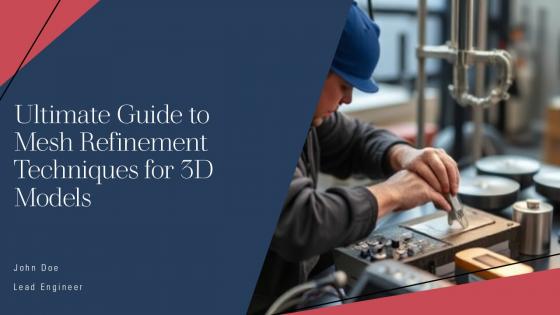
Ultimate Guide To Mesh Refinement Techniques For 3D Models PPT Slides ST AI




Try Before you Buy Download Free Sample Product
 Impress Your
Audience
 100%
Editable
 Save Hours
of Time


Unlock the potential of your 3D modeling projects with our Ultimate Guide to Mesh Refinement Techniques PowerPoint presentation. This comprehensive deck covers essential methods, best practices, and advanced strategies for optimizing mesh quality, ensuring stunning visuals and improved performance in your designs. Perfect for professionals and enthusiasts alike.
People who downloaded this PowerPoint presentation also viewed the following :
Ultimate Guide To Mesh Refinement Techniques For 3D Models PPT Slides ST AI with all 45 slides:
Use our Ultimate Guide To Mesh Refinement Techniques For 3D Models PPT Slides ST AI to effectively help you save your valuable time. They are readymade to fit into any presentation structure.











FAQs for Ultimate Guide To Mesh Refinement Techniques For 3D Models PPT
Mesh refinement is the process of systematically increasing grid density in computational domains to improve solution accuracy and capture complex physical phenomena more precisely. It proves crucial because refined meshes enable engineers and researchers to model intricate geometries, resolve boundary layers, and minimize numerical errors, with industries like aerospace, automotive, and energy finding that strategic refinement ultimately delivers more reliable simulations and competitive design advantages.
Different mesh refinement techniques significantly impact computational accuracy by reducing discretization errors, improving solution convergence, and capturing critical gradients more precisely. Adaptive refinement methods enhance results in complex simulations like fluid dynamics and structural analysis, with many engineering firms finding that strategic mesh optimization delivers faster convergence and more reliable predictions, ultimately reducing computational costs while maintaining precision.
Uniform mesh refinement divides all elements equally across the computational domain, while adaptive refinement selectively refines areas with high gradients, complex geometries, or critical flow features. Through adaptive approaches, engineering teams in aerospace, automotive, and energy sectors achieve significantly improved accuracy with fewer computational resources, ultimately delivering faster simulations and enhanced design optimization compared to uniform methods.
Local mesh refinement is preferred when computational resources are limited, solution accuracy is needed only in specific regions, or when dealing with complex geometries with varying detail requirements. Through adaptive algorithms, engineering teams in aerospace, automotive manufacturing, and structural analysis can concentrate computational power on critical areas like stress concentrations or fluid boundaries, ultimately delivering faster simulations while maintaining precision where it matters most.
Mesh refinement significantly increases computational cost and time by creating more elements, nodes, and degrees of freedom that require additional memory and processing power. While finer meshes demand substantially more resources, they deliver enhanced accuracy and precision in simulations, with many engineering firms finding that strategic refinement in critical areas optimizes the balance between computational efficiency and solution quality.
Error estimation serves as the compass for mesh refinement by identifying regions where computational accuracy falls short of desired thresholds, enabling targeted grid enhancement rather than uniform refinement. Through posterior error indicators and adaptive algorithms, engineers in aerospace, automotive, and structural analysis can strategically densify meshes in high-gradient zones, ultimately delivering superior simulation accuracy while minimizing computational costs and accelerating design cycles.
Common adaptive mesh refinement algorithms include error estimation-based refinement, gradient-based refinement, feature detection methods, hierarchical refinement, and anisotropic adaptation techniques. These algorithms streamline computational efficiency by automatically identifying critical solution regions, optimizing grid density, and reducing processing time, with many engineering firms finding that strategic mesh adaptation delivers significantly faster simulations and enhanced accuracy across complex modeling applications.
Software tools facilitate mesh refinement in finite element analysis by automating adaptive algorithms, providing error estimation capabilities, and enabling real-time visualization of mesh quality metrics. Through specialized FEA platforms, engineers in automotive and aerospace industries streamline iterative refinement processes, minimize computational overhead, and achieve optimal element distribution, ultimately delivering more accurate simulations while reducing manual intervention and analysis time.
Refining highly complex geometries presents challenges including computational intensity, mesh quality degradation, memory limitations, convergence difficulties, and boundary preservation issues. These obstacles require strategic approaches combining adaptive algorithms, parallel processing, and specialized software tools, with many engineering firms finding that hybrid refinement strategies ultimately deliver improved accuracy while managing computational costs and maintaining simulation reliability across aerospace, automotive, and biomedical applications.
Mesh quality maintenance strategies include angle optimization, aspect ratio control, smoothing algorithms, edge swapping, and node repositioning techniques. These methods work by preserving element geometry, preventing distortion during subdivision, and ensuring computational accuracy, with engineering simulation teams finding that strategic refinement delivers faster convergence and more reliable results across complex modeling scenarios.
Mesh refinement in multi-physics simulations enhances accuracy by dynamically adjusting grid density where different physical phenomena interact, such as heat transfer zones in fluid-structure interactions or electromagnetic fields near material boundaries. Through adaptive algorithms, engineers streamline computational efficiency while maintaining precision in critical coupling regions, with aerospace and automotive industries finding that targeted refinement delivers faster convergence and more reliable results in complex multi-domain analyses.
Choosing mesh refinement techniques requires evaluating computational resources, solution accuracy requirements, geometry complexity, and convergence behavior of your specific problem. Applications in aerospace simulations prioritize adaptive refinement for shock capture, while structural analysis in manufacturing often uses uniform refinement, with many engineers finding that hybrid approaches deliver optimal performance and computational efficiency.
Mesh refinement in 2D simulations involves subdividing triangular or quadrilateral elements along edges and surfaces, while 3D refinement adds volumetric complexity by subdividing tetrahedral, hexahedral, or prismatic elements throughout three-dimensional space. Engineering teams in aerospace, automotive, and manufacturing find that 3D refinement requires significantly more computational resources and memory management, ultimately delivering higher precision for complex geometries while demanding strategic resource allocation for optimal performance.
Mesh refinement enhances fluid dynamics model accuracy by increasing computational grid density in critical flow regions, improving gradient calculations, and reducing numerical errors. Through adaptive refinement algorithms, engineers can capture complex phenomena like boundary layers, shock waves, and turbulent structures more precisely, ultimately delivering faster convergence and more reliable simulation results for aerospace, automotive, and marine applications.
Machine learning enhances traditional mesh refinement by automatically predicting optimal mesh densities, identifying error-prone regions, and adapting refinement patterns based on solution characteristics. These AI-driven approaches streamline computational workflows in automotive crash simulations, aerospace design optimization, and biomedical modeling, ultimately delivering faster convergence, reduced manual intervention, and significantly improved accuracy for complex engineering analyses.
-
Their products can save your time, effort and money. What else you need. All in one package for presentation needs!
-
Loved the templates on SlideTeam, I believe I have found the go to place for my presentation needs!