

Understanding Computer Architecture A Comprehensive Guide PPT Slides ST AI




Try Before you Buy Download Free Sample Product
 Impress Your
Audience
 100%
Editable
 Save Hours
of Time


Unlock the complexities of computer architecture with our comprehensive PowerPoint presentation deck. Designed for professionals, this guide covers essential concepts, components, and systems. Enhance your understanding with clear visuals and expert insights, making it an invaluable resource for educators, students, and tech enthusiasts alike.
People who downloaded this PowerPoint presentation also viewed the following :
Understanding Computer Architecture A Comprehensive Guide PPT Slides ST AI with all 39 slides:
Use our Understanding Computer Architecture A Comprehensive Guide PPT Slides ST AI to effectively help you save your valuable time. They are readymade to fit into any presentation structure.
-

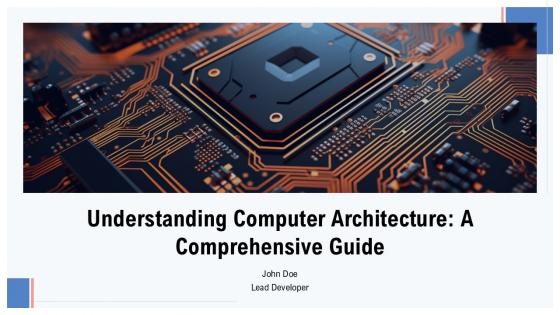
Understanding Computer Architecture A Comprehensive Guide
-

Understanding Computer Architecture Introduction
-

Importance of Computer Architecture
-

Core Components of Computer Architecture
-

Historical Evolution of Computer Architecture
-

Types of Computer Architecture Models
-

Von Neumann vs Harvard Architecture
-

Central Processing Unit CPU Overview
-

Memory Hierarchy and Storage Systems
-

Input Output Systems and Devices
-

Bus Systems and Communication Protocols
-

Instruction Set Architecture Explained
-

Microarchitecture Design and Techniques
-

Pipelining and Instruction Level Parallelism
-

Caching Mechanisms and Performance
-

Multiprocessing and Multithreading Concepts
-

Computer Architecture in Modern Computing
-

Embedded Systems and IoT Components
-

Distributed Systems and Cloud Architecture
-

Performance Analysis and Metrics
-

Computer Architecture Challenges and Solutions
-

Security Considerations in Architecture
-

Future Trends in Computer Architecture
-

Architectural Innovations and Research
-

Sustainable Computing and Energy Efficiency
-

Practical Applications of Computer Architecture
-

Case Studies in Innovative Architectures
-

Tools and Technologies for Design
-

Educational Resources for Learning Architecture
-

Summary of Key Concepts and Takeaways
-

Thank You
-

-

-

-

-

-

-

-

FAQs for Understanding Computer Architecture A Comprehensive Guide PPT
Computer architecture comprises the CPU, memory hierarchy, input/output systems, storage devices, and interconnection networks that enable data flow between components. These elements work together through the system bus and control units, with the CPU executing instructions while coordinating with memory for data storage and retrieval, ultimately delivering seamless processing capabilities that enable organizations to handle increasingly complex computational tasks and maintain competitive operational efficiency.
CPU architecture significantly impacts computer performance through instruction set efficiency, pipeline design, cache hierarchy, and parallel processing capabilities. Different architectures like x86, ARM, and RISC-V optimize for specific workloads, with ARM excelling in mobile devices through power efficiency, x86 dominating desktop performance, and specialized architectures enabling faster processing, reduced energy consumption, and enhanced computational throughput across various applications.
Cache memory serves as high-speed storage between the CPU and main memory, significantly reducing data access times and improving system performance. It's typically structured in multiple levels—L1, L2, and L3 caches—with each level offering different capacities and speeds, ultimately enabling faster processing and enhanced computational efficiency across applications.
The instruction set architecture (ISA) directly impacts software development by defining available operations, data types, and programming models that developers must work within. Different ISAs like x86, ARM, and RISC-V require specific compilers and optimizations, with many organizations finding that ISA choices affect performance, portability, and development costs across their software ecosystems.
RISC architectures feature simple, uniform instructions executed in single cycles, while CISC architectures use complex, variable-length instructions with multiple addressing modes and built-in memory operations. RISC processors deliver faster execution speeds and energy efficiency, making them ideal for mobile devices and embedded systems, while CISC architectures provide code density advantages and backward compatibility, with many enterprises finding that RISC's streamlined approach increasingly drives performance in cloud computing and data center environments.
Parallel processing and multi-core architectures improve computational efficiency by dividing tasks across multiple processors, enabling simultaneous execution of operations, and reducing bottlenecks through distributed workloads. Industries like financial services, scientific research, and data analytics leverage these technologies to accelerate complex calculations, enhance real-time processing capabilities, and ultimately deliver faster results while optimizing resource utilization.
Quantum computing presents both challenges and opportunities for traditional architecture, requiring hybrid systems that integrate classical processors with quantum accelerators, specialized error correction mechanisms, and entirely new programming paradigms. While current infrastructure remains essential for most computing tasks, organizations increasingly explore quantum-classical combinations for optimization, cryptography, and complex simulations, ultimately delivering computational advantages that traditional architectures cannot achieve.
Mobile device architecture emphasizes power efficiency, compact design, and thermal management through ARM-based processors, integrated system-on-chip designs, and simplified cooling systems. While desktop computers prioritize raw performance with modular x86 processors and dedicated components, mobile architecture enables longer battery life, portability, and optimized user experiences, with manufacturers increasingly finding that energy-efficient designs deliver competitive advantages.
Bus systems serve as the critical communication pathways that connect processors, memory, and input/output devices, enabling data, address, and control signal transmission throughout a computer. These interconnected pathways streamline system performance by facilitating faster data transfers, coordinating component operations, and supporting scalable architectures, with modern computing systems increasingly relying on advanced bus designs to deliver enhanced processing speeds and operational efficiency.
Virtualization fundamentally reshapes computer architecture by enabling hardware abstraction, resource pooling, and dynamic allocation across multiple virtual environments simultaneously. Modern designs incorporate dedicated virtualization support, enhanced memory management, and optimized processing cores, with data centers and cloud providers finding that these architectural improvements deliver significantly reduced infrastructure costs, improved scalability, and enhanced operational efficiency.
Designing energy-efficient data center architectures involves challenges including thermal management complexities, power distribution optimization, cooling system integration, processor workload balancing, and storage infrastructure efficiency. These architectural considerations require strategic combinations of hardware selection, airflow design, and dynamic resource allocation, with many organizations finding that comprehensive approaches ultimately deliver significant operational cost reductions and enhanced computational performance.
Neuromorphic computing revolutionizes computer architecture by mimicking brain structures, enabling parallel processing, adaptive learning capabilities, and ultra-low power consumption compared to traditional von Neumann designs. These brain-inspired architectures streamline AI workloads, enhance real-time decision making in autonomous vehicles and IoT devices, while delivering significant energy efficiency improvements, ultimately positioning organizations for competitive advantage in increasingly intelligent computing environments.
3D chip design significantly enhances performance by enabling vertical stacking of components, reducing signal travel distances, increasing transistor density, and improving bandwidth efficiency. While this architecture delivers substantial computational gains, it presents thermal management challenges, with many semiconductor manufacturers finding that advanced cooling solutions and thermal interface materials enable these designs to achieve superior performance-per-watt ratios in data centers.
SoC architectures enhance mobile and embedded performance by integrating processors, memory, graphics, and connectivity components onto single chips, reducing power consumption, physical footprint, and manufacturing costs. This strategic combination enables smartphones, IoT devices, and automotive systems to deliver faster processing, extended battery life, and seamless multitasking capabilities while minimizing heat generation.
Security considerations within computer architecture include hardware-based encryption, secure boot processes, memory protection mechanisms, trusted execution environments, and isolation between system components. These architectural safeguards enhance cybersecurity by preventing unauthorized access, protecting sensitive data during processing, and ensuring system integrity, with many financial institutions and healthcare organizations finding that hardware-level security ultimately delivers stronger defense against sophisticated threats.
-
Superb! The innovative and inspiring template designs provide an edge to the presentation.
-
The pricing page of this website is very sorted. I felt no pain while buying the PPTs.