


Understanding ERP Software Implementation Procedure Complete Deck




Try Before you Buy Download Free Sample Product
 Impress Your
Audience
 100%
Editable
 Save Hours
of Time


ERP is the acronym for enterprise resource planning. ERP is a type of software that companies use to manage the day to day operations such as accounting, project management, risk administration, resource management, etc. The deck Understanding ERP software implementation procedure mainly covers the major challenges faced by teams without ERP software. It also includes an overview of ERP industry trends to facilitate the adoption rate. It focuses on the major reasons and benefits of implementing enterprise resource planning software solutions. It includes sections containing a preparedness checklist, testing process, data migration process, etc. The presentation will assist the company to review its existing operating performance and determine the cost of adopting an ERP system within the organization. It includes features, advantages, and estimated cost of deploying cloud-based ERP solutions. It also constitutes an ERP implementation process with team roles and responsibilities. It covers various challenges and solutions of ERP systems. Furthermore, it provides key insights into dashboards and KPIs such as operating ratio, profit margin, gross sales, suppliers, vendor rejection rate, budget, ordered value, etc. Download this deck now.
People who downloaded this PowerPoint presentation also viewed the following :
Content of this Powerpoint Presentation
Slide 1: This slide displays the title Understanding ERP software implementation procedure.
Slide 2: This slide displays the title Agenda.
Slide 3: This slide exhibit table of content.
Slide 4: This slide discuss table of content that are to be discuss further.
Slide 5: The following slide showcases the key results of an industry survey regarding ERP adoption to further plan actions based on insights.
Slide 6: The following slide depicts the statistics revealing the industry ERP implementation rate to ensure business continuity.
Slide 7: The following slide depicts the results of enterprise resource planning (ERP) project implemented by top industry players.
Slide 8: This slide discuss table of content that are to be discuss further.
Slide 9: The following slide showcases the existing issues faced by workforce to determine the root cause and determine solutions.
Slide 10: The following slide depicts some key performance indicators (KPAs) to evaluate existing process capabilities.
Slide 11: This slide discuss table of content that are to be discuss further.
Slide 12: The following slide showcases the requirement of adopting enterprise resource planning (ERP) system in the organization to streamline processes.
Slide 13: The following slide highlights key reasons to adopt ERP system.
Slide 14: The following slide highlights the key advantages of executing enterprise resource planning (ERP) software in organization to leverage technology trends.
Slide 15: This slide discuss table of content that are to be discuss further.
Slide 16: The following slide showcases the various types of enterprise resource planning (ERP) software system to select the best fit for the organization.
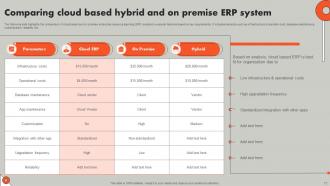
Slide 17: The following slide highlights the comparison of cloud based and on premise enterprise resource planning (ERP) system to evaluate features based on key requirements.
Slide 18: The following slide highlights some major factors deciding the cost of adopting enterprise resource planning (ERP) to examine and allocate budget accordingly.
Slide 19: This slide discuss table of content that are to be discuss further.
Slide 20: The following slide depicts the cost division of enterprise resource planning (ERP) to facilitate investment decision making.
Slide 21: The following slide illustrates the various fixed cost related to ERP adoption to determine investment opportunities.
Slide 22: The following slide showcase the multiple running costs associated with enterprise resource planning (ERP) to analyze day-to-day efficiency.
Slide 23: The following slide highlights the hidden costs related to enterprise resource planning (ERP) to determine to go ahead with investment opportunity.
Slide 24: This slide discuss table of content that are to be discuss further.
Slide 25: The following slide highlights the key attributes of cloud based enterprise resource planning (ERP) software to benefit from change.
Slide 26: The following slide highlights the multiple advantages of implementing cloud based enterprise resource planning (ERP) software to facilitate decision making.
Slide 27: The following slide showcases the cost savings derived from cloud usage as per industry specialists to evaluate return on investment (ROI).
Slide 28: This slide discuss table of content that are to be discuss further.
Slide 29: The following slide showcases enterprise resource planning (ERP) software system implementation plan to deploy latest technology.
Slide 30: The following slide covers the enterprise resource planning (ERP) budget to project and estimate software cost accurately.
Slide 31: The following slide covers the comparative assessment of multiple software to select and deploy best alternatives.
Slide 32: The following slide depicts the comparison of various vendors to attain maximum value at lowest cost.
Slide 33: The following slide showcases the six important phases of data migration to ensure easy and secure transfer of data.
Slide 34: The following slide showcases the training model for facilitating change post ERP implementation in the organization.
Slide 35: The following slide depicts the automated model for enterprise resource planning (ERP) test to validate implementation.
Slide 36: The following slide illustrates a checklist to ensure configuration and integration readiness of ERP system.
Slide 37: This slide discuss table of content that are to be discuss further.
Slide 38: The following slide depicts the timeline to begin enterprise resource planning (ERP) for prioritizing tasks and tracking progress.
Slide 39: This slide discuss table of content that are to be discuss further.
Slide 40: The following slide illustrates the key roles and responsibilities of enterprise resource planning executing team to ensure clarity and successful implementation.
Slide 41: This slide discuss table of content that are to be discuss further.
Slide 42: The following slide highlights some major issues faced during enterprise resource planning execution process to review and state appropriate solutions.
Slide 43: This slide discuss table of content that are to be discuss further.
Slide 44: The following slide highlights some key performance indicators to set standards and compare with previous performance.
Slide 45: This slide discuss table of content that are to be discuss further.
Slide 46: The following slide highlights the impact of adopting enterprise resource planning (ERP) software on financial performance to measure its success.
Slide 47: The following slide showcases the key performance indicators (KPIs) to track vendor performance post ERP implementation.
Slide 48: This is the icons slide.
Slide 49: This slide presents title for additional slides.
Slide 50: This slide showcase Pie chart.
Slide 51: This slide showcase the title Our mission.
Slide 52: This slide showcase Our awesome team.
Slide 53: This slide depicts 30-60-90 days plan for projects.
Slide 54: This slide showcase Financial.
Slide 55: This slide displays Venn.
Slide 56: This slide depicts posts for past experiences of clients.
Slide 57: This slide showcase Comparison.
Slide 58: This slide display SWOT analysis.
Slide 59: This slide display Location.
Slide 60: This slide shows Puzzle infographic.
Slide 61: This slide exhibit Timeline process.
Slide 62: This slide showcase creative ideas.
Slide 63: This slide showcase the title Quotes.
Slide 64: This slide display Roadmap.
Slide 65: This is thank you slide & contains contact details of company like office address, phone no., etc.
Understanding ERP Software Implementation Procedure Complete Deck with all 64 slides:
Use our Understanding ERP Software Implementation Procedure Complete Deck to effectively help you save your valuable time. They are readymade to fit into any presentation structure.












FAQs for Understanding ERP Software Implementation
ERP software implementation involves planning and assessment, system design and configuration, data migration and testing, training and change management, and go-live support phases. Organizations navigate these effectively by establishing clear project governance, engaging stakeholders early, conducting thorough testing protocols, and maintaining robust communication channels, with many companies finding that phased rollouts minimize disruption while accelerating user adoption.
Businesses evaluate ERP systems by assessing their industry requirements, scalability needs, integration capabilities, budget constraints, and user experience preferences. Through comprehensive vendor demonstrations, pilot testing, and stakeholder feedback sessions, organizations can compare functionality, customization options, and support quality, with many companies finding that involving end-users early ultimately delivers better adoption rates and operational efficiency.
Common ERP implementation challenges include resistance to change, data migration complexities, inadequate training, budget overruns, and integration difficulties with existing systems. These obstacles can be mitigated through comprehensive change management programs, thorough data cleansing processes, and extensive user training, with many organizations finding that phased rollouts and dedicated project teams ultimately deliver smoother transitions and better adoption rates.
Change management is crucial for ERP implementation success, as it addresses user resistance, ensures proper training, facilitates workflow transitions, and maintains organizational alignment throughout the transformation process. Through strategic communication, comprehensive training programs, and phased rollouts, organizations streamline adoption, minimize disruptions, and enhance user acceptance, ultimately delivering improved operational efficiency and higher implementation success rates.
User training and support are critical for ERP success, ensuring employees can effectively navigate new systems, understand changed workflows, and maximize software capabilities. Comprehensive training programs significantly reduce resistance to change, minimize errors, and accelerate adoption rates, with many organizations finding that well-trained users ultimately deliver faster ROI and enhanced operational efficiency.
Organizations ensure data integrity and security during ERP migration through comprehensive data validation, encrypted transfer protocols, role-based access controls, and systematic backup procedures. Financial institutions and healthcare organizations particularly benefit from phased migration approaches, real-time monitoring systems, and multi-layered security frameworks, ultimately delivering seamless transitions while maintaining regulatory compliance and operational continuity.
Key ERP success metrics include system uptime, user adoption rates, data accuracy percentages, process cycle times, and cost reduction figures across departments. Organizations typically track inventory turnover improvements, order processing speed, financial reporting accuracy, and employee productivity gains, with many finding that monitoring these metrics quarterly enables continuous optimization and demonstrates measurable ROI within the first implementation year.
Companies foster stakeholder buy-in through transparent communication, comprehensive training programs, early involvement in system design, and demonstrating clear ROI benefits. By establishing cross-functional implementation teams, conducting regular feedback sessions, and showcasing quick wins, organizations enable smoother adoption while addressing concerns proactively, ultimately delivering enhanced operational efficiency and stronger project success rates.
ERP customization best practices include conducting thorough process analysis, prioritizing configuration over code modifications, maintaining detailed documentation, implementing phased rollouts, and establishing rigorous testing protocols. These approaches enable organizations to align systems with unique workflows while preserving upgrade paths and system stability, with many enterprises finding that strategic customization delivers enhanced operational efficiency and competitive advantage without sacrificing long-term maintainability.
Agile methodologies enhance ERP implementation through iterative development cycles, continuous stakeholder feedback, cross-functional collaboration, and incremental deployment of modules. This approach enables organizations to adapt requirements dynamically, reduce implementation risks, and accelerate time-to-value, with many enterprises finding that Agile delivers more responsive ERP solutions and smoother organizational adoption.
Businesses should adopt a phased integration strategy that includes comprehensive system mapping, API-first connectivity, data standardization protocols, and thorough testing phases before full deployment. This strategic approach enables organizations to maintain operational continuity while seamlessly connecting ERP systems with existing CRM, accounting, and inventory management platforms, ultimately delivering enhanced data visibility and streamlined workflows.
ERP implementations benefit from feedback loops by enabling continuous monitoring, identifying bottlenecks early, and facilitating real-time adjustments to system configurations and user training programs. These iterative processes help organizations in manufacturing, retail, and healthcare streamline operations, enhance user adoption rates, and minimize post-deployment issues, ultimately delivering faster ROI and sustained operational efficiency.
Cloud-based ERP solutions offer greater scalability, automatic updates, lower upfront costs, and remote accessibility, while on-premises systems provide enhanced data control, customization capabilities, and potential long-term cost advantages. Organizations increasingly find that cloud solutions streamline operations and accelerate deployment, though industries like healthcare and finance often prefer on-premises for regulatory compliance and data sovereignty requirements.
Regulatory compliance requirements significantly influence ERP software selection by demanding systems with built-in audit trails, data encryption, automated reporting capabilities, and industry-specific compliance modules. Organizations in healthcare, finance, and manufacturing increasingly prioritize ERP solutions that streamline regulatory processes, minimize compliance risks, and deliver automated documentation, ultimately reducing manual oversight while ensuring adherence to evolving standards.
Vendor support plays a critical role by providing technical expertise, implementation guidance, training programs, ongoing maintenance, and troubleshooting assistance throughout the project lifecycle. Strong vendor partnerships enable organizations to navigate complex integrations, minimize downtime, and accelerate user adoption, with many companies finding that comprehensive support ultimately delivers faster ROI and reduced implementation risks.
-
They helped us design the pamphlets for our church’s food drive! The people loved the design, and I’m happy to say it was successful. Thank you, SlideTeam!
-
Wow, never been this impressed with any online service provider. Really appreciate the customer support all along from the navigation to purchasing the right products.