


Unified software development process it powerpoint presentation slides





Try Before you Buy Download Free Sample Product
 Impress Your
 Audience
 100%
100% Editable
 Save Hours
 of Time


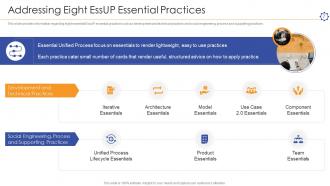
The unified software development process caters essentials to deliver easy-to-use practices that can be utilized and compatible with agile values and thinking. Each approach captures the small number of cards that render helpful, structured advice on how efficiently each method can be deployed. AUP essential practices are segregated into five technical and cross-cutting approaches. Here is a professionally designed template on Unified Software Development Process IT that covers crucial characteristics in developing software and salient features. The module covers slides related to eight essential practices of AUP in terms of iterative essentials, model essentials, use case 2.0 essentials, architecture essentials, team essentials, product essentials, unified process lifecycle essentials, component essentials. It covers slides about critical elements involved and the role of AUP in software development. Book a free demo with our research or design team and customize this 100 percent editable template based on your specific business requirements. Download the template now.
People who downloaded this PowerPoint presentation also viewed the following :
Content of this Powerpoint Presentation
Slide 1: This slide introduces Unified Software Development Process (IT). State Your Company Name and begin.
Slide 2: This slide shows Agenda for Unified Software Development Process (IT).
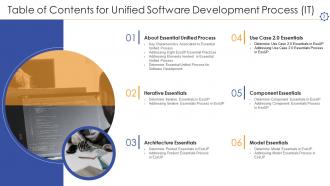
Slide 3: This slide presents Table of Contents for Unified Software Development Process (IT).
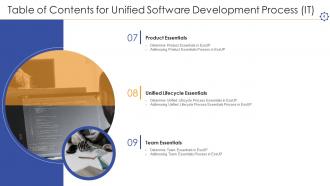
Slide 4: This is another slide continuing Table of Contents for Unified Software Development Process (IT).
Slide 5: This slide shows title for topics that are to be covered next in the template.
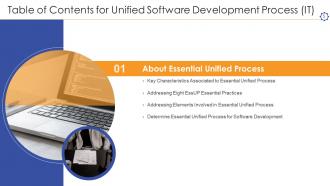
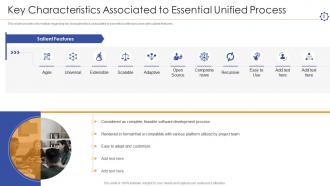
Slide 6: This slide provides information regarding key characteristics associated to essential unified process with salient features.
Slide 7: This slide displays eight EssUP essential practices such as development and technical practices, social engineering, etc.
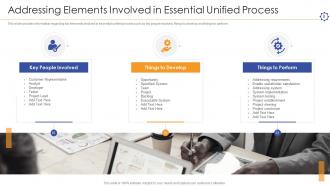
Slide 8: This slide represents Addressing Elements Involved in Essential Unified Process.
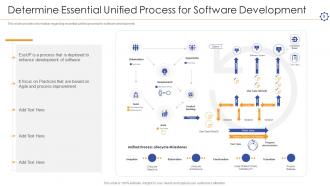
Slide 9: This slide shows Determine Essential Unified Process for Software Development.
Slide 10: This slide presents Table of Content for the presentation.
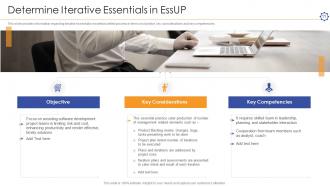
Slide 11: This slide shows iterative essential in essential unified process in terms of objective, key considerations and key competencies.
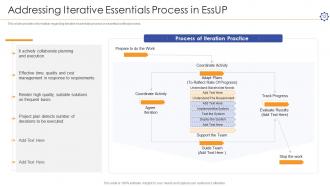
Slide 12: This slide displays information regarding iterative essentials process in essential unified process.
Slide 13: This slide represents Table of Content for the presentation.
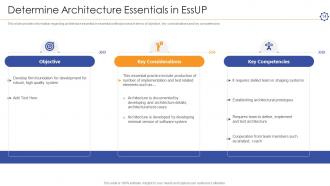
Slide 14: This slide shows architecture essential in essential unified process in terms of objective, key considerations and key competencies.
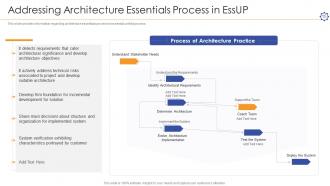
Slide 15: This slide presents information regarding architecture essentials process in essential unified process.
Slide 16: This slide shows Table of Content for the presentation.
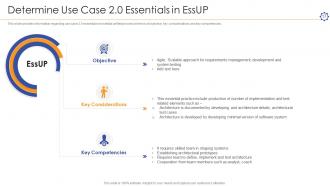
Slide 17: This slide displays use case 2.0 essential in essential unified process in terms of objective, key considerations and key competencies.
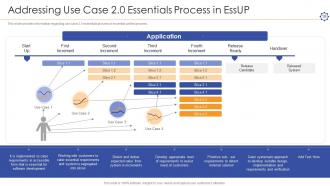
Slide 18: This slide represents information regarding use case 2.0 essentials process in essential unified process.
Slide 19: This slide shows Table of Content for the presentation.
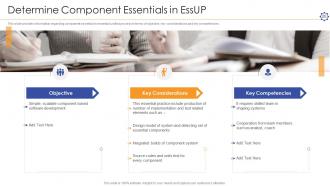
Slide 20: This slide presents component essential in essential unified process in terms of objective, key considerations and key competencies.
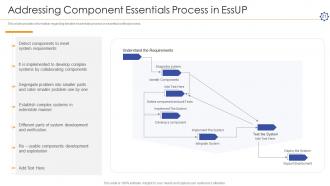
Slide 21: This slide shows Addressing Component Essentials Process in EssUP.
Slide 22: This slide displays Table of Content for the presentation.
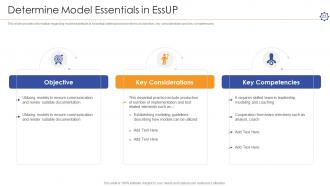
Slide 23: This slide represents Determine Model Essentials in EssUP.
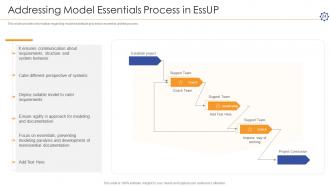
Slide 24: This slide provides information regarding model essentials process in essential unified process.
Slide 25: This slide presents Table of Content for the presentation.
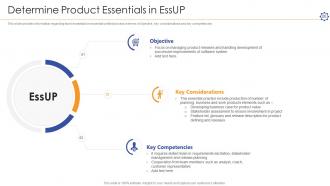
Slide 26: This slide shows team essentials in essential unified process in terms of objective, key considerations and key competencies.
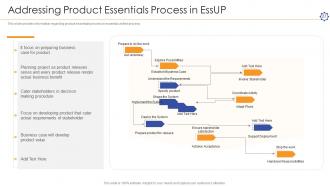
Slide 27: This slide displays information regarding product essentials process in essential unified process.
Slide 28: This slide represents Table of Content for the presentation.
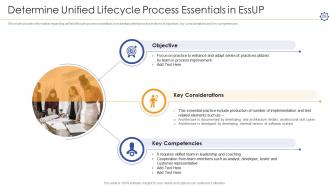
Slide 29: This slide shows Determine Unified Lifecycle Process Essentials in EssUP.
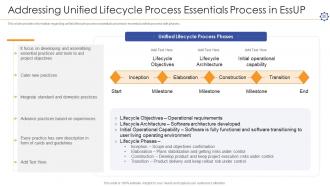
Slide 30: This slide presents Addressing Unified Lifecycle Process Essentials Process in EssUP.
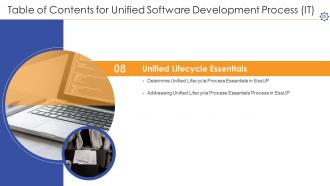
Slide 31: This slide shows Table of Content for the presentation.
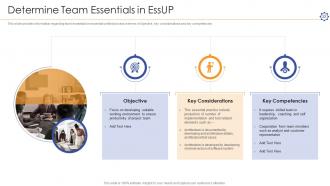
Slide 32: This slide displays team essentials in essential unified process in terms of objective, key considerations and key competencies.
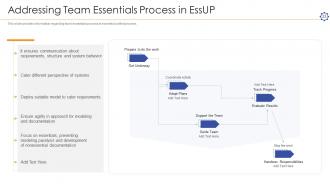
Slide 33: This slide represents Addressing Team Essentials Process in EssUP.
Slide 34: This slide showcases Icons for Unified Software Development Process (IT).
Slide 35: This slide is titled as Additional Slides for moving forward.
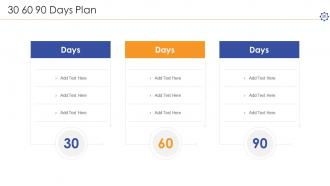
Slide 36: This slide provides 30 60 90 Days Plan with text boxes.
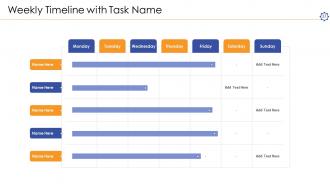
Slide 37: This slide presents Weekly Timeline with Task Name.
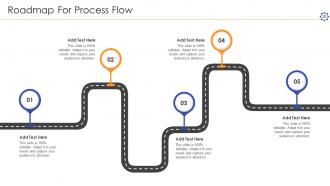
Slide 38: This slide displays Roadmap For Process Flow.
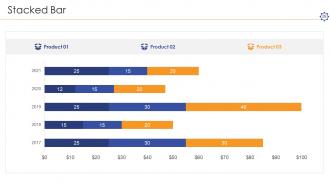
Slide 39: This slide represents Stacked Bar chart with two products comparison.
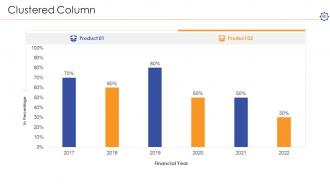
Slide 40: This slide showcases Clustered Column chart with two products comparison.
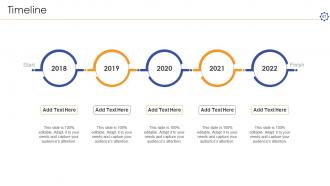
Slide 41: This is a Timeline slide. Show data related to time intervals here.
Slide 42: This slide shows Post It Notes. Post your important notes here.
Slide 43: This slide contains Puzzle with related icons and text.
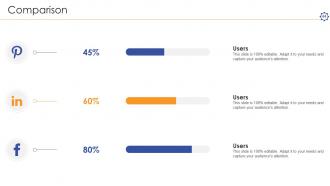
Slide 44: This is a Comparison slide to state comparison between commodities, entities etc.
Slide 45: This is a Thank You slide with address, contact numbers and email address.
Unified software development process it powerpoint presentation slides with all 50 slides:
Use our Unified Software Development Process IT Powerpoint Presentation Slides to effectively help you save your valuable time. They are readymade to fit into any presentation structure.







FAQs for Unified software development process it
The key phases of USDP include Inception, Elaboration, Construction, and Transition, each with distinct objectives and deliverables. These phases streamline software development by establishing project vision, defining architecture, building core functionality, and deploying solutions, with many organizations finding that this iterative approach ultimately delivers reduced development risks and enhanced product quality.
The USDP facilitates better communication through standardized artifacts, iterative reviews, role-based responsibilities, and collaborative workflows that ensure transparency across development phases. Through shared models, documentation templates, and regular milestone assessments, teams in software companies, financial institutions, and healthcare organizations streamline coordination, minimize miscommunication, and ultimately deliver more cohesive products with enhanced stakeholder alignment.
USDP can be tailored through customized workflows, modified phase durations, selective artifact creation, team-specific role definitions, and adaptable milestone criteria. Organizations across industries, from financial services to healthcare software development, increasingly customize iteration lengths, documentation requirements, and review processes to match project complexity and regulatory needs, ultimately delivering streamlined development cycles while maintaining quality standards.
Iterative development serves as the foundational framework in the Unified Software Development Process, enabling teams to build software through repeated cycles of planning, analysis, design, implementation, and testing. This approach allows organizations to refine requirements continuously, manage risks more effectively, and deliver incremental value, with many software companies finding that iterative cycles ultimately reduce development costs while enhancing product quality and customer satisfaction.
USDP aligns with Agile methodologies through iterative development cycles, continuous stakeholder feedback, and adaptive planning approaches that emphasize flexibility over rigid documentation. Teams can learn that combining USDP's structured phases with Agile's responsive practices enables better risk management, enhanced collaboration, and more predictable delivery timelines, ultimately delivering higher-quality software while maintaining strategic architectural vision.
The Unified Software Development Process produces key artifacts including requirements documents, use case models, system architecture designs, code modules, and testing documentation across its iterative phases. These artifacts work together by establishing clear project foundations, guiding development decisions, and ensuring quality deliverables, with many software organizations finding that this structured approach streamlines project management and enhances team collaboration.
Organizations measure USDP effectiveness through key performance indicators including project delivery timelines, defect rates, stakeholder satisfaction scores, budget adherence, and requirements traceability metrics. These measurements enable teams to track iterative progress, identify bottlenecks early, and optimize resource allocation, with many software companies finding that consistent USDP metrics ultimately deliver faster time-to-market and improved product quality.
Tools supporting the Unified Software Development Process include UML modeling software like Enterprise Architect and Visual Paradigm, project management platforms such as Jira and Azure DevOps, version control systems like Git, and integrated development environments including Eclipse and IntelliJ IDEA. These technologies streamline requirements gathering, design documentation, and code management, with many software teams finding that strategic tool integration accelerates development cycles while enhancing collaboration across distributed teams.
USDP addresses risk management through iterative development cycles, continuous stakeholder feedback, and early prototype validation at each phase. By identifying potential issues during inception and elaboration phases, development teams can mitigate technical risks, scope creep, and integration challenges before they escalate, ultimately delivering more predictable outcomes and reducing project failures across software development organizations.
The Unified Process differs from Waterfall through iterative development cycles, concurrent phase overlap, and risk-driven architecture-first approaches, while Waterfall follows sequential phases with minimal feedback loops. Unlike Waterfall's rigid documentation-heavy structure, UP emphasizes adaptive planning, continuous stakeholder feedback, and incremental deliveries, with many software organizations finding that this flexibility enables faster market responses, reduced project risks, and ultimately delivers higher-quality products through early testing integration.
Teams integrate quality assurance throughout USDP by embedding testing activities, code reviews, and validation checkpoints into each phase, from inception through transition. This approach enables continuous defect detection, requirement validation, and architectural verification, with many software organizations finding that early QA integration reduces post-deployment issues by up to 60%, ultimately delivering more reliable products and faster time-to-market.
**INPUT**: What factors should be considered when estimating project timelines using the USDP? **OUTPUT**: Timeline estimation in USDP requires considering project complexity, team experience, stakeholder availability, iterative feedback cycles, and risk assessment across phases. These factors work together by enabling realistic milestone planning, resource allocation adjustments, and scope refinements, with many development teams finding that early architectural decisions significantly impact delivery schedules. *[Word count: 52 words]*
The USDP effectively manages stakeholder expectations through iterative reviews, continuous feedback loops, and milestone-based deliverables that provide regular visibility into project progress. Through structured phases and use-case driven development, organizations in sectors like banking and healthcare can demonstrate tangible progress early, while stakeholders remain engaged throughout iterations, ultimately delivering solutions that align with business requirements and minimize scope creep.
Teams commonly face challenges including resistance to iterative methodology changes, difficulty managing comprehensive documentation requirements, coordinating multiple stakeholder feedback cycles, and balancing extensive modeling with development timelines. While these obstacles initially slow adoption, organizations in finance, healthcare, and enterprise software development find that structured training, phased implementation, and dedicated process champions ultimately deliver improved project predictability and reduced development risks.
USDP supports continuous improvement through iterative development cycles, regular risk assessment, milestone evaluations, and adaptive planning mechanisms that enable teams to refine processes based on project feedback. Through its phase-gate structure, organizations in sectors like financial services and healthcare can systematically identify inefficiencies, streamline development workflows, and enhance team collaboration, ultimately delivering higher-quality software with reduced time-to-market.
-
Unique research projects to present in meeting.
-
Wonderful templates design to use in business meetings.
-
Designs have enough space to add content.
-
Helpful product design for delivering presentation.