

Unlocking Innovation Future Of Biomimetic Robotics In Transforming Industries Ppt Slide





Try Before you Buy Download Free Sample Product
 Impress Your
Audience
 100%
Editable
 Save Hours
of Time


Learn how biomimetic robotics changes the game with our thorough presentation deck on Unlocking Innovation Future of Biomimetic Robotics in Transforming Industries. This robot evolution PPT deck explores the fascinating world of biomimetic robots, where natures most efficient designs merge seamlessly with cutting-edge technology. Go in-depth into what biomimetic robots are, how they evolved, and their categories. Learn about the advanced capabilities of multi-legged and flapping-wing robots, marine-inspired designs, and soft robots, all pushing the boundaries of whats possible in modern robotics. Furthermore, this biomimetic intelligence PowerPoint templates help in understanding the challenges faced, the gaps identified, and the essential needs that these innovations address across various sectors. Explore a world of biomimetic sensors, with features inspired by vision and acoustics, highly advanced tactile sensing, and an in-depth look at biomimetic intelligence algorithms, etc. Download the deck now to unlock the future of biomimetic robotics.
People who downloaded this PowerPoint presentation also viewed the following :
Content of this Powerpoint Presentation
Slide 1: This slide introduces Unlocking Innovation: Future of Biomimetic Robotics in Transforming Industries. State your company name and begin.
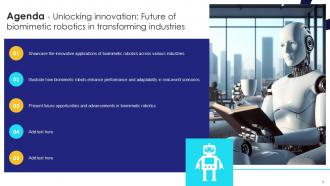
Slide 2: This is an Agenda slide. State your agendas here.
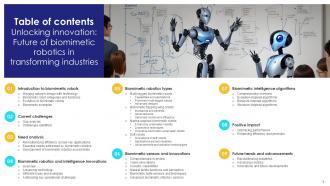
Slide 3: This slide shows Table of Content for the presentation.
Slide 4: This slide highlights the topics to be covered next.
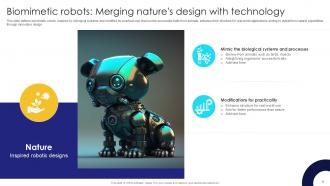
Slide 5: This slide defines biomimetic robots, inspired by biological systems and modified for practical use.
Slide 6: This slide depicts the different categories of biomimetic robots, inspired by diverse species and designed for various applications.
Slide 7: This slide provides details related to biomimetic robots, which have evolved from early prototypes to advanced models integrating biology and computing technologies.
Slide 8: This slide defines how biomimetic robotics are drawing inspiration from caterpillars, insects, and fish, showcases advancements.
Slide 9: This slide provides details related to Snake-like robotics that exhibit unique movement patterns and structural flexibility that enable them to adapt to various terrains.
Slide 10: This is another slide highlighting the topics to be covered next.
Slide 11: This slide depicts a gap analysis highlighting significant deficiencies in current robotics across various criteria.
Slide 12: This slide provides details related to key issues such as navigating unpredictable environments, ensuring precision in medical procedures, achieving stealth in military operations, etc.
Slide 13: This slide highlights the topics to be covered next.
Slide 14: This slide exhibits details related to biomimetic robotics, which enhances navigation in unpredictable environments, improves precision in medical procedures, etc.
Slide 15: This slide defines the need for biomimetic robotics arising from the limitations of conventional robots in handling complex, unpredictable, or hazardous environments.
Slide 16: This slide depicts biomimetic robotics, developed by imitating biological structures and integrating advanced mechanisms to adapt naturally to complex environments.
Slide 17: This is another slide highlighting the topics to be covered next.
Slide 18: This slide provides details related to biomimetic robotics, which integrates decision-making and learning from nature by utilizing novel algorithms.
Slide 19: This slide defines biomimetic robotics and intelligence as transforming various fields by inspiring efficient designs, developing advanced algorithms, and driving innovative research.
Slide 20: This slide represents how biomimetic robots are categorized into multi-legged robots, flapping-wing robots, underwater robots, and soft robots, along with details related to examples.
Slide 21: This slide depicts different biomimetic robots that tackle specific operational challenges such as navigation, precision, energy efficiency, and exploration in challenging conditions.
Slide 22: This slide highlights the topics to be covered next.
Slide 23: This slide outlines biomimetic multi-legged robots, simulating natural leg structures such as bipedal, quadrupedal, and hexapod designs, which excel in adapting to various terrains.
Slide 24: This slide provides details related to notable multi-legged robots.
Slide 25: This slide covers details related to biomimetic multi-legged robots showcasing advanced designs with hybrid models.
Slide 26: This slide highlights the topics to be covered next.
Slide 27: This slide defines the biomimetic flapping-wing robots that replicate natural flight by mimicking birds and insects, using fast-vibrating wings for versatile movements.
Slide 28: This slide showcases biomimetic flapping-wing robots that benefit from natural designs such as rhino beetle features enhancing collision resistance, hummingbird-inspired structures, etc.
Slide 29: This slide exhibits biomimetic flapping-wing robots that are engineered with advanced algorithms for stability, enhanced resistance to interference, and energy-efficient designs.
Slide 30: This is another slide highlighting the topics to be covered next.
Slide 31: This slide defines biomimetic underwater robots, inspired by evolution-refined marine creatures, that offer superior design, travel efficiency, and mobility.
Slide 32: This slide depicts biomimetic underwater robots that leverage caudal and fin propulsion to achieve efficient and stable movement in aquatic environments.
Slide 33: This slide provides biomimetic underwater robots, inspired by marine creatures such as manta rays and schools of fish, utilize advanced propulsion techniques.
Slide 34: This slide highlights the topics to be covered next.
Slide 35: This slide defines soft robots, constructed with materials such as fluids, gels, and elastomers, that offer adaptability to complex environments.
Slide 36: This slide highlights soft robots as revolutionizing industries with their ability to handle delicate tasks, navigate challenging terrains, and enhance biomedical procedures.
Slide 37: This slide presents recent advancements in soft robotics, including innovations in actuation methods.
Slide 38: This is another slide highlighting the topics to be covered next.
Slide 39: This slide defines biomimetic sensors inspired by human and animal sensory systems, enhancing robotic capabilities in vision, acoustics, tactile feedback, taste, and olfaction.
Slide 40: This slide provides biomimetic sensors, inspired by human and animal eyes, revolutionize vision technology with wide fields of view, high sensitivity, etc.
Slide 41: This slide showcases biomimetic sensors inspired by the auditory systems of crickets, flies, and humans which offer advanced solutions for sound localization, noise cancellation, etc.
Slide 42: This slide exhibits biomimetic sensors, inspired by human mechanoreceptors, arthropod hair sensors, and fish lateral line systems, replicate tactile functions.
Slide 43: This slide defines biomimetic taste sensors that replicate tongue receptor functions, detecting taste profiles such as sweetness and sourness using innovations.
Slide 44: This slide represents biomimetic sensors that replicate human nasal functions, enhancing gas detection and odor classification through innovative designs.
Slide 45: This slide highlights the topics to be covered next.
Slide 46: This slide provides the biomimetic intelligence algorithms, including evolution-inspired, behavior-inspired, and structure-inspired types.
Slide 47: This slide mentions evolution-inspired biomimetic intelligence algorithms that leverage natural processes to optimize solutions across various domains.
Slide 48: This slide depicts behavior-inspired algorithms, such as ant colony optimization (ACO), harmony search (HS), and cuckoo search (CS).
Slide 49: This slide defines structure-inspired biomimetic algorithms, including DNA computing, membrane computing, artificial immune systems, etc.
Slide 50: This is another slide highlighting the topics to be covered next.
Slide 51: This slide provides details related to biomimetic robotics, which excels in navigating unpredictable environments, achieving precision in medical procedures, etc.
Slide 52: This slide defines biomimetic robotics as significantly improving efficiency and precision by considering nature, offering superior terrain adaptation, etc.
Slide 53: This slide explains how biomimetic robotics excels in diverse environments, enhancing operations in confined spaces, adapting to various terrains, etc.
Slide 54: This slide highlights the topics to be covered next.
Slide 55: This slide showcases how biomimicry in robotics transforms industries by enhancing surgical precision, optimizing manufacturing efficiency, etc.
Slide 56: This slide provides details related to biomimicry in robotics and unlocks exceptional performance by mimicking nature’s designs.
Slide 57: This slide highlights details related to biomimicry in robotics that opens up opportunities by fostering cross-disciplinary collaboration.
Slide 58: This slide outlines details related to biomimetic robots evolving with advanced designs such as Air Ray, Aqua Jelly, and Smart Bird, showcasing innovations.
Slide 59: This slide shows all the icons included in the presentation.
Slide 60: This slide is titled as Additional Slides for moving forward.
Slide 61: This is Our Vision, Mission & Goal slide. Post your Visions, Missions, and Goals here.
Slide 62: This is Our Team slide with names and designation.
Slide 63: This slide depicts Venn diagram with text boxes.
Slide 64: This slide provides 30 60 90 Days Plan with text boxes.
Slide 65: This slide presents Roadmap with additional textboxes.
Slide 66: This slide shows Post It Notes. Post your important notes here.
Slide 67: This is a Financial slide. Show your finance related stuff here.
Slide 68: This is a Thank You slide with address, contact numbers and email address.
Unlocking Innovation Future Of Biomimetic Robotics In Transforming Industries Ppt Slide with all 76 slides:
Use our Unlocking Innovation Future Of Biomimetic Robotics In Transforming Industries Ppt Slide to effectively help you save your valuable time. They are readymade to fit into any presentation structure.












FAQs for Unlocking Innovation Future Of Biomimetic Robotics In Transforming
Key principles of biomimicry in robotics include structural mimicry, functional mimicry, behavioral mimicry, material adaptation, and sensory integration. These approaches enable engineers to replicate natural mechanisms like gecko adhesion for climbing robots, bird flight patterns for drones, and neural networks for autonomous systems, ultimately delivering enhanced efficiency, adaptability, and performance capabilities across manufacturing, healthcare, and exploration applications.
Animal locomotion research inspires robotic movement by analyzing natural gaits, muscle coordination patterns, energy conservation mechanisms, and adaptive balance systems found in creatures like cheetahs, birds, and insects. Through biomimetic engineering, robotics companies develop more agile manufacturing robots, search-and-rescue units, and delivery systems, ultimately delivering enhanced operational efficiency and reduced energy consumption across industries.
Engineers face challenges including material limitations that can't match biological flexibility, power consumption issues compared to efficient natural systems, complex control algorithms for coordinated movement, and sensor integration difficulties. These obstacles require innovative solutions combining advanced materials, AI-driven control systems, and miniaturized sensors, with many robotics companies finding that biomimetic approaches ultimately deliver enhanced adaptability and operational efficiency across manufacturing and healthcare applications.
Biomimetic robots contribute to environmental conservation through underwater monitoring systems, forest canopy research platforms, wildlife tracking devices, pollution detection sensors, and ecosystem restoration tools. These nature-inspired technologies streamline data collection, enhance species protection efforts, and automate conservation tasks, with marine research institutions and environmental agencies finding that robotic solutions deliver more comprehensive monitoring while minimizing human environmental impact.
Biomimetic robots enhance search and rescue operations by navigating confined spaces, detecting survivors through advanced sensors, and accessing unstable terrain that endangers human rescuers. These nature-inspired machines streamline disaster response through snake-like flexibility for rubble penetration, bird-inspired flight patterns for aerial surveillance, and insect-based swarm coordination, ultimately delivering faster victim location and safer rescue operations.
Artificial intelligence enables biomimetic robots to process sensory data, make autonomous decisions, and adapt behaviors by mimicking neural networks found in biological systems. Through machine learning algorithms, AI helps robots interpret environmental cues, optimize movement patterns, and refine motor control, with many researchers finding that this integration ultimately delivers more sophisticated, lifelike robotic systems.
Biomimetic robotics enhances human-robot collaboration by incorporating natural movement patterns, adaptive sensing capabilities, and intuitive interaction mechanisms that mirror biological systems. These bio-inspired designs enable seamless integration in manufacturing environments, construction sites, and logistics operations, delivering improved safety protocols, reduced training requirements, and enhanced operational efficiency, with many industrial facilities finding that biomimetic interfaces significantly streamline workforce adaptation.
Successful biomimetic robots include Boston Dynamics' quadruped robots mimicking animal locomotion, gecko-inspired climbing robots used in infrastructure inspection, bird-like drones for surveillance and mapping, snake robots for search and rescue operations, and fish-inspired underwater vehicles for marine research. These technologies enhance operational efficiency by accessing previously unreachable environments, reducing human risk exposure, and delivering precise data collection capabilities, with many industries finding that biomimetic designs ultimately provide significant competitive advantages over traditional robotic approaches.
Insect behavior informs drone design through flight mechanics, swarm intelligence, navigation systems, and energy efficiency patterns observed in bees, dragonflies, and locusts. Through biomimetic approaches, autonomous drones achieve enhanced maneuverability, collaborative task execution, and obstacle avoidance capabilities, with agricultural monitoring, search-and-rescue operations, and environmental surveying applications finding significant operational advantages.
Ethical considerations include privacy concerns from surveillance capabilities, job displacement in sectors like healthcare and manufacturing, consent issues for data collection, and potential misuse for military applications. These technologies present both challenges and opportunities, with many organizations finding that transparent development frameworks, regulatory compliance, and stakeholder engagement ultimately deliver responsible innovation while maintaining competitive advantage in increasingly automated environments.
Biomimetic robotics intersects with soft robotics by combining nature-inspired designs with flexible materials, creating adaptive systems that mimic biological movements, sensory capabilities, and structural properties. This strategic combination enables innovations like self-healing actuators, compliant grippers for delicate manufacturing, and medical devices that seamlessly interface with human tissue, ultimately delivering enhanced safety and operational efficiency across healthcare, manufacturing, and exploration industries.
Future trends in biomimetic robotics include advanced soft robotics mimicking octopus flexibility, swarm intelligence inspired by insect colonies, neural-inspired adaptive learning systems, and bio-hybrid technologies combining living tissues with mechanical components. These innovations will revolutionize healthcare through surgical precision, enhance manufacturing with self-repairing systems, and transform logistics with autonomous swarms, ultimately delivering unprecedented operational efficiency and competitive advantages across industries.
Biomimetic designs enhance sustainable energy generation and resource management by replicating nature's efficient mechanisms, including wind turbines inspired by whale fins, solar panels mimicking photosynthesis, and water collection systems based on desert beetles. These bio-inspired technologies streamline energy capture, minimize waste, and optimize resource allocation across manufacturing, renewable energy, and agricultural sectors, ultimately delivering cost-effective sustainability solutions while reducing environmental impact for organizations seeking competitive advantage in increasingly eco-conscious markets.
Biomimetic robotics pathways include interdisciplinary engineering degrees, specialized robotics programs, biology-engineering dual majors, research internships, and graduate studies in bio-inspired systems. Universities increasingly offer dedicated biomimetics courses, hands-on lab experiences, and industry partnerships, with many students finding that combining mechanical engineering, biology, and computer science delivers comprehensive expertise and competitive advantage in this rapidly expanding field.
Biomimicry principles influence assistive robotics by replicating natural movement patterns, sensory systems, and adaptive mechanisms found in biological organisms. Through gecko-inspired gripping surfaces, octopus-like flexible manipulation, and neural pathway modeling, developers create prosthetics and mobility aids that respond more intuitively to user needs, ultimately delivering enhanced functionality and seamless integration with human physiology.
-
The designs by SlideTeam are honestly the best I have seen so far. Will be definitely coming back for more.
-
The quality of PowerPoint templates I found here is unique and unbeatable. Keep up the good work and continue providing us with the best slides!