

Unlocking Power Of IoT Solutions Industrial Dashboard To Track Factory Energy Consumption IoT SS




Try Before you Buy Download Free Sample Product
 Impress Your
 Audience
 100%
100% Editable
 Save Hours
 of Time


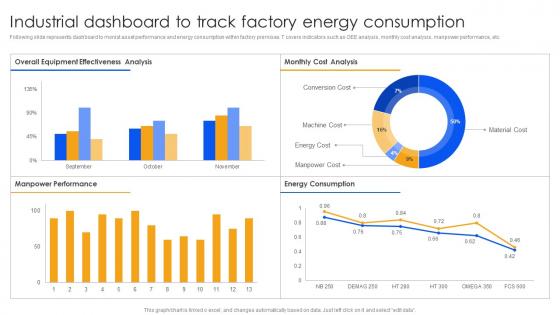
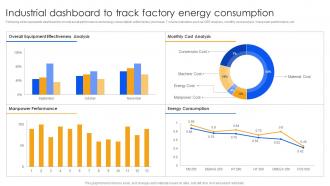
Following slide represents dashboard to monist asset performance and energy consumption within factory premises. T covers indicators such as OEE analysis, monthly cost analysis, manpower performance, etc.
People who downloaded this PowerPoint presentation also viewed the following :
Unlocking Power Of IoT Solutions Industrial Dashboard To Track Factory Energy Consumption IoT SS with all 10 slides:
Use our Unlocking Power Of IoT Solutions Industrial Dashboard To Track Factory Energy Consumption IoT SS to effectively help you save your valuable time. They are readymade to fit into any presentation structure.








FAQs for Unlocking Power Of IoT Solutions Industrial Dashboard To Track Factory Energy
Key features include real-time data visualization, customizable alerts and notifications, predictive analytics capabilities, multi-device compatibility, and robust security protocols. These features streamline operations by enabling proactive maintenance, reducing downtime, and enhancing decision-making across manufacturing, energy, and logistics sectors, ultimately delivering improved operational efficiency and competitive advantage.
Real-time data visualization transforms industrial decision-making by providing instant insights into equipment performance, production metrics, and operational efficiency, enabling managers to identify bottlenecks, predict maintenance needs, and optimize resource allocation immediately. Manufacturing plants and energy facilities leverage these dashboards to reduce downtime by up to 30%, streamline workflows, and make data-driven adjustments that enhance productivity and minimize costly operational disruptions.
Data integration serves as the foundation of effective IoT industrial dashboards by consolidating information from sensors, machines, databases, and enterprise systems into unified, actionable views. Through seamless integration protocols, manufacturers and logistics companies streamline operations, enhance predictive maintenance capabilities, and accelerate decision-making processes, ultimately delivering improved operational efficiency and competitive advantage in increasingly complex industrial environments.
Predictive analytics integrates into IoT industrial dashboards through machine learning algorithms, real-time data processing, historical trend analysis, and automated forecasting models. Manufacturing facilities and energy companies leverage these capabilities to anticipate equipment failures, optimize maintenance schedules, and reduce downtime costs, ultimately delivering proactive operational efficiency and competitive advantage.
Best practices for designing intuitive IoT dashboard interfaces include clear data hierarchy, real-time visualization with minimal cognitive load, customizable widgets for different user roles, and responsive design that works across devices. These approaches streamline operations by prioritizing critical alerts, grouping related metrics logically, and enabling quick decision-making, with manufacturing and energy sectors finding that intuitive dashboards reduce response times and enhance operational efficiency.
IoT industrial dashboards require multi-layered security including device authentication, encrypted data transmission, network segmentation, real-time threat monitoring, and edge-level protection that traditional dashboards don't need. While conventional dashboards focus primarily on user access controls and data encryption, IoT systems must secure thousands of connected sensors, actuators, and communication protocols across manufacturing floors, energy grids, and supply chains, ultimately delivering comprehensive operational visibility with enterprise-grade protection.
Common sensors used with IoT industrial dashboards include temperature, pressure, vibration, humidity, flow rate, proximity, and accelerometer sensors for comprehensive equipment monitoring. These sensors enable predictive maintenance, real-time quality control, and operational efficiency tracking across manufacturing, energy, and processing facilities, with many organizations finding that integrated sensor data significantly reduces downtime and enhances production visibility.
IoT dashboards reduce manufacturing downtime by providing real-time equipment monitoring, predictive maintenance alerts, and automated failure detection across production lines. Through continuous sensor data analysis, manufacturers can identify potential issues before breakdowns occur, schedule maintenance during planned periods, and optimize resource allocation, ultimately delivering 15-30% reduction in unplanned downtime and significantly enhanced operational efficiency.
Scaling IoT industrial dashboards across multiple facilities presents challenges including data standardization across different equipment, network connectivity variations, integration with legacy systems, security protocols consistency, and real-time synchronization requirements. While these complexities demand strategic planning, organizations in manufacturing and energy sectors find that standardized APIs, cloud-based architectures, and centralized management ultimately deliver operational visibility and enhanced decision-making capabilities.
IoT dashboards facilitate compliance by providing real-time monitoring, automated reporting, audit trail documentation, and standardized data visualization that meets regulatory requirements. Through continuous tracking of environmental conditions, safety metrics, and operational parameters, organizations in pharmaceuticals, food processing, and manufacturing can demonstrate adherence to standards like FDA, ISO, and OSHA, while streamlining compliance reporting and reducing regulatory risks.
Machine learning significantly enhances IoT industrial dashboards by enabling predictive analytics, automated anomaly detection, and intelligent data pattern recognition across manufacturing operations. Through advanced algorithms, these dashboards deliver proactive maintenance scheduling, real-time quality control insights, and optimized resource allocation, with manufacturing facilities finding that ML-powered systems reduce downtime while streamlining operational efficiency.
Mobile compatibility transforms IoT industrial dashboards by enabling real-time data access, remote equipment monitoring, and instant alert notifications directly from field locations. Field workers in manufacturing, oil and gas, and utilities can troubleshoot equipment issues, update maintenance records, and coordinate with control room operators seamlessly, ultimately reducing response times and enhancing operational efficiency across distributed industrial environments.
Businesses should prioritize operational efficiency metrics, equipment performance indicators, energy consumption data, predictive maintenance alerts, and real-time production quality measurements when developing IoT industrial dashboards. These strategic metrics enable manufacturing facilities, oil refineries, and logistics operations to minimize downtime, optimize resource allocation, and enhance decision-making capabilities, ultimately delivering cost reductions and competitive advantage.
User feedback enhances IoT dashboard functionality through iterative design improvements, feature prioritization based on actual usage patterns, and interface customization addressing specific operational needs. Manufacturing facilities and energy companies increasingly leverage user insights to streamline data visualization, automate critical alerts, and optimize workflow integration, ultimately delivering more intuitive monitoring experiences and faster decision-making capabilities.
**Case studies showcasing successful IoT industrial dashboard implementations include General Electric's Predix platform monitoring jet engines, Siemens' MindSphere optimizing manufacturing processes, and John Deere's precision agriculture systems tracking equipment performance. These organizations have achieved 20-30% reductions in maintenance costs, improved operational efficiency, and enhanced predictive capabilities, with many industrial companies finding that real-time visibility ultimately delivers competitive advantage and streamlined decision-making.**
-
The designs are super attractive. Me and my team love using SlideTeam’s presentations.
-
Their professional templates are very impressive, even my manager was curious about the source. I am very grateful.