


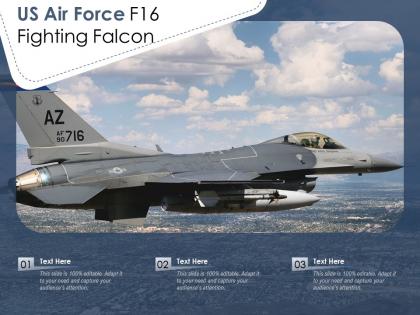
Us air force f16 fighting falcon




Try Before you Buy Download Free Sample Product
 Impress Your
 Audience
 100%
100% Editable
 Save Hours
 of Time


Our US Air Force F16 Fighting Falcon are explicit and effective. They combine clarity and concise expression.
People who downloaded this PowerPoint presentation also viewed the following :
Content of this Powerpoint Presentation
Description:
This image presents a PowerPoint template that can be customized for presentations related to the military, aerospace technology, or defense strategies. It features a photograph of a U.S. Air Force F-16 Fighting Falcon in flight, with a clear sky and mountainous terrain in the background. The slide is structured with text placeholders indicating it is fully editable, allowing presenters to adapt the content to their specific needs. This template is likely intended for professional settings, providing a compelling backdrop for discussions about aviation, military operations, or technological advancements in aircraft design and capabilities.
Use Cases:
The slide is well-suited for various industries that deal with defense, technology, and education, providing a professional and contextually relevant visual for presentations.
1. Military and Defense:
Use: Discussing air force capabilities and strategies
Presenter: Military Officer
Audience: Defense Personnel, Cadets
2. Aerospace:
Use: Showcasing advancements in aircraft technology
Presenter: Aerospace Engineer
Audience: Industry Specialists, Engineering Students
3. Government and Policy:
Use: Briefing on defense budgeting and resource allocation
Presenter: Policy Analyst
Audience: Legislators, Civil Servants
4. Education and Training:
Use: Teaching about aerodynamics and military history
Presenter: Educator
Audience: Students, Military History Enthusiasts
5. Technology and Engineering:
Use: Detailing design and performance specifications of fighter jets
Presenter: Engineering Expert
Audience: Technical Teams, Contractors
6. Aviation Industry:
Use: Marketing civilian applications of military aviation technology
Presenter: Marketing Executive
Audience: Commercial Aviation Professionals, Buyers
7. Security and Strategy:
Use: Analyzing global security challenges and the role of air power
Presenter: Security Analyst
Audience: Analysts, Strategic Planners
Us air force f16 fighting falcon with all 2 slides:
Give your audience a fulfilling experience. They will find our US Air Force F16 Fighting Falcon elevating.
FAQs for Us air force
Dude, the F-16 is basically the Swiss Army knife of fighters. That fly-by-wire system makes it crazy maneuverable, plus the side stick helps pilots handle insane G-forces without passing out. What's really smart though is how modular everything is - same plane can do air-to-air one day, bomb runs the next. Just swap the pylons and update software. Single engine keeps it affordable too, which matters when you're buying hundreds of these things. Honestly, the plug-and-play avionics are genius. Way ahead of its time when it first flew.
Dude, the F-16's been completely overhauled since the late 70s. Every decade they basically gut the thing and rebuild it. Block 15s from back in the day? Nothing like the Block 50/52s that came out in the 90s - way better radar, avionics, all that stuff. A Block 70 today is honestly a different aircraft entirely. They've got AESA radar now, advanced targeting pods, helmet displays. The electronic warfare systems are insane compared to what they started with. Oh and here's the thing - always check the block number when you're looking at specs. Makes all the difference between what looks like the same plane on paper.
So basically the F-16's fly-by-wire is like having a super smart copilot. The plane's actually unstable on purpose - sounds crazy right? But the computer constantly makes tiny adjustments so you don't have to fight it. This lets pilots pull insane turns that would make older jets stall out completely. Plus it won't let you accidentally break your own aircraft, which honestly seems like a no-brainer feature. That's why F-16s can dance around older fighters like they're standing still. Pretty wild how much tech can change the game.
Dude, the F-16 is everywhere for a reason - it's the ultimate jack-of-all-trades fighter. Air-to-air? Check. Ground attack? Yep. Close air support? Does that too. What makes it so valuable is how well it works with ground troops and other aircraft. Since like half of NATO flies these things, coordination is seamless. Honestly, I think it's one of the best designs ever - not the flashiest jet out there, but damn reliable. Perfect for joint operations where you need something that won't let you down. It's basically the Honda Civic of fighter jets, if that makes sense.
Dude, the F-16 was honestly groundbreaking back in the day. First fighter with proper fly-by-wire and heads-up display standard. Way lighter and cheaper than the F-15 or F/A-18, but still packed solid tech. That bubble canopy? Visibility is insane compared to older jets. Yeah, it wasn't as fancy as the pricier F-15, but that wasn't really the point anyway. Modern versions have been upgraded like crazy though - they can totally hang with way newer aircraft. Pretty impressive for something that's been around forever.
Dude, the F-16 is basically a flying weapons platform. It's got AIM-120 AMRAAMs for long-range air combat, plus AGM-88 HARMs to take out enemy radar sites. There's also the 20mm cannon for up-close fights. Sidewinders, JDAMs for precision bombing, Mavericks for tank busting - honestly, the modularity is crazy good. What's really cool is how pilots can swap between air-to-air and ground attack modes mid-flight. Makes it super versatile compared to older jets that were more specialized. The whole loadout changes based on whatever mission you're flying that day.
The F-16's everywhere now - like 25+ countries fly them. America was pretty clever about this whole thing, setting up deals where places like Turkey and South Korea could actually build their own versions locally. Foreign Military Sales made it happen. Now you've got this huge network of allied air forces that can all work together, which is kinda the point I guess. Plus the U.S. keeps making money off upgrades for decades. Honestly, if you want to see where America has defense partnerships, just look at who's flying F-16s.
F-16s run about $7-8k per flight hour, which honestly isn't terrible for a fighter jet. Fuel and maintenance eat up most of that cost. Every 4,000 hours the engine needs major work - that's when your wallet really feels it. All the fancy radar and avionics stuff requires specialized techs too, and those parts aren't cheap. Think of it like owning a supercar that happens to break the sound barrier lol. You're looking at 30-40 maintenance hours for every flight hour, but at least parts are pretty available since so many countries fly them.
Honestly, the F-16 is still around because Lockheed nailed three things back in the 70s. First, they made it super modular - you can literally swap out avionics without rebuilding the whole plane. Smart move. Operating costs stay low thanks to that single engine design, unlike those gas-guzzling twin-engine jets. The airframe itself was way overbuilt too, so it handles all these decades of upgrades without falling apart. My dad worked on these things in the 80s and always said they were built like tanks. Bottom line: designing stuff to adapt beats designing for what you need right now.
So basically you'd start with regular flight training, then move into the fighter stuff - air-to-air combat, ground attacks, all that. The actual F-16 training happens at places like Luke AFB. Honestly sounds brutal from what I've heard. Months in simulators first, learning every system. Then real flights that get progressively harder. Whole thing takes like 18-24 months, which is crazy when you think about it. Oh, and definitely try talking to actual F-16 pilots if you can - they'll give you the real scoop since requirements change depending on which air force you're dealing with.
Look, F-16s are basically everywhere in air defense these days. NATO countries love them because they're cheap to run compared to the heavy hitters. Taiwan and South Korea use them to keep their neighbors honest, if you know what I mean. They've proven themselves in Iraq, the Balkans - pretty much wherever there's been action. What's cool is how versatile they are - one day they're intercepting threats, next day they're doing close air support. Israel does something really smart by linking theirs with missile defense systems. Honestly, they're like the Honda Civic of fighter jets.
Dude, F-16s are basically the poster child for proven combat fighters. Israeli jets have been demolishing Syrian air defenses and hitting Iranian targets. Turkey used theirs against ISIS and PKK. They were everywhere during Iraq and Afghanistan too - total workhorses. Israel's got some insane kill numbers but they're super secretive about specifics. What's crazy is these things do everything well. Air-to-air combat, ground strikes, taking out enemy radar - honestly it's kinda unfair how good they are. If you want to see what works in real combat, the F-16's track record is pretty much unbeatable for multirole fighters.
Yeah, stealth is definitely putting the F-16 in a weird spot. F-35s are built for low observability from day one, but the F-16? Not so much. The Air Force isn't giving up on them though – they're dumping money into updated avionics and electronic warfare gear. Smart move honestly. These upgrades basically turn old F-16s into "smart" legacy fighters that can hang with the stealth guys. They're not gonna be your first-wave penetrators anymore, but as multi-role workhorses? Still plenty useful. If you're following the modernization programs, that's the angle to watch.
Look, F-16s are basically the ultimate multirole fighter - air-to-air, ground strikes, recon, you name it. Your air force instantly becomes way more capable. The best part is joining this huge international club where everyone shares training and maintenance know-how. Downside is you're kinda stuck with whatever the US decides about parts and upgrades. Honestly though? Most countries think it's totally worth it. You get decades of combat-proven tech and seamless integration with NATO forces. My cousin who works in defense swears by their reliability.
So they're doing some pretty sick upgrades to F-16s actually. The QF-16 program converts old jets into unmanned drones for targets and maybe combat later. Active F-16s are getting new sensors, AI flight assistance, and better data-linking with other aircraft. It's honestly crazy - these 80s fighters are becoming like half-robot half-plane. The whole point is better pilot awareness and making them play nice with newer jets. Oh and if you're watching defense stuff, Lockheed's modernization schedule is worth tracking since it'll mess with procurement plans down the line.
No Reviews