


Using IOT Technologies For Better Logistics Management Powerpoint Presentation Slides





Try Before you Buy Download Free Sample Product
 Impress Your
 Audience
 100%
100% Editable
 Save Hours
 of Time


Logistics management through IoT refers to integrating smart systems to handle supply chains, warehousing, transportation, etc. Its main purpose is to provide these operations efficiency, compliance, and security. Check out our professionally designed presentation on Using IoT Technologies for Better Logistics Management. It provides a general overview, significance, spending trends, use cases, architecture, etc., which can be referred by manufacturing or warehouse managers. This PowerPoint presentation offers access to multiple strategies which can help logistics businesses in optimizing and upgrading their operations, these include IoT technology implementation, fleet management, warehousing and packaging, IoT infrastructure, blockchain logistics, etc. Furthermore, the complete deck includes slides that can help the logistics department through roles and responsibilities, workflow, and training program. Moreover, it also provides costs and software selection related to implementing IoT in logistics. Lastly, the PPT deck can help assess the performance of the above strategies through impact analysis, KPIs, and dashboards. Get access to this powerful template now.
People who downloaded this PowerPoint presentation also viewed the following :
Content of this Powerpoint Presentation
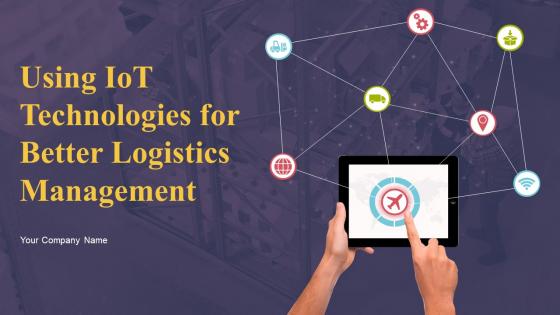
Slide 1: This slide introduces Using IoT Technologies for Better Logistics Management. State your company name and begin.
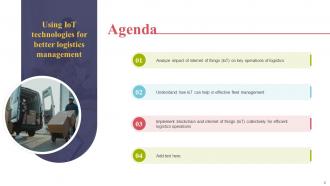
Slide 2: This slide states Agenda of the presentation.
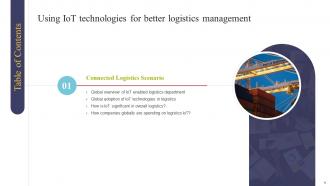
Slide 3: This slide presents Table of Content for the presentation.
Slide 4: This slide highlights title for topics that are to be covered next in the template.
Slide 5: This slide shows Global Overview of IoT in Logistics Department.
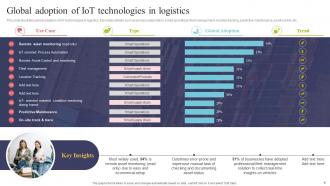
Slide 6: This slide presents Global Adoption of IoT Technologies in Logistics.
Slide 7: This slide displays How is IoT Significant in Overall Logistics.
Slide 8: This slide represents How Companies Globally are Spending on Logistics IoT.
Slide 9: This slide highlights title for topics that are to be covered next in the template.
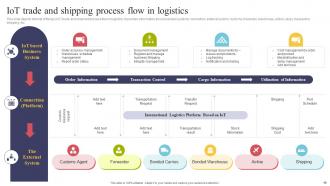
Slide 10: This slide showcases IoT Trade and Shipping Process Flow in Logistics.
Slide 11: This slide shows Key Use Cases of IoT in Logistics.
Slide 12: This slide presents IoT Architecture for End to End Logistics Visibility.
Slide 13: This slide highlights title for topics that are to be covered next in the template.
Slide 14: This slide depicts logistics internet of things (IoT) deployment timeline.
Slide 15: This slide highlights title for topics that are to be covered next in the template.
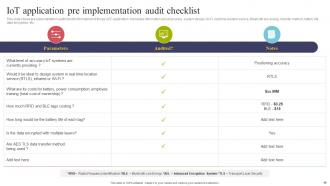
Slide 16: This slide displays IoT Application Pre Implementation Audit Checklist.
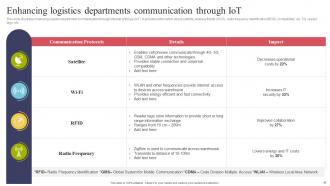
Slide 17: This slide represents Enhancing Logistics Departments Communication Through IoT.
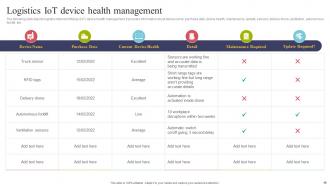
Slide 18: This slide showcases Logistics IoT Device Health Management.
Slide 19: This slide shows Pairing 5G Network for Smart Logistics.
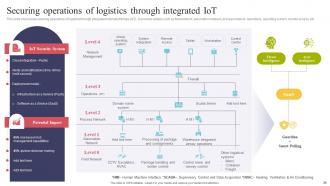
Slide 20: This slide presents Securing Operations of Logistics Through Integrated IoT.
Slide 21: This slide highlights title for topics that are to be covered next in the template.
Slide 22: This slide displays Efficient Location Tracking and Route Optimization.
Slide 23: This slide represents Condition Based and Vehicle Breakdown Management.
Slide 24: This slide showcases Utilizing Drones for Last Mile Deliveries.
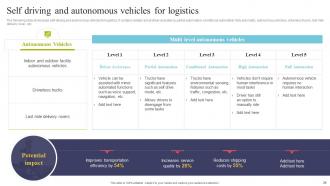
Slide 25: This slide shows Self Driving and Autonomous Vehicles for Logistics.
Slide 26: This slide highlights title for topics that are to be covered next in the template.
Slide 27: This slide presents Overall Architecture of IoT in Warehouse Operations.
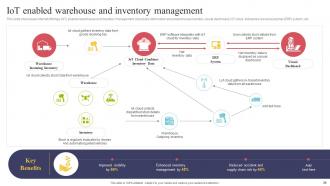
Slide 28: This slide displays IoT Enabled Warehouse and Inventory Management.
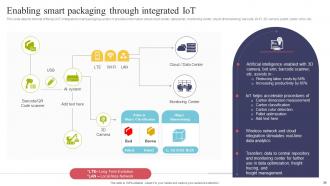
Slide 29: This slide represents Enabling Smart Packaging Through Integrated IoT.
Slide 30: This slide highlights title for topics that are to be covered next in the template.
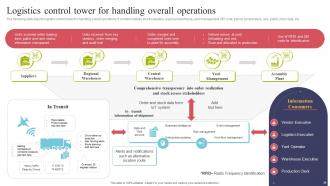
Slide 31: This slide showcases Logistics Control Tower for Handling Overall Operations.
Slide 32: This slide shows IoT Based Logistics Driver Monitoring System.
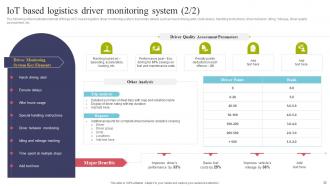
Slide 33: This is another slide continuing IoT Based Logistics Driver Monitoring System.
Slide 34: This slide presents IoT Based Customer Service Monitoring.
Slide 35: This slide highlights title for topics that are to be covered next in the template.
Slide 36: This slide displays Strategy to Protect IoT Integrated Devices.
Slide 37: This slide represents Strategy to Provide Layered Security Across Networks.
Slide 38: This slide showcases IoT Security Lock for Safe Fleet Management.
Slide 39: This slide highlights title for topics that are to be covered next in the template.
Slide 40: This slide shows Streamlining Logistics and Supply Chain Through IoT and Blockchain Framework.
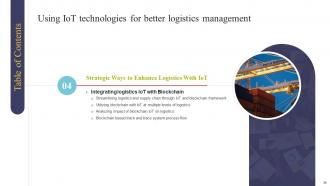
Slide 41: This slide presents Utilizing Blockchain With IoT at Multiple Levels of Logistics.
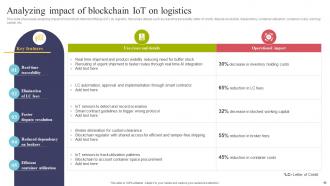
Slide 42: This slide displays Analyzing Impact of Blockchain IoT on Logistics.
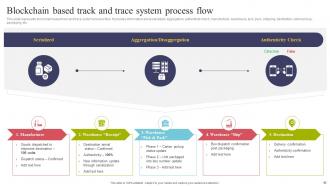
Slide 43: This slide represents Blockchain Based Track and Trace System Process Flow.
Slide 44: This slide highlights title for topics that are to be covered next in the template.
Slide 45: This slide showcases Key Members of Logistics Information Technology Department.
Slide 46: This slide shows Roles and Responsibilities of Logistics Information Technology Department.
Slide 47: This slide presents Logistics Team Workflow with IoT Integration.
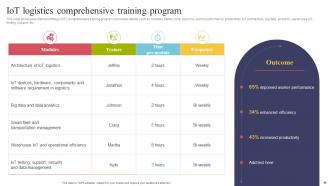
Slide 48: This slide displays IoT Logistics Comprehensive Training Program.
Slide 49: This slide highlights title for topics that are to be covered next in the template.
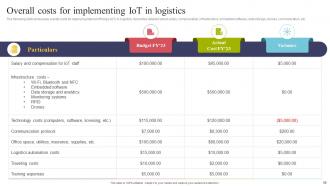
Slide 50: This slide represents Overall Costs for Implementing IoT in Logistics.
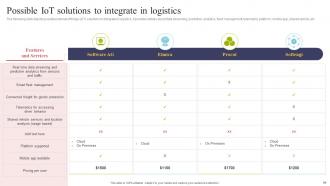
Slide 51: This slide showcases Possible IoT Solutions to Integrate in Logistics.
Slide 52: This slide highlights title for topics that are to be covered next in the template.
Slide 53: This slide shows Analyzing Impact of IoT on Major Logistics KPIs.
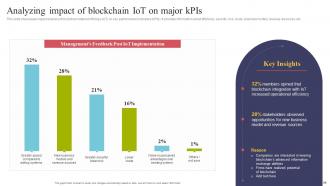
Slide 54: This slide presents Analyzing Impact of Blockchain IoT on major KPIs.
Slide 55: This slide highlights title for topics that are to be covered next in the template.
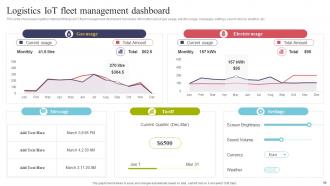
Slide 56: This slide displays Logistics IoT Fleet Management Dashboard.
Slide 57: This slide represents IoT Dashboard for Tracking Warehouse Pallets.
Slide 58: This slide contains all the icons used in this presentation.
Slide 59: This slide is titled as Additional Slides for moving forward.
Slide 60: This slide provides 30 60 90 Days Plan with text boxes.
Slide 61: This slide shows Post It Notes. Post your important notes here.
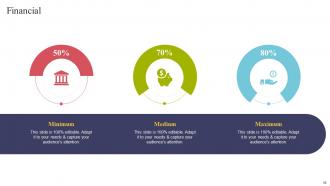
Slide 62: This is a Financial slide. Show your finance related stuff here.
Slide 63: This is Our Goal slide. State your firm's goals here.
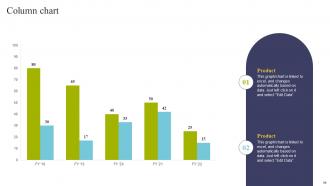
Slide 64: This slide displays Column chart with two products comparison.
Slide 65: This is Our Mission slide with related imagery and text.
Slide 66: This is a Comparison slide to state comparison between commodities, entities etc.
Slide 67: This slide presents Roadmap with additional textboxes.
Slide 68: This is a Thank You slide with address, contact numbers and email address.
Using IOT Technologies For Better Logistics Management Powerpoint Presentation Slides with all 73 slides:
Use our Using IOT Technologies For Better Logistics Management Powerpoint Presentation Slides to effectively help you save your valuable time. They are readymade to fit into any presentation structure.





































FAQs for Using IOT Technologies For Better Logistics Management
IoT technology delivers enhanced visibility, real-time tracking, predictive maintenance, automated inventory management, and optimized route planning across logistics operations. These capabilities streamline supply chain efficiency by reducing delays, minimizing costs, and improving delivery accuracy, with many transportation companies finding that IoT-enabled systems ultimately deliver faster customer service and significant competitive advantages.
IoT enhances supply chain visibility by providing real-time tracking of shipments, monitoring environmental conditions, automating inventory updates, and enabling predictive maintenance of logistics equipment. Through connected sensors and devices, companies streamline operations, reduce delays, and deliver enhanced customer experiences, with many logistics providers finding that this transparency ultimately drives competitive advantage and operational efficiency.
Sensors enable real-time inventory tracking by monitoring stock levels, detecting movement patterns, and automatically updating inventory systems through RFID, weight sensors, and proximity detectors. These technologies streamline warehouse operations by providing instant visibility into stock availability, reducing manual counting errors, and triggering automated reordering processes, ultimately delivering improved accuracy and operational efficiency.
IoT solutions enhance route optimization by providing real-time traffic data, vehicle performance monitoring, weather condition updates, and delivery status tracking. Through connected sensors and GPS technologies, logistics providers streamline fuel consumption, reduce delivery times, and improve customer satisfaction, with many transportation companies finding that IoT-driven route planning delivers significant cost savings and competitive advantage.
IoT significantly reduces logistics operational costs by automating route optimization, enabling predictive maintenance of fleet vehicles, and streamlining inventory management through real-time tracking. These technologies deliver cost savings by minimizing fuel consumption, reducing equipment downtime, and eliminating manual oversight processes, with many logistics companies finding operational efficiency improvements of 20-30% annually.
IoT facilitates predictive maintenance through real-time sensor monitoring, data analytics, automated alerts, and performance tracking across transportation fleets. These technologies enable logistics companies to detect equipment failures before they occur, schedule maintenance proactively, and minimize costly downtime, with many trucking and shipping companies finding significantly reduced operational costs and enhanced service reliability.
IoT enhances customer service in logistics by enabling real-time tracking, proactive communication, and precise delivery predictions through connected sensors and smart devices. These technologies streamline transparency by providing instant shipment visibility, automated status updates, and predictive analytics, with many retailers and e-commerce companies finding that customers experience significantly reduced uncertainty and improved satisfaction levels.
IoT in logistics presents security challenges including device vulnerabilities, data breaches, network intrusions, inadequate authentication, and supply chain attacks targeting connected sensors and tracking systems. These risks can be mitigated through encrypted communications, regular firmware updates, network segmentation, and multi-factor authentication, with many logistics companies finding that comprehensive cybersecurity frameworks ultimately enhance operational resilience while maintaining competitive advantage.
IoT data analytics transforms logistics decision-making by providing real-time visibility into fleet performance, inventory levels, route optimization, and predictive maintenance scheduling. Through advanced sensors and connectivity, logistics companies streamline operations, reduce fuel costs, and enhance delivery accuracy, with many transportation firms finding that data-driven insights ultimately deliver significant competitive advantages and improved customer experiences.
Emerging IoT trends in logistics include edge computing for real-time processing, AI-powered predictive analytics, blockchain integration for supply chain transparency, 5G connectivity for faster data transmission, and digital twin technology for warehouse optimization. These innovations streamline operations by enhancing route planning, automating inventory management, and enabling predictive maintenance, with many logistics companies finding significantly improved delivery times and reduced operational costs.
IoT-enabled devices ensure better compliance by providing real-time monitoring of temperature, humidity, location, and handling conditions, automatically documenting regulatory requirements throughout the supply chain. These smart sensors enable pharmaceutical companies, food distributors, and chemical manufacturers to maintain detailed audit trails, receive instant alerts for compliance breaches, and generate automated reports, ultimately reducing regulatory violations while streamlining inspection processes.
**INPUT**: What types of IoT devices are most commonly used in warehouse management? **OUTPUT**: Common IoT devices in warehouse management include RFID tags, barcode scanners, temperature sensors, motion detectors, and automated guided vehicles (AGVs). These technologies streamline inventory tracking, optimize storage conditions, and enhance operational efficiency by providing real-time visibility, reducing manual errors, and enabling predictive maintenance, ultimately delivering faster fulfillment and lower costs. [Word count: 54 words]
Small logistics companies can leverage IoT solutions by starting with fleet tracking devices, temperature sensors for sensitive goods, and automated inventory management systems. These technologies deliver immediate value through reduced fuel costs, improved delivery accuracy, and enhanced customer transparency, while many smaller operators find that cloud-based IoT platforms offer enterprise-level capabilities without significant upfront infrastructure investments.
**INPUT**: What are the barriers to IoT adoption in the logistics sector, and how can they be overcome? **OUTPUT**: IoT adoption barriers include high implementation costs, data security concerns, legacy system integration challenges, and workforce skill gaps. These obstacles can be overcome through phased deployment strategies, robust cybersecurity frameworks, and comprehensive training programs, with many logistics companies finding that strategic partnerships with technology providers ultimately deliver enhanced operational efficiency and competitive advantage.
Successful IoT implementations in logistics include Walmart's temperature-controlled supply chain for perishables, DHL's smart truck sensors for route optimization, and Amazon's warehouse automation systems. These deployments demonstrate how IoT streamlines inventory management, reduces spoilage, and enhances delivery accuracy, with many logistics companies finding that strategic sensor integration delivers significant cost reductions and improved customer satisfaction.
-
The information is visually stunning and easy to understand, making it perfect for any business person. So I would highly recommend you purchase this PPT design now!
-
I am so thankful for all of the templates I've found on your site. They have saved me hours every week and helped make my presentations come alive. Keep up with these amazing product releases!