


Various Designs Of Main Door Lock System For Security Iot Smart Homes Automation IOT SS




Try Before you Buy Download Free Sample Product
 Impress Your
 Audience
 100%
100% Editable
 Save Hours
 of Time


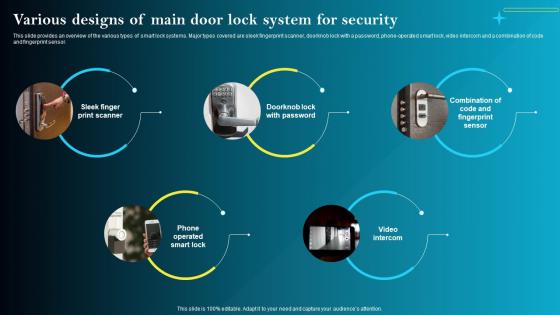
This slide provides an overview of the various types of smart lock systems. Major types covered are sleek fingerprint scanner, doorknob lock with a password, phone-operated smart lock, video intercom and a combination of code and fingerprint sensor.
People who downloaded this PowerPoint presentation also viewed the following :
Various Designs Of Main Door Lock System For Security Iot Smart Homes Automation IOT SS with all 6 slides:
Use our Various Designs Of Main Door Lock System For Security Iot Smart Homes Automation IOT SS to effectively help you save your valuable time. They are readymade to fit into any presentation structure.





FAQs for Various Designs Of Main Door Lock System For Security Iot Smart Homes
Key features include biometric authentication, remote access control, real-time monitoring, battery backup systems, and encrypted communication protocols. These technologies enhance security by enabling multi-factor verification, smartphone integration, and instant alerts, with many homeowners finding that strategic combinations of fingerprint scanning and mobile connectivity deliver seamless access management while maintaining robust protection against unauthorized entry.
Smart lock integration with home automation systems enhances security by enabling real-time monitoring, automated access controls, and coordinated responses with other connected devices like cameras and alarms. Through IoT connectivity, homeowners can receive instant notifications, remotely manage entry permissions, and create comprehensive security protocols that automatically lock doors, activate surveillance systems, and alert authorities during suspicious activities, ultimately delivering seamless protection and enhanced peace of mind.
IoT smart door lock vulnerabilities include weak encryption, unsecured network connections, firmware flaws, inadequate authentication protocols, and poor password management. These security risks can be mitigated through end-to-end encryption, regular firmware updates, multi-factor authentication, and secure network configurations, with many smart home manufacturers increasingly implementing advanced cybersecurity measures to deliver enhanced protection and user confidence.
Different connectivity types significantly impact smart door lock performance through range, power consumption, and integration capabilities. Wi-Fi offers extensive remote access but consumes more power, Bluetooth provides energy efficiency for proximity-based access, while Zigbee enables mesh networking with lower battery drain, with many smart home systems finding that combining these technologies delivers enhanced security, seamless automation, and reliable connectivity across various residential environments.
Encryption and authentication protocols serve as the foundational security layers for IoT lock systems, protecting data transmission through AES encryption, securing device identity verification via multi-factor authentication, and preventing unauthorized access through certificate-based validation. These security measures enable smart locks to safely communicate with mobile apps, cloud servers, and home automation networks, with many residential and commercial properties finding that robust protocol implementation significantly reduces cybersecurity vulnerabilities while maintaining seamless user experiences.
Smart door locks provide user-friendly access control through keyless entry methods, smartphone apps, temporary access codes, biometric recognition, and remote management capabilities. These systems streamline home security by enabling homeowners to grant instant access to family members through personalized codes, provide visitors with time-limited entry permissions, and monitor all access activity in real-time, ultimately delivering enhanced convenience and peace of mind while eliminating traditional key management concerns.
Battery life efficiency in IoT smart locks requires optimizing power consumption through low-energy communication protocols like Zigbee or Thread, implementing sleep modes during inactive periods, utilizing motion sensors for selective activation, and incorporating energy-harvesting technologies. These design strategies enable smart locks to operate for months without replacement while maintaining security responsiveness, with many residential and commercial installations finding that efficient power management ultimately delivers reduced maintenance costs and enhanced user satisfaction.
Manufacturers balance aesthetics and functionality by integrating sleek, minimalist designs with advanced biometric sensors, touch-screen interfaces, and concealed mechanical components that maintain visual appeal. Through strategic material choices like brushed metals and premium finishes, companies create locks that complement modern architecture while delivering robust security features, with many homeowners finding that well-designed smart locks enhance property value and curb appeal.
Innovative smart lock trends include biometric authentication, voice control integration, temporary digital keys, geofencing automation, and AI-powered adaptive learning systems. These technologies enhance user experience by eliminating physical keys, enabling seamless voice commands through Alexa or Google Assistant, and automatically adjusting access based on user behavior patterns, with many smart home installations finding that these features significantly streamline daily routines while delivering enhanced security and convenience.
Smart door locks integrate with voice-controlled systems through wireless protocols like Wi-Fi, Zigbee, and Z-Wave, enabling voice commands via Alexa, Google Assistant, and Siri for remote access control. These integrations streamline home security by allowing hands-free locking, unlocking, and status checking, while connecting with broader automation systems to enhance convenience and deliver seamless smart home experiences.
Biometric authentication in IoT door lock systems presents both enhanced security and privacy considerations, offering fingerprint, facial recognition, and iris scanning capabilities that eliminate key-based vulnerabilities while raising data protection concerns. These systems streamline access control by reducing lockouts, enabling seamless user management, and providing detailed audit trails, with many smart home installations finding that biometric integration ultimately delivers faster authentication and improved user experiences despite requiring robust encryption protocols.
Location-based services enhance smart lock accessibility by enabling automatic unlocking as authorized users approach, geofenced security zones, and remote access management through GPS tracking. These technologies streamline entry for families and businesses by reducing manual interactions, providing real-time location verification, and enabling dynamic security protocols, ultimately delivering seamless user experiences while maintaining robust protection against unauthorized access.
Environmental considerations in IoT smart door locks include weather resistance for temperature extremes and moisture, energy efficiency through low-power components and battery optimization, sustainable materials selection, and electromagnetic interference mitigation. These design elements enhance durability by weatherproofing circuits, extending battery life, and reducing environmental impact, with many manufacturers finding that robust environmental engineering ultimately delivers reliable performance and lower maintenance costs across diverse climates.
Smart lock systems manage guest access through automated code generation, time-based restrictions, and remote management capabilities that eliminate physical key exchanges. Property owners can create unique access codes for each booking, set specific entry windows, and monitor access remotely through mobile apps, with platforms like Airbnb increasingly integrating with smart lock providers to streamline check-ins and enhance security for rental properties.
IoT smart lock manufacturers should adhere to cybersecurity standards like NIST guidelines, FCC regulations for wireless communications, UL certification for electrical safety, and data protection laws like GDPR or CCPA. These regulatory frameworks ensure device security, user privacy, and operational reliability, with many manufacturers finding that compliance ultimately delivers consumer trust, market access, and competitive advantage in an increasingly regulated IoT landscape.
-
“You have the structure in place that are easy to explore new opportunities.I will be recommending your services to other people.”
-
SlideTeam’s pool of 2Million+ PPTs has really benefited my team, everyone from the IT department to HR. We are lucky to have crossed ways with them.