

Various Long Term Incentive Policy Plan Chart




Try Before you Buy Download Free Sample Product
 Impress Your
 Audience
 100%
100% Editable
 Save Hours
 of Time


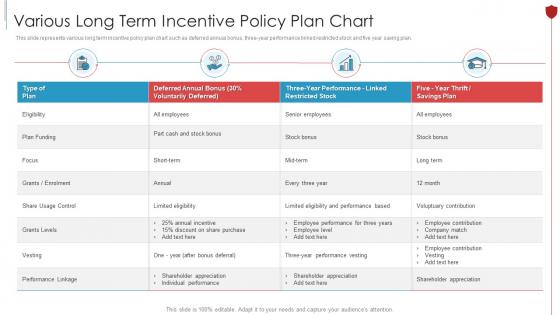
This slide represents various long term incentive policy plan chart such as deferred annual bonus, three year performance linked restricted stock and five year saving plan.
People who downloaded this PowerPoint presentation also viewed the following :
Various Long Term Incentive Policy Plan Chart with all 6 slides:
Use our Various Long Term Incentive Policy Plan Chart to effectively help you save your valuable time. They are readymade to fit into any presentation structure.





FAQs for Various Long Term Incentive
Honestly, start by asking your team what they'd actually want as rewards - you'd be surprised how off-base most companies get this. Set goals that are clear and measurable, but don't make them impossible to hit or people will just give up. Mix individual stuff with team incentives so nobody's backstabbing each other for commission. Regular check-ins are huge - don't just disappear until review time. Oh, and pay out quarterly if you can swing it. A year is forever when you're grinding toward a goal. Make sure everything's transparent about how performance gets tracked too.
Honestly, incentive plans can totally make or break your team's motivation. Bonuses are solid for hitting quick targets, but they backfire when people feel like you're just waving money around constantly. Recognition programs and flexible schedules? Way better for keeping people engaged long-term. Career development stuff too - though that obviously takes more planning. The trick is figuring out what your specific team actually wants. Some are all about the cash. Others care more about growth or work-life balance. I'd probably just ask them straight up in a survey or something, then build from there.
Track the obvious stuff first - did sales actually go up? Are people more productive? But here's the thing, those numbers don't tell you if your program's gonna crash and burn later. Check participation rates and whether people actually like it, because what's the point if everyone's miserable? I'd survey people every few months and compare turnover from before you started. Oh, and don't go crazy tracking 20 different things. Pick maybe 3-4 metrics that matter most. Short-term wins mean nothing if you're burning people out.
Just be super upfront about everything from day one. Write down exactly how you'll measure performance, when bonuses kick in, who qualifies - all that stuff. Then actually share it with everyone, don't keep it some big secret. I swear, half the companies I've worked with just make it up as they go and then act shocked when people are pissed. Keep your team posted on how things are tracking too. If you change anything, explain it beforehand. Oh and definitely get employees involved in creating the plan - they'll catch problems you'd never think of. Honestly, if your team can't easily explain how it works, you've overcomplicated it.
Dude, culture and incentives have to match or you're screwed. People will either totally ignore what you're pushing or find sneaky ways around it that backfire. Say you reward individual wins but everyone's used to working as a team - that's just asking for weird drama. I learned this the hard way at my last place. You've got to reward what people already do naturally, not some ideal version of your company. Otherwise they'll just go through the motions. Check if your current setup actually fits how your team operates day-to-day.
Honestly, just match the incentives to what actually makes each team tick. Sales loves commission obviously, but engineers? Maybe project bonuses or time for passion projects work better. Ask them directly what they want - I know it sounds too simple but most managers skip this step. Your finance people might want training budgets while creatives probably prefer flexible time off. Map out what success looks like for each role first. Then build rewards around those specific goals. HR tied to retention, customer service to satisfaction scores, etc. Don't overthink it.
Oh man, bad incentive plans are such a nightmare! People start gaming the system instead of doing good work. You'll see employees hit their numbers but completely trash quality or customer service - it's wild how tunnel-visioned they get. Team dynamics fall apart too because everyone's competing instead of collaborating. And honestly? Nothing kills motivation faster than unrealistic goals paired with crappy rewards. I've watched this trainwreck happen multiple times at different companies. Test your metrics with a small group first. Also make sure whatever you're measuring actually matches what you want people to accomplish.
I'd say check quarterly if you can manage it - annually feels too slow these days. Things change so fast now, and what got your team pumped last year might be totally meh by now. Markets are weird like that. Don't wait until people start jumping ship to realize your incentives aren't working. Set up some quick pulse surveys every few months to see what actually motivates them. Then adjust based on what you hear. Business pivots, new competition, different workforce - all that stuff matters. Being proactive beats scrambling to fix retention problems later.
So there's cash bonuses tied to hitting certain goals, profit-sharing, stock options - the usual stuff. Sales people obviously get commissions. But honestly? The non-money perks are where it's at right now. Extra vacation days, working from home, paying for courses or conferences. I've seen people turn down higher salaries for better flexibility. Most companies throw together a mix depending on what level you're at. The trick is actually knowing what each person on your team cares about - some want cash, others just want to leave early on Fridays, you know?
You'll want to mix short-term and long-term rewards - quarterly bonuses for hitting numbers, but also equity that vests over 3-5 years. The key is making sure your quick wins actually support bigger goals. Don't reward pure sales volume if it kills customer loyalty later (learned that one the hard way). Map out what behaviors you want at different time frames first. Short sprints are great, but you need that marathon vision too. Oh, and make sure the metrics actually make sense together - I've seen companies where the quarterly goals totally contradicted their annual strategy.
Start with compliance stuff - labor laws, tax regs, overtime rules. That's the boring but crucial foundation. Your criteria have to be objective too, can't accidentally discriminate against anyone. The ethics thing is where it gets messy though. Quotas can make people do sketchy things when they're desperate to hit numbers. Build in some guardrails so you're not pushing folks toward shortcuts or bending rules. Oh, and definitely loop in legal and HR before you launch this. They'll catch stuff you missed.
Honestly, tech is a total game-changer for incentive programs. No more spreadsheet hell - you can automate all those calculations and get real-time tracking. Your team sees exactly where they stand 24/7, which is way more motivating than waiting around for updates. The analytics are pretty sweet too - you'll actually know what's working. I'd look into incentive management software that plays nice with whatever systems you're already using. Seriously saves so much time and headache. Plus your programs just work better when everything's automated and transparent like that.
Netflix does unlimited PTO plus stock options tied to performance - pretty solid combo. HubSpot has this thing called "GSD Reviews" where people literally set their own quarterly goals, which is kinda genius. Salesforce uses their V2MOM framework with spot bonuses when you crush targets. Google's famous 20% time gave us Gmail, but let's be real - most places would never trust employees with that much freedom. Best approach? Mix individual wins with team success, throw in learning budgets or sabbaticals. Honestly just ask your team what motivates them beyond money first.
Oh man, you definitely can't just copy-paste your US incentive plan everywhere - learned that one the hard way! Different cultures want totally different things. Like in Asia, team rewards work way better than singling people out individually. Some places expect more guaranteed salary vs. commission-heavy structures too. Honestly, your best bet is working closely with local HR folks who actually get what motivates people in their market. What works in Denver might completely flop in Tokyo, you know?
You really gotta ask your people what they actually want. Survey them, do focus groups, whatever - just don't guess because you'll probably get it wrong. I learned this the hard way at my last job where management thought pizza parties were motivating (spoiler: they weren't). Regular pulse surveys work great for checking if your rewards feel fair and if goals are realistic. Even casual one-on-ones can reveal tons about what's broken. The feedback lets you fix reward structures before people get frustrated and check out. Seriously, start collecting this stuff now if you haven't already.
-
I have been using SlideTeam for the past six months. Very happy and satisfied!
-
It saves your time and decrease your efforts in half.