


Vendor Risk Assessment Matrix Powerpoint PPT Template Bundles





Try Before you Buy Download Free Sample Product
 Impress Your
Audience
 100%
Editable
 Save Hours
of Time


Our Vendor Risk Assessment Matrix Powerpoint PPT Template Bundles are topically designed to provide an attractive backdrop to any subject. Use them to look like a presentation pro.
People who downloaded this PowerPoint presentation also viewed the following :
Vendor Risk Assessment Matrix Powerpoint PPT Template Bundles with all 17 slides:
Use our Vendor Risk Assessment Matrix Powerpoint PPT Template Bundles to effectively help you save your valuable time. They are readymade to fit into any presentation structure.

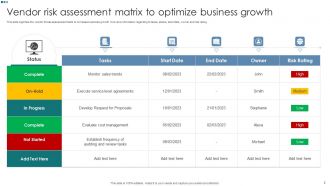
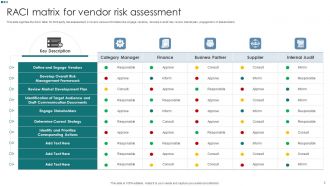
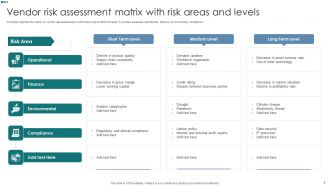

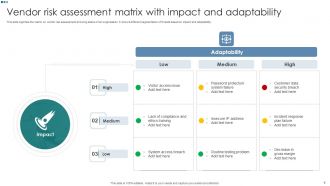
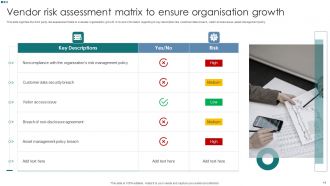






FAQs for Vendor Risk Assessment Matrix Powerpoint
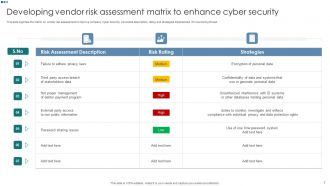
The primary purpose of a Vendor Risk Assessment Matrix is to systematically evaluate and categorize suppliers based on their potential impact on business operations, financial stability, compliance adherence, and operational reliability. This strategic tool enables organizations to prioritize vendor relationships, allocate resources effectively, and implement targeted mitigation strategies, ultimately delivering enhanced supply chain resilience and competitive advantage.
Organizations effectively categorize vendors by evaluating multiple risk factors including financial stability, data access levels, regulatory compliance requirements, business criticality, and operational dependencies. This comprehensive assessment enables strategic resource allocation, with high-risk vendors like payment processors or cloud providers receiving enhanced due diligence, while low-risk suppliers get streamlined oversight, ultimately delivering cost-effective risk management.
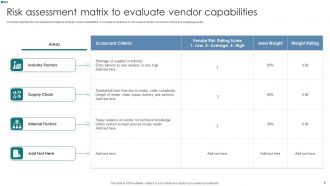
A Vendor Risk Assessment Matrix should include financial stability, data security protocols, regulatory compliance history, operational resilience, and service level guarantees. These criteria enable organizations to evaluate potential vulnerabilities across critical business functions, with many companies finding that comprehensive assessments streamline vendor selection while minimizing supply chain disruptions and regulatory exposure.
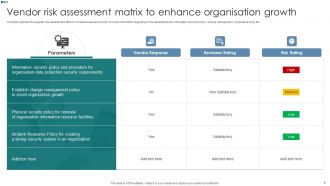
A Vendor Risk Assessment Matrix helps regulatory compliance by systematically documenting risk evaluations, establishing consistent assessment criteria, and creating audit trails that demonstrate due diligence to regulators. Through standardized risk scoring and monitoring protocols, organizations streamline compliance reporting, identify regulatory gaps more efficiently, and maintain transparent vendor oversight, with many financial institutions and healthcare organizations finding that structured matrices significantly reduce compliance violations and regulatory penalties.
Technology significantly enhances Vendor Risk Assessment Matrix effectiveness by automating data collection, enabling real-time monitoring, providing predictive analytics, and streamlining risk scoring processes. Through AI-powered platforms and integrated dashboards, organizations can continuously track vendor performance, identify emerging threats faster, and make data-driven decisions, with many financial institutions and healthcare systems finding that automated assessments reduce evaluation time while improving accuracy and compliance oversight.
Organizations assess vendor financial stability through the matrix by evaluating credit ratings, debt-to-equity ratios, cash flow patterns, revenue consistency, and profitability trends across standardized risk categories. This systematic approach enables procurement teams to identify financially vulnerable suppliers, negotiate appropriate contract terms, and develop contingency plans, with many companies finding that regular financial assessments significantly reduce supply chain disruptions and protect operational continuity.
Inadequate vendor risk assessments can lead to financial losses, operational disruptions, compliance violations, reputational damage, and security breaches that compromise sensitive data. Organizations across industries, from healthcare to financial services, often face cascading impacts including regulatory penalties, customer churn, and competitive disadvantage, ultimately undermining operational efficiency and long-term business sustainability.
Organizations should review their Vendor Risk Assessment Matrix quarterly for high-risk vendors and annually for medium to low-risk vendors, with immediate updates triggered by significant changes in vendor operations, regulatory requirements, or security incidents. This strategic approach enables companies to maintain current risk profiles, ensure compliance with evolving standards, and proactively address emerging threats, ultimately delivering enhanced vendor oversight and operational resilience.
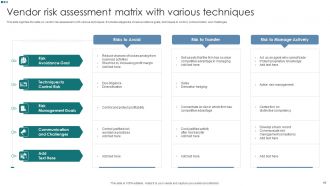
Risk mitigation strategies include implementing enhanced due diligence procedures, establishing continuous monitoring systems, diversifying vendor portfolios, requiring additional insurance coverage, and creating detailed contingency plans. These approaches work by strengthening contractual safeguards, improving oversight mechanisms, and reducing single points of failure, with many organizations finding that proactive risk management ultimately delivers greater operational resilience and competitive advantage.
A Vendor Risk Assessment Matrix assists in disaster recovery planning by identifying critical vendor dependencies, evaluating potential disruption impacts, and prioritizing recovery sequences based on business criticality. Through systematic risk categorization, organizations can develop targeted contingency plans, establish alternative supplier relationships, and create communication protocols, with many enterprises finding that this structured approach significantly reduces recovery time and maintains operational continuity during crisis situations.
Key metrics include financial stability ratios, compliance audit scores, service level agreement adherence, security incident frequency, and business continuity test results. These performance indicators enable organizations to track vendor reliability, identify emerging risks, and make data-driven decisions about contract renewals, with many enterprises finding that regular monitoring significantly reduces supply chain disruptions and enhances operational resilience.
Collaboration and communication improve vendor risk assessments by ensuring comprehensive risk identification, facilitating real-time information sharing, and enabling coordinated response strategies across departments. Through cross-functional teams involving procurement, IT, compliance, and operations, organizations streamline evaluation processes, reduce assessment blind spots, and ultimately deliver more accurate risk profiles, with many finding that enhanced stakeholder alignment significantly accelerates vendor onboarding timelines.
A Vendor Risk Assessment Matrix supports data security initiatives by standardizing risk evaluation criteria, mapping vendor access levels to sensitive information, establishing security control requirements, monitoring compliance protocols, and identifying potential vulnerabilities across third-party relationships. Through systematic assessment frameworks, organizations streamline security oversight, enhance breach prevention capabilities, and ensure regulatory compliance, while enabling faster incident response and ultimately delivering stronger data protection across their entire vendor ecosystem.
Best practices for training employees on Vendor Risk Assessment tools include establishing role-based curricula, conducting hands-on workshops with real scenarios, creating standardized documentation, implementing mentorship programs, and scheduling regular refresher sessions. Organizations across industries like healthcare and financial services find that combining theoretical knowledge with practical exercises, ongoing support systems, and periodic competency assessments ultimately enhances risk identification accuracy and streamlines vendor evaluation processes.
Organizations determine assessment depth by evaluating vendor risk factors including data access levels, business criticality, regulatory requirements, financial impact, and operational dependencies. High-risk vendors like cloud providers, financial processors, or those handling sensitive data require comprehensive due diligence, while low-impact suppliers need basic evaluations, ultimately enabling efficient resource allocation and strategic risk management.
-
Eye-catching PPT designs, outstanding team, and best customer service. I’m a super satisfied customer here!
-
I was confident and well prepared for my presentation for the first time ever. With SlideTeam’s templates, I could deliver one of my best presentations. Will be coming back for more!