

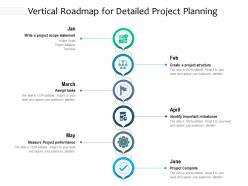
Vertical roadmap for detailed project planning





Try Before you Buy Download Free Sample Product
 Impress Your
Audience
 100%
Editable
 Save Hours
of Time


Outline milestones, processes, and goals with this Vertical Roadmap For Detailed Project Planning slideshow. Showcase the details that should be included in project planning by incorporating the project development roadmap PPT theme. This project management plan PPT layout will help you to identify your project goals and categorize tasks. Highlight the effective steps to create a project timeline with the help of a visually appealing PPT slideshow. You can mention various ways to present a project plan by utilizing a PowerPoint template. Take advantage of a content-ready project planning roadmap PPT infographic to depict the timeline of monthly project milestones. With the aid of a professionally designed PPT layout, you can easily break down your projects into smaller tasks with staggered deadlines. You can include specific dates for tasks to complete within each month by taking the advantage of a ready-to-use PowerPoint visual. Plan a project from start to finish by downloading our modern design PPT presentation.
People who downloaded this PowerPoint presentation also viewed the following :
Vertical roadmap for detailed project planning with all 2 slides:
Use our Vertical Roadmap For Detailed Project Planning to effectively help you save your valuable time. They are readymade to fit into any presentation structure.
FAQs for Vertical roadmap for
The key phases of a project planning roadmap include initiation, planning, execution, monitoring, and closure, each building systematically toward project success. These phases streamline resource allocation, timeline management, and stakeholder coordination by establishing clear milestones, defining deliverables, and enabling proactive risk management, with many organizations finding that structured roadmaps enhance project visibility and ultimately deliver faster completion times.
Effective project objectives are defined by establishing specific, measurable outcomes aligned with business goals, identifying key stakeholders and their requirements, and setting realistic timelines with clear deliverables. This strategic approach enables organizations to maintain focus throughout execution, allocate resources efficiently, and track progress meaningfully, with many project teams finding that well-defined objectives significantly reduce scope creep and enhance overall success rates.
Stakeholder analysis identifies key individuals, groups, and organizations affected by the project, assessing their influence, interests, expectations, and potential impact on project success. This strategic process enables project managers to develop targeted communication strategies, manage expectations effectively, and secure necessary buy-in, ultimately reducing risks and enhancing project outcomes through proactive relationship management.
Timeline estimation influences project success by enabling accurate resource allocation, budget planning, and stakeholder expectation management, while identifying potential bottlenecks early. Organizations across industries, from software development to construction, find that realistic timelines streamline coordination, minimize costly delays, and enhance client satisfaction, ultimately delivering competitive advantage through predictable project outcomes.
Tools for visualizing project planning roadmaps include Gantt charts, timeline diagrams, milestone maps, Kanban boards, and interactive dashboards. These visual frameworks streamline project communication by displaying dependencies, deadlines, and progress tracking, with many organizations finding that visual roadmaps enhance stakeholder alignment, accelerate decision-making, and ultimately deliver better project outcomes across teams.
Risk management integrates into project planning roadmaps through early identification, continuous monitoring, and mitigation planning at each phase milestone. Organizations embed risk assessment matrices, contingency protocols, and stakeholder communication channels directly into their roadmap timelines, with many finding that proactive risk integration reduces project delays by 30-40% while enhancing overall delivery confidence.
Best practices for resource allocation include conducting thorough skills assessments, implementing capacity planning frameworks, establishing clear priority matrices, utilizing resource leveling techniques, and maintaining flexible buffer allocations. These approaches streamline project delivery by matching capabilities to requirements, preventing bottlenecks, and optimizing utilization rates, with many organizations finding that strategic resource management reduces costs while accelerating timelines.
Project milestones are determined by identifying critical deliverables, key decision points, major phase completions, stakeholder review requirements, and resource allocation checkpoints throughout the project lifecycle. These strategic markers enable project managers to track progress, manage dependencies, and maintain stakeholder alignment, with many organizations finding that well-defined milestones significantly enhance project visibility and successful delivery outcomes.
Task prioritization methods include MoSCoW (Must/Should/Could/Won't), Eisenhower Matrix for urgency assessment, value-based scoring, critical path analysis, and resource dependency mapping. These approaches streamline project execution by identifying bottlenecks, optimizing resource allocation, and ensuring strategic deliverables receive focus first, with many project managers finding that combining multiple methods ultimately delivers faster milestone completion and enhanced stakeholder satisfaction.
Communication strategies in a project planning roadmap include stakeholder identification matrices, communication frequency schedules, reporting hierarchies, feedback mechanisms, and escalation protocols. These frameworks streamline information flow by establishing clear channels, defining roles and responsibilities, and setting expectations for updates, with many project teams finding that structured communication reduces delays, enhances collaboration, and ultimately delivers improved project outcomes.
**INPUT**: What metrics should be tracked to assess project progress? **OUTPUT**: Essential project progress metrics include schedule adherence, budget variance, milestone completion rates, resource utilization, and quality indicators like defect rates or deliverable acceptance. These metrics enable project managers to identify bottlenecks early, optimize resource allocation, and maintain stakeholder confidence, with many organizations finding that consistent tracking ultimately delivers improved project success rates and enhanced operational efficiency.
Budgeting integrates into project planning by establishing financial parameters, aligning resource allocation with deliverables, and creating cost controls throughout project phases. Through detailed budget frameworks, organizations can monitor expenditures, prevent scope creep, and ensure strategic resource distribution, with many project managers finding that early budget integration ultimately delivers better financial outcomes and stakeholder confidence.
Roadmap adaptation strategies include regular milestone reviews, flexible timeline adjustments, stakeholder feedback integration, risk assessment updates, and resource reallocation protocols. These approaches enable organizations to maintain project momentum while accommodating market shifts, budget changes, and evolving requirements, with many finding that quarterly reassessments deliver enhanced responsiveness and ultimately stronger project outcomes.
Team alignment with project roadmap goals is ensured through regular communication touchpoints, clearly defined role responsibilities, transparent progress tracking mechanisms, and consistent milestone reviews. Organizations increasingly find that combining collaborative planning sessions with real-time dashboard updates and structured feedback loops delivers enhanced accountability, minimized miscommunication, and ultimately stronger project outcomes across diverse teams.
Agile roadmaps emphasize flexibility, iterative development, and continuous adaptation through short sprints, while traditional roadmaps follow sequential phases with fixed timelines and detailed upfront planning. Agile approaches enable faster responses to market changes and stakeholder feedback, particularly benefiting software development and product innovation teams, whereas traditional methods work well for construction and manufacturing projects requiring predictable, linear execution.
No Reviews