

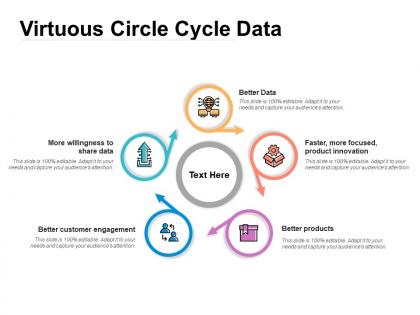
Virtuous circle cycle data




Try Before you Buy Download Free Sample Product
 Impress Your
 Audience
 100%
100% Editable
 Save Hours
 of Time


Fashion a connection with your audience. Let our Virtuous Circle Cycle Data dress up your thoughts.
People who downloaded this PowerPoint presentation also viewed the following :
Virtuous circle cycle data with all 2 slides:
Build a connect with our Virtuous Circle Cycle Data. They will be good conduits for your thoughts.
FAQs for Virtuous
Key metrics for measuring sustainability in data-driven initiatives include energy consumption per data processing unit, carbon footprint reduction, resource optimization ratios, waste elimination percentages, and renewable energy adoption rates. These metrics enable organizations to track environmental impact while delivering operational efficiency, with many companies in manufacturing, retail, and financial services finding that sustainable data practices ultimately reduce costs and enhance competitive advantage.
Businesses can utilize data analytics to enhance sustainability practices by monitoring energy consumption patterns, tracking waste generation metrics, optimizing supply chain efficiency, and measuring carbon footprint across operations. Through predictive analytics and real-time monitoring systems, organizations streamline resource allocation, reduce operational costs, and identify improvement opportunities, with many finding that data-driven approaches deliver both environmental benefits and competitive advantage.
Organizations face challenges including data quality inconsistencies, integration complexities across multiple systems, measurement standardization difficulties, and resource allocation constraints when implementing data-driven sustainability strategies. These obstacles often require significant upfront investment and technical expertise, though many companies find that strategic partnerships with technology providers and phased implementation approaches ultimately deliver enhanced operational efficiency, regulatory compliance, and competitive advantage in increasingly environmentally-conscious markets.
Big data enhances sustainability reporting accuracy by integrating real-time environmental metrics, supply chain emissions data, and operational performance indicators across multiple touchpoints. Through advanced analytics platforms, organizations can automatically track carbon footprints, resource consumption, and waste generation with granular precision, ultimately delivering transparent compliance reporting and enabling data-backed sustainability strategies that drive competitive advantage.
Artificial intelligence enhances data-driven sustainability through predictive analytics, automated resource optimization, real-time environmental monitoring, pattern recognition in consumption data, and intelligent forecasting systems. These AI capabilities enable organizations to minimize waste, reduce energy consumption, and optimize supply chains more effectively, with companies in manufacturing and retail finding that AI-driven insights deliver significant cost reductions while advancing environmental goals.
Lifecycle assessment data informs sustainable product design by revealing environmental impacts across materials, manufacturing, usage, and disposal phases, enabling designers to identify optimization opportunities. Through comprehensive LCA insights, companies like Patagonia and Interface strategically select eco-friendly materials, reduce energy consumption, and minimize waste generation, ultimately delivering products with lower carbon footprints and enhanced market competitiveness.
IoT devices serve as critical data collection points for sustainable operations, monitoring energy consumption, water usage, waste generation, equipment efficiency, and environmental conditions in real-time. Through smart sensors and connected systems, organizations across manufacturing, retail, and logistics streamline resource optimization, reduce operational costs, and enhance environmental compliance, ultimately delivering measurable sustainability improvements and competitive advantage.
Companies can balance data privacy with sustainability transparency by implementing data anonymization techniques, aggregating information at organizational rather than individual levels, and using privacy-preserving technologies like differential privacy. Through strategic data governance frameworks, organizations in manufacturing, retail, and financial services streamline reporting while protecting sensitive information, ultimately delivering credible sustainability metrics and maintaining stakeholder trust in an increasingly regulated environment.
Effective data visualization techniques for sustainability include heat maps for energy consumption patterns, trend lines for emissions tracking, geographic mapping for environmental impact zones, dashboard scorecards for KPI monitoring, and comparative bar charts for benchmarking progress. These visualizations streamline complex environmental data into actionable insights, enabling organizations to identify inefficiencies, communicate progress to stakeholders, and make strategic decisions that enhance operational sustainability while delivering measurable cost reductions.
Social media data informs community-driven sustainability initiatives by revealing local environmental concerns, tracking engagement patterns, identifying influential advocates, measuring campaign effectiveness, and pinpointing geographic hotspots for action. Through sentiment analysis and hashtag tracking, communities can tailor messaging strategies, mobilize neighborhood participation, and demonstrate measurable impact to stakeholders, ultimately building stronger grassroots movements with data-backed credibility.
Open data initiatives enhance collaborative sustainability efforts by providing transparent environmental metrics, standardized reporting frameworks, and shared research datasets across industries. Through accessible platforms, organizations in manufacturing, energy, and transportation can benchmark performance, identify best practices, and coordinate resource-efficient solutions, ultimately delivering faster innovation and scalable environmental impact reduction.
Data-driven decision-making accelerates renewable energy adoption by optimizing site selection, predicting energy output, reducing operational costs, and demonstrating clear ROI projections. Through advanced analytics and IoT sensors, organizations can identify optimal wind and solar locations, forecast maintenance needs, and streamline grid integration, ultimately delivering faster deployment timelines and enhanced competitive positioning in sustainable energy markets.
Predictive analytics enhances waste management by forecasting generation patterns, optimizing collection routes, predicting equipment maintenance needs, and identifying contamination risks in recycling streams. Through machine learning algorithms, municipalities and corporations streamline operations, reduce fuel costs, improve recycling quality rates, and minimize landfill overflow, ultimately delivering significant environmental impact while reducing operational expenses.
Best practices for integrating sustainability metrics into corporate KPIs include establishing baseline measurements, aligning environmental goals with business objectives, implementing real-time monitoring systems, creating cross-departmental accountability frameworks, and setting science-based targets. These approaches streamline reporting by connecting sustainability data directly to operational performance, with many organizations finding that integrated metrics enhance stakeholder confidence while delivering competitive advantages in increasingly ESG-focused markets.
Consumer behavior analytics influence sustainable product development by revealing purchasing patterns, preference shifts toward eco-friendly options, and price sensitivity for green alternatives. Through data analysis, companies identify which sustainable features resonate most with target audiences, optimize product positioning and messaging, and predict market demand for environmentally conscious innovations, ultimately enabling more strategic resource allocation and faster development of products that deliver both environmental benefits and commercial success.
No Reviews