

Virtuous cycle of invention




Try Before you Buy Download Free Sample Product
 Impress Your
 Audience
 100%
100% Editable
 Save Hours
 of Time


Help to produce favorable outcomes by employing this Virtuous Cycle Of Invention slide. Explain a situation in which a complex chain of events generates desired results. You can describe the process of creating, developing and communicating, concrete or visual ideas. Analyze each process of the innovation cycle like idea source, idea focus, Idea outcome in this effective PowerPoint layout. Solve problems and come up with unique solutions by utilizing this creativity PPT visual. Elucidate the thinking process and understand how ideas develop and create shape by employing this Imagination PowerPoint graphic. Convey the information on entrepreneurship skills that teach to go beyond by simply sharing the work and bring an idea to completion. Give an idea of how entrepreneurship brings unique ideas to the system with this innovative idea PPT layout. Thus address the opportunities and challenges by downloading this ready to use invention cycle PowerPoint presentation.
People who downloaded this PowerPoint presentation also viewed the following :
Content of this Powerpoint Presentation
Description:
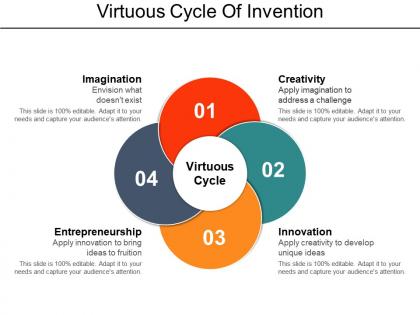
The image depicts a PowerPoint slide titled "Virtuous Cycle Of Invention," which outlines a four-step iterative process that encourages continuous improvement and innovation.
1. Creativity:
This element is marked with the number '01' and is colored red. It involves applying imagination to address a challenge. The text emphasizes that the process starts with a creative approach to problems or tasks.
2. Innovation:
Marked as '02' and colored teal, this section highlights the importance of applying creativity to develop unique ideas. Innovation is the practical implementation of the creative thoughts that were sparked in the first step.
3. Entrepreneurship:
Number '03,' colored dark blue, this stage is about putting innovation into practice by applying it to bring ideas to fruition and launching novel products, services, or processes into the market.
4. Imagination:
Finally, '04' is colored gray and cycles back to the importance of envisioning what doesn't exist. This stage suggests returning to the conceptual phase to imagine new possibilities, fostering a continuous loop of innovation.
Use Cases:
This model is versatile and can be applied in various industries where innovation, creativity, and entrepreneurship are essential for growth and development:
1. Technology:
Use: Encouraging a culture of continuous technological advancement and innovation.
Presenter: Innovation Manager or Chief Technology Officer (CTO).
Audience: Product Development Team, Technical Staff.
2. Education:
Use: Promoting innovation in educational methods, curriculum development, and the learning experience.
Presenter: Educational Consultant or Academic Leader.
Audience: School Administrators, Teachers, Educational Staff.
3. Healthcare:
Use: Facilitating the development of innovative medical treatments, healthcare solutions, and patient care.
Presenter: Healthcare Innovator, Medical Researcher.
Audience: Medical Professionals, Health Administrators, Researchers.
4. Manufacturing:
Use: Improving manufacturing processes and product innovation.
Presenter: Process Engineer, Operations Manager.
Audience: Factory Managers, Production Teams, Quality Control.
5. Financial Services:
Use: Creating and implementing innovative financial products and services.
Presenter: Financial Product Developer, Chief Financial Officer (CFO).
Audience: Bank Executives, Financial Advisors, Investment Teams.
6. Marketing and Advertising:
Use: Enhancing creativity and innovation in marketing campaigns and strategies.
Presenter: Creative Director, Marketing Strategist.
Audience: Marketing Team, Advertising Professionals.
7. Startup Ecosystems:
Use: Guiding startups through the stages of concept development, innovation, and market launch.
Presenter: Startup Mentor, Entrepreneurship Coach.
Audience: Entrepreneurs, Startup Founders, Business Incubator Programs.
Virtuous cycle of invention with all 5 slides:
Become a big gun with our Virtuous Cycle Of Invention. Convince everyone you have good calibre.



FAQs for Virtuous
Innovation drives competitive advantage by enabling businesses to differentiate products, streamline operations, reduce costs, and respond faster to market changes. Companies that consistently innovate, particularly in sectors like technology, healthcare, and retail, create sustainable market positions while enhancing customer experiences, ultimately delivering improved profitability and long-term growth opportunities.
Organizations foster innovation culture through open communication channels, dedicated innovation time, cross-functional collaboration, risk tolerance policies, and recognition programs that celebrate creative thinking. These approaches streamline idea generation by encouraging experimentation, breaking down silos, and rewarding calculated risks, with many companies finding that empowered employees ultimately deliver breakthrough solutions and sustained competitive advantage.
Effective strategies for measuring innovation impact include tracking revenue from new products, monitoring time-to-market improvements, analyzing patent portfolios, measuring employee engagement in innovation programs, and assessing customer satisfaction with new offerings. These metrics enable organizations to quantify innovation ROI across departments, with many companies finding that combining financial indicators with operational benchmarks ultimately delivers clearer strategic insights and competitive advantage.
Technology accelerates innovation by enabling rapid prototyping, facilitating global collaboration, and providing advanced analytical tools for research and development. Through artificial intelligence, cloud computing, and digital platforms, organizations streamline product development cycles, enhance cross-functional teamwork, and leverage data-driven insights, ultimately delivering faster time-to-market and more sophisticated solutions in increasingly competitive landscapes.
Key barriers to innovation include limited resources, resistance to change, lack of leadership support, rigid organizational structures, and fear of failure. These challenges can be overcome by fostering a culture of experimentation, providing dedicated innovation budgets, encouraging cross-functional collaboration, and implementing structured processes that allow for calculated risk-taking, ultimately delivering competitive advantage and sustainable growth.
Innovation can be aligned with sustainability goals through circular economy initiatives, renewable energy adoption, waste reduction technologies, sustainable supply chain optimization, and green product development. These strategic combinations enable corporations to reduce operational costs, meet regulatory requirements, and capture emerging market opportunities, while many organizations finding that sustainable innovation ultimately delivers competitive advantage and enhanced brand value in an increasingly environmentally-conscious marketplace.
Netflix revolutionizing entertainment through streaming, Uber transforming transportation with ride-sharing technology, and Amazon reshaping retail via e-commerce platforms represent classic disruptive innovations. These companies fundamentally altered traditional business models by leveraging digital technologies, creating new customer experiences, and ultimately forcing entire industries to adapt or risk obsolescence.
User feedback enhances innovation processes by identifying unmet needs, revealing pain points, validating concepts early, and guiding iterative development cycles. Organizations across sectors like healthcare, retail, and financial services increasingly integrate customer insights into their R&D frameworks, ultimately delivering more market-relevant solutions while reducing development costs and accelerating time-to-market.
Cross-departmental collaboration accelerates innovation by combining diverse expertise, breaking down silos, and enabling faster problem-solving and resource sharing. Through integrated teams, organizations streamline product development cycles, enhance creative solutions, and reduce time-to-market, with many companies finding that collaborative approaches deliver significantly higher innovation success rates and competitive advantage.
Small businesses can effectively innovate through strategic partnerships, leveraging free digital tools, implementing customer feedback loops, and focusing on process improvements rather than expensive R&D. By collaborating with local universities, utilizing cloud-based platforms, and adopting lean methodologies, these organizations streamline operations while developing creative solutions, ultimately delivering competitive advantages without significant capital investment.
Innovation trends shaping the future of work include artificial intelligence automation, hybrid workplace technologies, continuous learning platforms, collaborative digital tools, and data-driven performance analytics. These advancements streamline operations by reducing repetitive tasks, enhancing remote collaboration, and enabling real-time decision-making, with many organizations finding that strategic technology adoption ultimately delivers greater workforce agility and competitive advantage.
Intellectual property protection is crucial for innovation as it safeguards creators' investments, encourages continued research and development, and provides competitive advantages through patents, trademarks, and copyrights. These protections enable companies across sectors like pharmaceuticals, technology, and manufacturing to secure market positioning while fostering innovation ecosystems that ultimately deliver sustainable growth and strategic value.
Open innovation is significant because it enables organizations to leverage external expertise, accelerate development cycles, and reduce R&D costs through strategic partnerships and collaborative ecosystems. This approach allows companies to access diverse talent pools, emerging technologies, and market insights beyond internal capabilities, with many enterprises finding that collaborative innovation delivers faster time-to-market and sustainable competitive advantages.
Innovation labs and incubators support startups by providing mentorship, funding access, technical resources, networking opportunities, and structured development programs. Through expert guidance and collaborative environments, startups can accelerate product development, refine business models, and scale operations more efficiently, with many finding that incubator support significantly enhances their market readiness and competitive positioning.
Customers play a pivotal role in innovative product development through direct feedback, usage data analysis, co-creation initiatives, and market validation testing. Their insights guide feature prioritization, user experience design, and functionality improvements, with companies like Apple, Tesla, and Amazon leveraging customer communities to refine products, ultimately delivering solutions that enhance market adoption and competitive positioning.
-
Wonderful templates design to use in business meetings.
-
Amazing product with appealing content and design.