


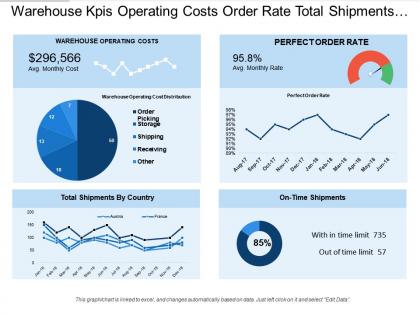
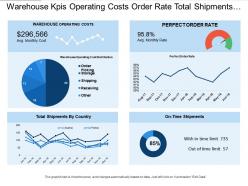
Warehouse kpis operating costs order rate total shipments country




Try Before you Buy Download Free Sample Product
 Impress Your
 Audience
 100%
100% Editable
 Save Hours
 of Time


Our Warehouse Kpis Operating Costs Order Rate Total Shipments Country are designed to enhance convenience. Easy to access and employ.
People who downloaded this PowerPoint presentation also viewed the following :
Warehouse kpis operating costs order rate total shipments country with all 5 slides:
Indicate flaws in the findings with our Warehouse Kpis Operating Costs Order Rate Total Shipments Country. Disprove invalid conclusions.


FAQs for Warehouse kpis operating costs order rate
Definitely focus on inventory accuracy, order fulfillment time, and picking accuracy first. Labor productivity stuff like picks per hour is solid too. Warehouse capacity utilization matters, but honestly that's more of a longer-term thing. Don't go nuts trying to track everything right away - I made that mistake and it was overwhelming. Pick 3-4 metrics that actually match whatever's driving you crazy right now. Weekly dashboards work way better than monthly ones since you can catch problems faster. Oh, and make sure your team gets what these numbers actually mean for their day-to-day stuff, otherwise they'll just ignore them.
Take your cost of goods sold and divide it by average inventory - so $500K COGS ÷ $100K average inventory = 5x turnover. I'd go with quarterly calculations over monthly ones since the monthly numbers get pretty messy with seasonal stuff. Oh, and make sure you're using average inventory (add beginning + ending, then divide by 2) instead of just the final number. That's where people mess up sometimes. Quarterly gives you cleaner data anyway. Don't stress about one bad month - focus on whether the trend's heading up or down over time.
Order accuracy is huge for warehouse performance - it affects everything downstream. Hit 99%+ consistently and you'll dodge expensive returns while keeping customers happy. Your team won't waste hours fixing screw-ups either. I've watched places get obsessed with speed while accuracy goes to hell, which makes zero sense honestly. Bad accuracy crushes your efficiency numbers and jacks up labor costs when people have to redo work. Track it by picker, shift, and product type. That way you can catch patterns and figure out where coaching is actually needed.
So basically you're timing everything from when the order hits your system until it's out the door. Break it down though - order processing, picking, packing, all that stuff. That way you can actually see where things are getting stuck. Your WMS should spit out reports for this (seriously, doing it manually would suck). Once you know your baseline numbers, just fix the slowest part first. Maybe it's your pick routes being weird, or you need more cross-trained people. I'd probably start with layout changes since those usually give you the biggest bang for your buck. Just don't try to fix everything at once or you won't know what actually worked.
Dude, space utilization matters because warehouse rent is expensive as hell. You're measuring how much of your space actually holds stuff vs sitting empty. Better utilization means you can pack more inventory without expanding - plus pickers don't waste time walking around dead zones. I always tell people to track it monthly and shoot for 80-85%. Go higher and you'll hate yourself during busy seasons when you need room to breathe. Poor utilization is just burning money on unused square footage, honestly.
So for warehouse productivity, most places track units per hour per worker - basically how many items your team picks, packs, or receives divided by total labor hours. Lines per hour works better though, since grabbing 50 tiny screws is way different than hauling 50 engine blocks around. You can break this down by worker, shift, whatever makes sense for your setup. Honestly the trick is just being consistent with whatever metric you pick. Don't get caught up comparing to industry benchmarks right away - focus on your own baseline first. Start simple with one solid measurement before you go crazy adding more stuff.
Dude, shipping mistakes will kill your customer relationships faster than anything else. When someone's order shows up wrong or incomplete, they're done with you - probably forever. I learned this the hard way when I ordered a camera and got sent a phone case instead. Anyway, you really need to hit 99%+ accuracy because even tiny screw-ups create massive headaches. Returns are expensive and annoying for everyone involved. Your pick-and-pack process needs serious attention - maybe double-check those pricey orders? Trust me, preventing mistakes costs way less than fixing them after customers start calling pissed off.
First things first - get your baseline numbers down before buying anything. Track order accuracy, picking speed, inventory turnover, labor productivity per hour. Otherwise you're flying blind on whether that fancy WMS actually helped or just drained your budget (learned this the hard way lol). Error rates and customer satisfaction are huge too - those usually jump when you nail the right tech. Honestly, most people skip the measurement part and wonder why they can't prove ROI. Set up a basic monthly dashboard. Some investments will crush it, others will collect dust.
Yeah definitely track them separately - they're completely different beasts. Inbound stuff is like receiving accuracy, how fast you get from dock to stock, supplier compliance rates. Outbound? Pick accuracy, cycle times, on-time shipping. That's what customers actually care about. Honestly, I wasted so much time trying to make the metrics "match" on both sides when I started. Just set up different dashboards for each. Inbound problems usually mean awkward calls with suppliers that take forever to resolve. Outbound issues though? You gotta fix those yesterday or customers lose their minds.
Yeah, return rates are basically your warehouse's report card. When they spike, it usually means picking errors, quality control issues, or stuff getting banged up during shipping. Your team might be rushing through orders, which honestly happens to everyone during busy periods. Track returns by reason code so you can figure out if it's picking mistakes, crappy packaging, or inventory getting damaged. I'd do weekly reviews of that data - you'll spot patterns way faster and actually fix what's causing the problems instead of just dealing with angry customers all the time.
Track your incident rate first - that's injuries per 100 employees. Near-misses are huge too since they predict actual accidents. Lost time injuries and days away from work are the ones that'll make your boss pay attention fast. Safety training completion rates matter more than people think, honestly. Equipment inspections are another good predictor of future headaches. Oh, and workers' comp costs per employee - that one hits the budget directly. If you're just starting out, focus on incident rate and near-miss tracking. You can always add the fancy leading indicators like audit completion later.
Yeah, seasonal stuff totally messes with warehouse KPIs - it's such a pain! Holiday rushes will tank your picking accuracy while throughput goes crazy, plus storage gets packed way beyond normal. Instead of using annual averages (which are basically useless), set up different benchmark ranges for peak, slow, and shoulder seasons. Compare year-over-year seasonal data rather than month-to-month changes. Look back at your last 2-3 years to spot the patterns. Trust me, once you adjust your targets this way, tracking performance actually makes sense again instead of looking like random chaos.
Dude, first thing - figure out what's actually broken before you start fixing random stuff. Dig into your data and find the real bottleneck. Bad picking accuracy? Could be training issues or your zones are set up weird. Throughput sucks? Layout problems maybe, or people need cross-training. Half the time it's just some ancient process everyone's too lazy to question. Don't try fixing everything at once though - pick one KPI and focus there. Oh, and do weekly check-ins to see if you're actually making progress or just spinning your wheels.
Honestly, KPIs are like a financial health check for your warehouse - they'll show you exactly where money's going down the drain. Track stuff like picking accuracy and inventory turnover to catch expensive mistakes early. Low order accuracy? You're probably hemorrhaging cash on returns and re-ships (been there, it sucks). Labor productivity metrics help you figure out if you're overstaffed or understaffed. Don't go crazy with tracking everything though. Pick maybe 3-5 metrics that hit your biggest problem areas and check them weekly. Focus on what's actually costing you the most money first.
Power BI or Tableau are your best bets - there's a reason everyone uses them. Real-time data feeds work great on both, plus the dashboards actually make sense to warehouse teams (which honestly isn't always a given with these tools). Excel's still totally fine for basic tracking if you don't want to spend the money yet. Once you're dealing with multiple locations or trying to track something like order accuracy over different time periods though, you'll save yourself so much time with the visual stuff. I'd just go with whatever your IT people already know how to support.
-
Perfect template with attractive color combination.
-
Great product with effective design. Helped a lot in our corporate presentations. Easy to edit and stunning visuals.