

Web Development Overview Roadmap To Design And Develop Responsive Website




Try Before you Buy Download Free Sample Product
 Impress Your
Audience
 100%
Editable
 Save Hours
of Time


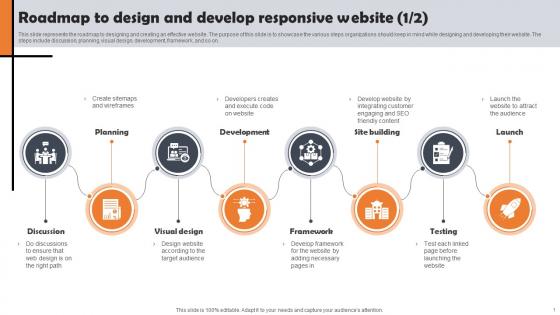
This slide describes the recent trends in the website development industry. This slide aims to highlight the latest trends in the website development market, including real time web applications, single page websites, chatbots and AI, and mobile first design.
People who downloaded this PowerPoint presentation also viewed the following :
Web Development Overview Roadmap To Design And Develop Responsive Website with all 7 slides:
Use our Web Development Overview Roadmap To Design And Develop Responsive Website to effectively help you save your valuable time. They are readymade to fit into any presentation structure.






FAQs for Web Development Overview Roadmap To Design And
Foundational web development skills include HTML/CSS for structure and styling, JavaScript for interactivity, responsive design principles, version control with Git, and basic understanding of frameworks like React or Vue. These competencies enable developers to create dynamic, mobile-optimized websites and collaborate effectively in team environments, with many organizations finding that developers with these core skills deliver faster project turnaround and enhanced user experiences.
HTML provides the structural foundation and content framework, CSS handles visual styling and layout presentation, and JavaScript enables dynamic functionality and user interactions. These three technologies work synergistically in modern development, with HTML defining elements, CSS controlling responsive design and animations, and JavaScript managing real-time updates, ultimately delivering seamless user experiences across devices.
Responsive design ensures websites adapt seamlessly across devices, delivering consistent user experiences on desktops, tablets, and smartphones through flexible layouts, scalable images, and optimized navigation. This approach significantly enhances user engagement while reducing bounce rates, with many e-commerce and service companies finding that responsive sites increase conversions and customer satisfaction.
Frameworks and libraries accelerate web development by providing pre-built components, standardized structures, and reusable code modules that eliminate repetitive programming tasks. These tools streamline development workflows, enhance code maintainability, and enable faster project delivery, with many development teams finding that strategic framework adoption significantly reduces development time while improving application scalability and performance.
Understanding SEO significantly shapes web development strategies by influencing site architecture, page loading speeds, mobile responsiveness, content structure, and technical implementation decisions. Through strategic SEO integration, developers create faster-loading websites, implement clean URL structures, and optimize user experiences, while ensuring search engine visibility, ultimately delivering enhanced organic traffic and competitive digital positioning for businesses across industries.
Best practices for version control in collaborative web projects include using Git with clear branching strategies, writing descriptive commit messages, conducting regular code reviews, maintaining consistent naming conventions, and implementing automated testing before merges. These practices streamline development workflows by minimizing conflicts, enhancing code quality, and enabling seamless collaboration, with many development teams finding that structured version control ultimately delivers faster deployments and reduced project risks.
Advancements in web technologies have revolutionized user experience design by enabling responsive layouts, interactive animations, real-time data processing, and seamless cross-device functionality. Through progressive web apps, AI-powered personalization, and faster loading frameworks, businesses across retail, healthcare, and financial services deliver more intuitive interfaces, reduced bounce rates, and enhanced customer engagement, ultimately driving higher conversion rates.
Common security risks in web development include SQL injection, cross-site scripting (XSS), cross-site request forgery (CSRF), insecure authentication, and data breaches. These vulnerabilities can be mitigated through input validation, parameterized queries, secure coding practices, regular security audits, and implementing HTTPS encryption, with many organizations finding that proactive security measures ultimately reduce operational costs and enhance customer trust.
Progressive Web Apps transform traditional web development by combining native mobile app features with web accessibility, enabling offline functionality, push notifications, device integration, and app-like user experiences. Through service workers and responsive design, organizations across retail, media, and financial services deliver faster loading times, reduced development costs, and enhanced customer engagement, ultimately providing competitive advantage in an increasingly mobile-first landscape.
Developers should consider project requirements, scalability needs, team expertise, development timeline, and long-term maintenance when choosing technologies. Front-end decisions impact user experience and performance, while back-end choices affect data processing, security, and integration capabilities, with many development teams finding that strategic technology alignment ultimately delivers faster deployment, reduced costs, and enhanced system reliability.
Accessibility is critically important in web development, ensuring websites are usable by people with disabilities while expanding market reach and meeting legal requirements. Following WCAG 2.1 guidelines, developers implement semantic HTML, proper contrast ratios, keyboard navigation, and screen reader compatibility, ultimately delivering inclusive user experiences that enhance brand reputation and reduce legal risks.
Current web development trends include responsive design frameworks, progressive web applications, serverless architecture, artificial intelligence integration, and component-based development using React or Vue. These technologies streamline development processes by reducing complexity, accelerating deployment timelines, and enhancing user experiences across devices, with many organizations finding that modern frameworks ultimately deliver faster performance and improved scalability.
Performance optimization techniques improve website load times by compressing images and files, minifying code, leveraging browser caching, optimizing databases, and implementing content delivery networks. These strategies streamline data delivery and resource management, with e-commerce platforms and financial services finding that faster loading enhances user experiences, reduces bounce rates, and ultimately delivers improved conversion rates and competitive advantage.
Web development debugging tools include browser DevTools, IDE debuggers, console logging, network monitors, and performance profilers like Chrome DevTools, Firefox Developer Tools, and Visual Studio Code extensions. These resources streamline error identification by enabling real-time code inspection, breakpoint management, and network analysis, with many developers finding that strategic debugging ultimately accelerates development cycles and enhances application reliability.
No-code and low-code platforms are reshaping web development by democratizing application creation, accelerating development cycles, and enabling citizen developers to build functional solutions without extensive coding knowledge. While these platforms streamline rapid prototyping and basic application development, they also create new opportunities for traditional developers to focus on complex integrations, custom functionality, and enterprise-scale solutions, ultimately expanding rather than replacing the development ecosystem.
-
I have been using SlideTeam for the past six months. Very happy and satisfied!
-
Their templates are super easy to edit and use even for the one like me who is not familiar with PowerPoint. Great customer support.