

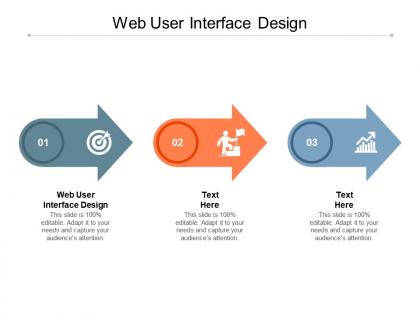
Web user interface design ppt powerpoint presentation styles portfolio cpb




Try Before you Buy Download Free Sample Product
 Impress Your
 Audience
 100%
100% Editable
 Save Hours
 of Time


Our Web User Interface Design Ppt Powerpoint Presentation Styles Portfolio Cpb are explicit and effective. They combine clarity and concise expression.
People who downloaded this PowerPoint presentation also viewed the following :
Web user interface design ppt powerpoint presentation styles portfolio cpb with all 2 slides:
Give your audience a fulfilling experience. They will find our Web User Interface Design Ppt Powerpoint Presentation Styles Portfolio Cpb elevating.
FAQs for Web user interface design ppt powerpoint presentation
Key principles of effective web user interface design include clarity, consistency, intuitive navigation, responsive layouts, and accessibility standards. These principles enhance user experiences by streamlining interactions, reducing cognitive load, and ensuring seamless functionality across devices, with many organizations finding that well-designed interfaces ultimately deliver higher engagement rates and improved conversion outcomes.
Color theory and typography significantly influence user experience by affecting readability, emotional response, navigation clarity, and brand perception across web interfaces. Through strategic color palettes and typographic hierarchies, organizations enhance user engagement, reduce cognitive load, and improve conversion rates, with many e-commerce and financial services platforms finding that thoughtful design choices ultimately deliver better accessibility and competitive advantage.
Accessibility ensures web interfaces are usable by people with disabilities through screen reader compatibility, keyboard navigation, color contrast standards, and alternative text for images. These design principles enhance usability for all users while meeting legal compliance requirements, with many organizations finding that accessible interfaces ultimately deliver broader market reach, improved SEO performance, and enhanced user experiences across diverse audiences.
Responsive design enhances usability by automatically adapting layouts, navigation elements, and content formatting to optimize viewing experiences across smartphones, tablets, and desktops. This approach streamlines user interactions through flexible grids, scalable images, and touch-friendly interfaces, with many e-commerce and service platforms finding that responsive designs significantly reduce bounce rates while increasing customer engagement and conversion rates.
**INPUT**: What are the best practices for navigation in web design to improve user engagement? **OUTPUT**: Best practices for web navigation include clear menu hierarchies, consistent placement, breadcrumb trails, search functionality, and mobile-responsive designs. These approaches streamline user experiences by reducing cognitive load, minimizing click paths, and enhancing site accessibility, with many e-commerce and service organizations finding that intuitive navigation ultimately delivers higher conversion rates and improved customer satisfaction. [Word count: 54]
User feedback informs iterative UI design by identifying usability pain points, revealing user behavior patterns, and highlighting feature gaps through testing sessions, surveys, and analytics data. This continuous feedback loop enables designers to refine navigation structures, optimize conversion funnels, and enhance user experiences, with many organizations finding that user-driven iterations significantly reduce development costs while improving customer satisfaction and engagement rates.
Common web UI design mistakes include cluttered layouts, poor navigation structure, inconsistent visual elements, slow loading times, and inadequate mobile responsiveness. These design flaws significantly impact user experience by creating confusion, frustration, and abandonment, with many e-commerce and service platforms finding that streamlined, intuitive interfaces ultimately deliver higher engagement rates and improved conversion outcomes.
Imagery choice significantly influences user perception by establishing emotional connection, communicating brand values, reinforcing content hierarchy, and guiding user attention throughout the interface. Strategic visual selections enhance credibility and usability, with many e-commerce and corporate websites finding that high-quality, relevant imagery increases user engagement and conversion rates while ultimately delivering stronger brand recognition.
Techniques to improve web interface load times include image optimization, code minification, browser caching, content delivery networks, and lazy loading implementation. These approaches streamline performance by reducing file sizes, minimizing server requests, and delivering content more efficiently, with many e-commerce and media organizations finding that faster interfaces significantly enhance user experiences and conversion rates.
Microinteractions enhance web user experience by providing immediate feedback, guiding user behavior, and creating emotional connections through subtle animations, hover effects, and responsive elements. These small design details streamline navigation, reduce cognitive load, and increase engagement, with many e-commerce and SaaS platforms finding that thoughtful microinteractions significantly improve conversion rates and user satisfaction.
Minimalism in web interface design significantly enhances user experience by reducing cognitive load, improving navigation clarity, and accelerating page loading times. This approach streamlines user interactions while eliminating visual clutter, with many e-commerce and SaaS platforms finding that minimalist designs increase conversion rates, reduce bounce rates, and ultimately deliver better customer engagement and competitive advantage.
Animations enhance usability when they provide clear feedback, guide user attention, and communicate system status through subtle transitions and micro-interactions. Effective animations should be purposeful rather than decorative, with durations under 300ms for micro-interactions, while maintaining accessibility options and ensuring they support task completion rather than creating distractions.
Emerging web UI design trends for 2024 include AI-powered personalization, immersive micro-interactions, sustainable design principles, advanced accessibility features, and seamless voice integration. These approaches streamline user experiences by reducing cognitive load, enhancing engagement, and improving accessibility across diverse audiences, with many organizations finding that strategic UI investments deliver significantly higher conversion rates and customer satisfaction.
User personas significantly shape web interface design by informing layout decisions, navigation structures, content prioritization, visual aesthetics, and interaction patterns based on target user behaviors and preferences. Through persona-driven design, companies create more intuitive user experiences, with e-commerce platforms, healthcare portals, and financial services finding that persona-informed interfaces deliver higher engagement rates and improved user satisfaction.
Key web UI effectiveness metrics include user engagement rates, task completion times, bounce rates, conversion rates, and user satisfaction scores. These metrics enable organizations to streamline user experiences by identifying navigation bottlenecks, optimizing content placement, and enhancing interface responsiveness, with many e-commerce and SaaS companies finding that data-driven UI improvements deliver significantly higher customer retention and revenue growth.
No Reviews