


Website development project timeframe concept design ppt powerpoint presentation example file




Try Before you Buy Download Free Sample Product
 Impress Your
Audience
 100%
Editable
 Save Hours
of Time


Our Website Development Project Timeframe Concept Design Ppt Powerpoint Presentation Example File are explicit and effective. They combine clarity and concise expression.
People who downloaded this PowerPoint presentation also viewed the following :
Content of this Powerpoint Presentation
Description:
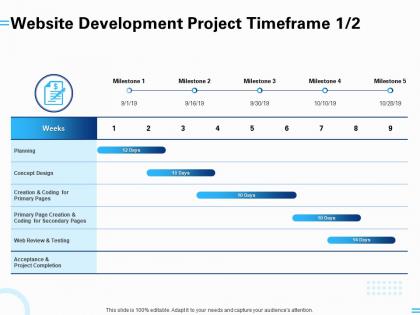
The image exhibits a project timeline for a website development project, laid out in a succinct and visually accessible Gantt chart format. The timeline spans a 9-week period, indicating key milestones along the project's duration, specifically highlighting five distinct milestones. Each milestone is tagged to a date, demonstrating a clear schedule from the start of the project on September 1st, 2019, to its projected completion on October 28th, 2019.
Beneath the milestones, the Gantt chart segments the project into various phases: Planning, Concept Design, Creation & Coding for Primary Pages, Primary Page Creation & Coding for Secondary Pages, Web Review & Testing, and Acceptance & Project Completion. Each of these phases is associated with a different duration, expressed in terms of days (12, 10, 10, 10, and 14 days respectively).
Use Cases:
The format and content of this slide can be advantageous for several industries involving project management and client communication. The specifics for various industries are as follows:
1. Technology:
Use: Laying out a timeline for software development projects.
Presenter: Project Manager
Audience: Development team, stakeholders, or clients
2. Advertising:
Use: Structuring campaign development timelines with clear deliverables.
Presenter: Account Manager
Audience: Creative teams, clients, or stakeholders
3. Construction:
Use: Planning construction phases, from design to completion.
Presenter: Construction Manager
Audience: Contractors, clients, or the planning board
4. Education:
Use: Planning and tracking the rollout of educational programs or curriculum development.
Presenter: Program Director
Audience: Teachers, administrative staff, education board
5. Event Planning:
Use: Organizing the timeline for event planning, from concept to the event day.
Presenter: Event Coordinator
Audience: Clients, vendors, event staff
6. Healthcare:
Use: Managing the timeline for the implementation of new healthcare services or IT systems.
Presenter: Healthcare Administrator
Audience: Medical staff, IT team, administrative bodies
7. Manufacturing:
Use: Scheduling product development or factory upgrade phases.
Presenter: Operations Manager
Audience: Engineers, production teams, company executives
Website development project timeframe concept design ppt powerpoint presentation example file with all 2 slides:
Give your audience a fulfilling experience. They will find our Website Development Project Timeframe Concept Design Ppt Powerpoint Presentation Example File elevating.


FAQs for Website development project timeframe concept design ppt powerpoint
Website development projects include planning and strategy, design and wireframing, development and coding, content creation, testing and quality assurance, and deployment phases. These stages typically span 8-16 weeks total, with planning taking 1-2 weeks, design requiring 2-3 weeks, development consuming 4-6 weeks, and testing demanding 1-2 weeks, ultimately delivering scalable digital solutions that enhance user experiences and competitive positioning.
Project scope and requirements significantly impact website development timeframes by determining complexity levels, resource allocation, and implementation phases. Complex e-commerce platforms with custom integrations, advanced functionality, and extensive content management systems require 3-6 months, while basic informational sites streamline delivery to 4-8 weeks, with many agencies finding that clearly defined requirements upfront accelerate development and minimize revisions.
Team size and expertise significantly impact development timelines, with larger, experienced teams often accelerating delivery through parallel workflows, specialized skill sets, and efficient problem-solving capabilities. However, oversized teams can create communication bottlenecks, while highly skilled developers streamline complex integrations and minimize revision cycles, ultimately delivering faster launches and reduced project costs for organizations prioritizing competitive market entry.
Effective project management practices significantly reduce web development timeframes by establishing clear milestones, streamlining communication between developers and stakeholders, and implementing agile methodologies that prevent scope creep. Through strategic resource allocation and regular sprint reviews, organizations can accelerate delivery by 30-40%, with many agencies finding that structured workflows ultimately deliver faster launches while maintaining quality standards.
Common bottlenecks during website development include unclear requirements, scope creep, delayed content delivery, technical integration challenges, and extended client feedback cycles. These obstacles significantly impact project timelines by creating revision loops, technical debt, and resource allocation conflicts, with many development teams finding that establishing clear communication protocols and milestone-based approval processes ultimately streamlines delivery and enhances client satisfaction.
Technology stack selection significantly impacts website development timelines through complexity levels, developer availability, learning curves, and integration requirements. Simpler stacks like WordPress or React with established frameworks typically accelerate delivery by weeks, while custom solutions using newer technologies may extend timelines but ultimately deliver greater scalability and competitive advantage for growing businesses.
Best practices for setting realistic website development timelines include thorough project scoping, stakeholder requirement gathering, technical complexity assessment, buffer time allocation, and phased milestone planning. These approaches streamline project management by establishing clear expectations, accommodating inevitable revisions, and ensuring quality deliverables, with many development teams finding that structured timeline frameworks ultimately deliver faster project completion and enhanced client satisfaction.
Client feedback and revisions can significantly extend web development timeframes through scope creep, multiple revision cycles, delayed approvals, and fundamental design changes that require rebuilding components. While thorough feedback ultimately enhances the final product, projects often experience 20-40% timeline extensions, with many agencies finding that establishing clear revision limits and structured feedback phases helps balance client satisfaction with project efficiency.
Agile methodologies deliver working software in 2-4 week sprints with continuous feedback, while waterfall follows sequential phases that can extend projects by months. Agile enables faster time-to-market through iterative development, adaptive planning, and early bug detection, with many organizations finding that agile reduces overall project timelines by 25-40% while enhancing flexibility.
Website development tools include content management systems like WordPress and Drupal, design platforms like Figma and Sketch, development frameworks such as React and Angular, and project management software like Jira and Trello. These technologies streamline workflows by automating repetitive tasks, enabling collaborative design processes, and facilitating faster deployment cycles, with many development teams finding that strategic tool integration reduces project timelines by 30-40% while enhancing overall quality.
Pre-development phases significantly streamline development timelines by establishing clear project scope, identifying potential technical challenges early, and creating detailed roadmaps that prevent costly mid-project changes. Through comprehensive research and strategic planning, development teams can anticipate integration requirements, allocate resources more effectively, and minimize revision cycles, with many organizations finding that thorough pre-development investment reduces overall project duration by 20-30%.
Third-party integrations significantly extend website development timelines by requiring additional testing phases, API compatibility checks, and custom configuration work. These integrations often present both technical challenges and opportunities, with many development teams finding that payment gateways, CRM systems, and analytics tools can add 2-4 weeks to project schedules, while ultimately delivering enhanced functionality and streamlined user experiences.
Content readiness before development significantly accelerates project timelines by eliminating bottlenecks, reducing revision cycles, and enabling seamless design integration. With finalized content, development teams can optimize site architecture, implement proper SEO structures, and conduct accurate testing simultaneously, ultimately delivering faster launches and reducing overall project costs by 20-30%.
Past project lessons reveal that realistic timeline estimation requires analyzing previous scope creep patterns, technical complexity variations, client feedback cycles, and resource availability fluctuations. By documenting these factors from completed projects, development teams can create more accurate buffer calculations, identify recurring bottlenecks, and establish clearer milestone expectations, ultimately delivering more predictable schedules and enhanced client satisfaction across future engagements.
Effective contingency plans include establishing buffer time for each development phase, maintaining flexible resource allocation, identifying alternative technical solutions, and creating phased launch strategies. These approaches streamline project management by minimizing scope creep, enabling rapid team scaling, and facilitating stakeholder communication, with many development teams finding that proactive planning ultimately delivers projects on schedule while maintaining quality standards.
No Reviews