


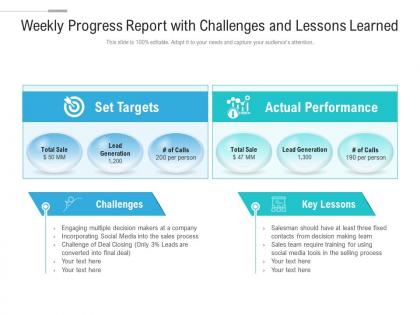
Weekly progress report with challenges and lessons learned




Try Before you Buy Download Free Sample Product
 Impress Your
 Audience
 100%
100% Editable
 Save Hours
 of Time


Our Weekly Progress Report With Challenges And Lessons Learned are topically designed to provide an attractive backdrop to any subject. Use them to look like a presentation pro.
People who downloaded this PowerPoint presentation also viewed the following :
Weekly progress report with challenges and lessons learned with all 2 slides:
Use our Weekly Progress Report With Challenges And Lessons Learned to effectively help you save your valuable time. They are readymade to fit into any presentation structure.
FAQs for Weekly progress report with challenges
Key metrics should include task completion percentages, budget variance, timeline adherence, resource utilization rates, and risk mitigation progress. These indicators enable project managers to streamline communication with stakeholders by delivering comprehensive status updates, identifying potential bottlenecks early, and maintaining strategic alignment, ultimately enhancing operational efficiency and project success rates.
Visual elements like charts, graphs, progress bars, trend lines, and infographics transform complex data into easily digestible insights, enabling stakeholders to quickly identify patterns, bottlenecks, and achievements at a glance. These visual tools streamline communication by reducing reading time, enhancing comprehension across different audiences, and facilitating faster decision-making, with many organizations finding that visual reports increase engagement and accountability while delivering more impactful progress presentations.
Teams face challenges including inconsistent data collection, time-consuming manual compilation, lack of standardized formats, difficulty tracking cross-functional dependencies, and ensuring accurate status updates from all members. These obstacles can be addressed through automated tracking tools, standardized templates, regular check-in schedules, and centralized dashboards, with many organizations finding that streamlined reporting processes ultimately enhance project visibility, accountability, and decision-making efficiency.
Weekly progress reports help identify potential risks and issues by providing regular visibility into project milestones, resource constraints, budget variances, timeline deviations, and team performance indicators. Through systematic tracking, project managers can spot emerging bottlenecks, resource shortages, and scope creep before they escalate, with many organizations finding that this proactive approach enables faster corrective actions and ultimately delivers better project outcomes.
Weekly progress reports should follow clear formatting with executive summaries, quantified accomplishments, visual progress indicators, identified roadblocks, and actionable next steps. These structured elements enhance readability through consistent headings, bullet points, and data visualization, with many organizations finding that standardized templates streamline communication while enabling stakeholders to quickly assess project status and make informed decisions.
Feedback from weekly progress reports can be utilized by identifying performance gaps, recognizing high-impact activities, reallocating resources strategically, and implementing targeted training interventions. Through systematic analysis, organizations streamline workflow bottlenecks, enhance team collaboration, and accelerate project timelines, with many management teams finding that consistent feedback loops ultimately deliver improved productivity and stronger competitive positioning.
Accountability serves as the foundation of weekly progress reports by establishing clear ownership of tasks, deadlines, and outcomes, while creating transparent documentation of individual and team performance. Through structured reporting, organizations enhance responsibility, minimize project delays, and improve communication across departments, with many teams finding that consistent accountability measures ultimately drive better project execution and strategic goal achievement.
Technology streamlines weekly progress reports through automated data collection, real-time tracking dashboards, customizable templates, integration capabilities, and collaborative features. Project management platforms like Asana or Monday.com enable teams to automatically generate comprehensive reports by pulling task completions, timeline updates, and resource utilization data, while facilitating seamless stakeholder communication and reducing manual reporting time significantly.
Industries customize weekly progress reports by emphasizing sector-specific metrics, compliance requirements, stakeholder priorities, and operational frameworks unique to their business models. Manufacturing focuses on production targets and safety metrics, healthcare tracks patient outcomes and regulatory compliance, while financial services emphasizes risk assessments and client portfolio performance, ultimately enabling more strategic decision-making and industry-relevant insights.
Common mistakes include being too vague about accomplishments, failing to quantify results with specific metrics, overloading reports with unnecessary details, and neglecting to address challenges or setbacks honestly. These errors undermine credibility and decision-making effectiveness, with many managers finding that clear, data-driven progress updates enhance team accountability, streamline resource allocation, and ultimately deliver better project outcomes.
Team members contribute meaningfully when progress reports connect individual work to broader team objectives, use structured formats that highlight achievements and challenges, and create collaborative environments where insights are valued. By incorporating peer recognition, rotating presentation responsibilities, and linking contributions to professional development goals, organizations streamline communication while enhancing engagement, ultimately delivering stronger project outcomes and team cohesion.
A standardized framework should include objective completion rates, key performance indicators, upcoming milestones, resource requirements, and risk identification. This structured approach enables organizations to maintain consistent reporting across departments, streamline management reviews, and identify cross-team dependencies early, with many companies finding that standardized templates enhance visibility while reducing administrative overhead and improving strategic alignment.
Weekly progress reports for remote teams should include visual project dashboards, asynchronous video updates, collaborative goal tracking, and structured feedback sections that accommodate different time zones. These adaptations enhance transparency by enabling real-time status visibility, streamlined communication workflows, and consistent team alignment, with many distributed organizations finding that regular virtual check-ins ultimately deliver improved accountability and stronger collaborative outcomes.
Comparing weekly progress reports reveals patterns in resource allocation, timeline adherence, bottleneck frequency, and team productivity cycles across project phases. These longitudinal insights enable organizations to identify recurring challenges, optimize workflow processes, and enhance forecasting accuracy, with many project managers finding that trend analysis significantly improves strategic planning and delivers more realistic timeline estimates for future initiatives.
Qualitative data in weekly progress reports provides crucial context, stakeholder feedback, team morale insights, risk assessments, and strategic observations that quantitative metrics alone cannot capture. While numbers show what happened, qualitative insights explain why outcomes occurred, how team dynamics affect performance, and what operational challenges or opportunities emerged, ultimately enabling more informed decision-making and strategic adjustments.
-
Nice and innovative design.
-
The content is very helpful from business point of view.
-
The Designed Graphic are very professional and classic.
-
Awesome presentation, really professional and easy to edit.
-
Qualitative and comprehensive slides.