


What where when why how assess issue identify opportunity




Try Before you Buy Download Free Sample Product
 Impress Your
 Audience
 100%
100% Editable
 Save Hours
 of Time


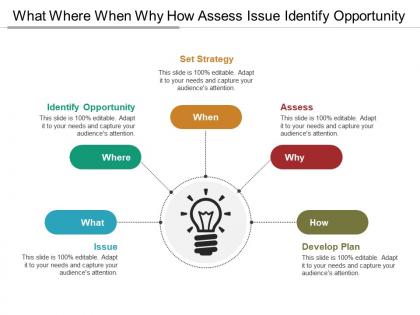
Introducing What Where When Why How Assess Issue Identify Opportunity. Mention the ways to find business opportunities using this PPT visual. Identify risks so that businesses can understand the market prior to expanding an offering. Highlight the business activities carried out by the organization such as budgeting, accounting, and auditing, marketing, sales activities, etc. Evaluate the attractiveness of the new market opportunity by utilizing this growth initiative PowerPoint layout. Make a knowledgeable presentation by giving some examples of business opportunities such as E-learning, online referral service, onsite computer service, online gaming, management consulting, etc. Take the advantage of this favorable chances PPT slideshow and showcase the keys to conducting marketing opportunity analysis. Also, mention the things to consider when evaluating a business opportunity using this strategy PPT infographic. Thus, create an effective business strategy by downloading this performance management PowerPoint presentation.
People who downloaded this PowerPoint presentation also viewed the following :
What where when why how assess issue identify opportunity with all 5 slides:
Conquer the heights with our What Where When Why How Assess Issue Identify Opportunity. Climb further than anyone else.


FAQs for What where when why how assess
Key components include clear learning objectives, diverse question formats, appropriate difficulty levels, reliable scoring rubrics, and accessibility features. These elements work together by ensuring comprehensive evaluation, accommodating different learning styles, and maintaining measurement consistency, with many educational institutions and corporate training programs finding that well-designed assessments ultimately enhance learning outcomes and performance tracking.
Formative assessments enhance learning by providing real-time feedback, identifying knowledge gaps, adjusting instruction methods, and promoting student self-reflection throughout the educational process. These ongoing evaluation strategies enable teachers to modify lesson plans immediately, while students develop metacognitive skills and improve performance, ultimately delivering personalized learning experiences and better academic outcomes across diverse educational environments.
Technology revolutionizes modern assessment practices by enabling automated grading, real-time analytics, adaptive testing, personalized feedback systems, and remote proctoring capabilities. These digital tools streamline evaluation processes while enhancing accuracy and accessibility, with educational institutions and corporate training programs finding that technology-driven assessments deliver faster results and deeper insights into performance patterns.
Assessments can be tailored through multiple formats like visual presentations, oral evaluations, project-based tasks, digital simulations, and flexible timing options to accommodate different learning styles and abilities. These personalized approaches enable educators to capture authentic student understanding while reducing barriers, with many educational institutions finding that diversified assessment strategies ultimately enhance learning outcomes and student engagement across diverse populations.
Reliability and validity are fundamental pillars of effective assessment design, ensuring consistent measurement accuracy and meaningful evaluation of intended outcomes across diverse contexts. These principles enable organizations, educational institutions, and businesses to make informed decisions based on trustworthy data, ultimately delivering fair evaluations, reduced bias, and strategic insights that enhance performance measurement and competitive advantage.
Educators can effectively utilize rubrics by establishing clear performance criteria, providing consistent scoring standards, offering transparent feedback mechanisms, and enabling student self-assessment opportunities. These structured evaluation tools streamline grading processes while enhancing learning outcomes, with many educational institutions finding that well-designed rubrics improve both teaching efficiency and student understanding of expectations.
Effective strategies include creating clear expectations, offering practice opportunities, implementing diverse assessment formats, providing timely feedback, and teaching relaxation techniques. These approaches work by reducing uncertainty, building confidence, and accommodating different learning styles, with many educational institutions finding that combining multiple strategies creates supportive environments that enhance student performance while minimizing stress-related barriers to academic success.
Peer assessments enhance learning by encouraging critical thinking, self-reflection, and collaborative problem-solving, while developing communication and analytical skills through structured feedback processes. This approach enables students and professionals to gain diverse perspectives, identify knowledge gaps, and strengthen understanding through teaching others, with many educational institutions and corporate training programs finding that peer evaluation ultimately delivers improved retention rates and stronger team dynamics.
Summative assessment is crucial for measuring final educational achievement and program effectiveness, providing comprehensive data on student mastery, curriculum success, and institutional performance. It enables educators, administrators, and policymakers to evaluate learning outcomes objectively, make informed decisions about instruction and resource allocation, while ultimately delivering accountability and strategic insights for continuous educational improvement.
Assessments align with learning objectives and curriculum standards through backward design planning, criterion-referenced rubrics, standards mapping, and systematic alignment audits. Educational institutions achieve this by developing assessments that directly measure specified learning outcomes, incorporating authentic performance tasks, and regularly reviewing alignment effectiveness, ultimately ensuring students demonstrate mastery of intended competencies while meeting accountability requirements.
Best practices for providing feedback include being specific and actionable, focusing on learning objectives, offering both corrective and reinforcing comments, providing timely responses, and encouraging self-reflection. These approaches enhance student learning by clarifying misconceptions, reinforcing successful strategies, and guiding future improvement, with many educators finding that detailed feedback ultimately delivers deeper understanding and increased academic performance.
Self-assessments empower students by developing metacognitive skills, promoting reflection on learning progress, building critical thinking abilities, and fostering personal accountability for academic outcomes. Through regular self-evaluation practices, students identify knowledge gaps, set personalized learning goals, and develop strategic study approaches, ultimately enhancing their academic independence and creating lifelong learners who actively engage with educational content.
Performance assessments evaluate learners through real-world tasks, projects, presentations, portfolios, and practical demonstrations rather than traditional testing methods. These approaches capture critical thinking, creativity, collaboration, and problem-solving skills that standardized tests often miss, with many educational institutions finding that performance-based evaluation delivers deeper insights into student readiness and competencies.
Educators can assess soft skills and emotional intelligence through peer evaluations, self-reflection journals, behavioral observations during group projects, role-playing scenarios, and portfolio assessments showcasing interpersonal interactions. Many schools implement 360-degree feedback systems and structured interviews, enabling teachers to evaluate communication, empathy, and collaboration skills while delivering comprehensive student development insights that enhance workforce readiness.
Innovative assessment methods for digital-native learners include gamified quizzes, interactive simulations, peer evaluation platforms, multimedia portfolio projects, and real-time polling systems. These approaches enhance engagement by incorporating collaborative elements, immediate feedback mechanisms, and technology-driven formats, with many educational institutions finding that students demonstrate improved participation rates and deeper learning outcomes through these interactive assessment strategies.
-
Commendable slides with attractive designs. Extremely pleased with the fact that they are easy to modify. Great work!
-
Very well designed and informative templates.