


Wine And Cocktail Bar Business Plan Powerpoint Presentation Slides




Try Before you Buy Download Free Sample Product
 Impress Your
 Audience
 100%
100% Editable
 Save Hours
 of Time


Our Wine And Cocktail Bar Business Plan Powerpoint Presentation Slides are topically designed to provide an attractive backdrop to any subject. Use them to look like a presentation pro.
People who downloaded this PowerPoint presentation also viewed the following :
Content of this Powerpoint Presentation
Slide 1: The slide introduces Wine and Cocktail Bar Business Plan. State your Company name and begin.
Slide 2: This is an Agenda slide. State your agendas here.
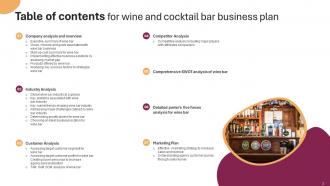
Slide 3: The slide displays Table of contents for the presentation.
Slide 4: The slide renders another Table of contents.
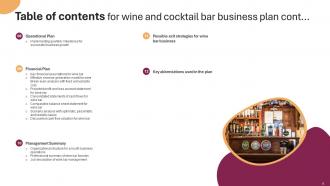
Slide 5: The slide continues Table of contents.
Slide 6: This slide provides a glimpse of key highlights of the wine bar business including a quick pitch.
Slide 7: This slide covers the wine bar business vision, mission, and goals to ensure that it will deliver a top-notch customer experience.
Slide 8: This slide provides information about start-up expenditures that incur during the process of establishing a wine bar.
Slide 9: The slide is to provide a glimpse of the products offered by the wine bar to a wide range of clients in the US and other parts of the world.
Slide 10: The slide again provide a glimpse of the products offered by the wine bar to a wide range of clients in the US and other parts of the world.
Slide 11: This slide covers the essential points to be considered while developing business strategy for wine bar.
Slide 12: The slide displays Title of contents further.
Slide 13: The purpose of this slide is to highlight the market size of the global wine bar industry.
Slide 14: The slide describes the market size of the US wine bar industry.
Slide 15: This slide highlights the thorough assessment of market data within the wine bar industry.
Slide 16: This slide highlights the key market trends that have the potential to change the current market scenario.
Slide 17: This slide portrays details about various challenges catered by the wine bar industry.
Slide 18: This slide caters to details about various growth drivers resulting in wine bar industry progress.
Slide 19: This slide portrays an ideal business location for a wine bar that minimizes the risk of failure.
Slide 20: The slide renders Title of contents further.
Slide 21: This slide covers an assessment of how the company's products will be targeted to a particular market based on customer segmentation.
Slide 22: This slide covers an assessment of how the company's products will fit into a particular market and where they will acquire the most traction with customers.
Slide 23: This slide provides a glimpse of how to better understand the target audience, to fine-tune marketing campaigns, and increase personalization.
Slide 24: The slide is to depict the market potential of wine bar in terms of TAM, SAM, and SOM.
Slide 25: The slide dislays Title of contents which is to be discussed further.
Slide 26: The slide provides a glimpse of major participants and key competitors of the industry to gain insight into their products, revenue, and global presence.
Slide 27: The slide displays Title of contents further.
Slide 28: The purpose of this slide is to identify the industry’s strengths, weaknesses, opportunities, and threats related to the wine bar.
Slide 29: The slide displays Title of contents further.
Slide 30: The slide highlights porter’s five forces model and its implications in the US wine bar.
Slide 31: The slide renders Title of contents further.
Slide 32: The purpose of this slide is to implement an effective go-to-market strategy for bringing the company's products or services.
Slide 33: The slide is to implement an effective go-to-market strategy for bringing the company's products or services further.
Slide 34: This slide provides information regarding the wine bar customer journey mapping to track users' actions and key touch points across levels.
Slide 35: The slide also displays Title of contents.
Slide 36: The slide covers particular objectives or goals that the organization intends to attain as part of its business plan.
Slide 37: The slide renders Title of contents further.
Slide 38: This slide provides a glimpse of important financial assumptions that are to be made while setting wine bar in terms of income, expense, and balance sheet.
Slide 39: The slide shows the effective revenue model of the wine bar, which displays the cost incurred and the various sources of income.
Slide 40: The slide continues the effective revenue model of the wine bar, which displays the cost incurred and the various sources of income.
Slide 41: The slide shows the effective revenue model of the wine bar, which displays the cost incurred and the various sources of income further.
Slide 42: The slide shows another effective revenue model of the wine bar, which displays the cost incurred and the various sources of income.
Slide 43: The slide also displays the effective revenue model of the wine bar, which displays the cost incurred and the various sources of income.
Slide 44: The slides highlight the break-even analysis of the firm.
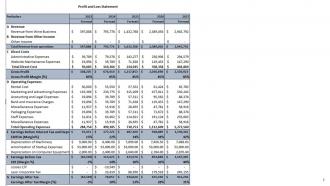
Slide 45: The slides provide a glimpse of the projected profit and loss statement to visualize the wine bar financial performance for the next five years.
Slide 46: The slides continues a glimpse of the projected profit and loss statement to visualize the wine bar financial performance for the next five years.
Slide 47: The slides highlight the company's cash flow statement to provide a detailed picture of what happened to a business's cash during a specified period.
Slide 48: The slides cover the snapshot of the company's financial position at a specific time by showing the details of the assets of the company.
Slide 49: The slides continues the snapshot of the company's financial position at a specific time by showing the details of the assets of the company.
Slide 50: The slides again depicts the snapshot of the company's financial position at a specific time by showing the details of the assets of the company.
Slide 51: The slide highlights the effects of potential future events on the company’s performance by considering different outcomes.
Slide 52: The slide again examines the effects of potential future events on the company’s performance by considering different outcomes.
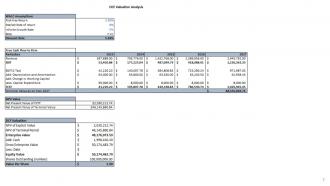
Slide 53: The slide is to calculate the amount of money an investor would get from an investment after adjusting for the time value of money.
Slide 54: The slide renders Title of contents further.
Slide 55: The slide again depicts the organizational hierarchy in the company.
Slide 56: This slide highlights the founder’s biggest professional achievements and most valuable skills.
Slide 57: This slide renders the job roles and responsibilities of wine bar key management people to determine what kind of job has to be done.
Slide 58: This slide also shows the job roles and responsibilities of wine bar key management people to determine what kind of job has to be done.
Slide 59: This slide again renders the job roles and responsibilities of wine bar key management people to determine what kind of job has to be done.
Slide 60: This slide also depicts the job roles and responsibilities of wine bar key management people to determine what kind of job has to be done.
Slide 61: This slide highlights the job roles and responsibilities of wine bar key management people to determine what kind of job has to be done further.
Slide 62: The slide represents Title of contents further.
Slide 63: This slide presents exit strategies such as liquidation, management buyout, transfer of ownership, initial public offering, franchising and acquisitions.
Slide 64: The slide displays Title of contents which is to be discussed further.
Slide 65: The slide is to highlight the shorter version of existing words to save time and take up less space.
Slide 66: This slide shows all the icons included in the presentation.
Slide 67: This slide is titled as Additional Slides for moving forward.
Slide 68: This is a Comparison slide to state comparison between commodities, entities etc.
Slide 69: This slide depicts Venn diagram with text boxes.
Slide 70: This is our vision, mission and goal slide. State your goal here.
Slide 71: This slide provides 30 60 90 Days Plan with text boxes.
Slide 72: This slide presents Roadmap with additional textboxes.
Slide 73: This is a Thank You slide with address, contact numbers and email address.
Wine And Cocktail Bar Business Plan Powerpoint Presentation Slides with all 81 slides:
Use our Wine And Cocktail Bar Business Plan Powerpoint Presentation Slides to effectively help you save your valuable time. They are readymade to fit into any presentation structure.











































































FAQs for Wine And Cocktail Bar Business Plan
A successful wine and cocktail bar business plan includes market analysis, target demographics, beverage program strategy, location assessment, financial projections, and operational workflows. These components work together by identifying customer preferences, optimizing inventory management, and streamlining service delivery, with many hospitality entrepreneurs finding that comprehensive planning ultimately delivers higher profit margins and sustainable competitive advantage.
Market research influences wine and cocktail bar business plan design by identifying target demographics, analyzing competitor pricing strategies, determining optimal location factors, and revealing consumer preferences for specific beverages and atmospheres. Through comprehensive market analysis, bar owners can strategically position their establishment, develop targeted menu offerings, and create competitive pricing structures, ultimately delivering enhanced customer experiences and sustainable profitability in an increasingly competitive hospitality landscape.
Budget considerations for a wine and cocktail bar should include initial setup costs like equipment, furniture, and licensing, ongoing operational expenses such as inventory, staff wages, and utilities, plus contingency funds for unexpected costs. These financial elements enable strategic resource allocation across premium beverage inventory, skilled bartender recruitment, and customer experience enhancements, ultimately delivering sustainable profitability and competitive positioning in an increasingly crowded hospitality market.
Defining your target market involves analyzing demographics like age, income, and lifestyle preferences, geographic factors including neighborhood characteristics and foot traffic patterns, and psychographic elements such as social behaviors and entertainment spending habits. This strategic combination enables bar owners to tailor their wine selections, cocktail menus, and ambiance accordingly, ultimately delivering personalized experiences that drive customer loyalty and competitive advantage in an increasingly crowded hospitality landscape.
Location fundamentally determines a wine and cocktail bar's customer base, operational costs, revenue potential, and competitive positioning within the market. Strategic placement in high-traffic areas like downtown districts, entertainment zones, or upscale neighborhoods enables establishments to attract target demographics, maximize foot traffic, and command premium pricing, with many successful bars finding that proximity to complementary businesses ultimately delivers sustained profitability.
A unique selling proposition should be woven throughout your wine and cocktail bar business plan by defining your distinctive value in the market concept, target audience analysis, marketing strategy, and operational procedures. This strategic integration helps differentiate your establishment from competitors through specific elements like craft cocktail expertise, wine education experiences, or themed atmospheres, ultimately delivering enhanced customer loyalty and sustainable competitive advantage in an increasingly crowded hospitality market.
Licensing requirements include liquor licenses, food service permits, business registration, health department approvals, and fire safety certifications. These regulatory elements streamline operations by ensuring compliance, minimizing legal risks, and establishing credibility with suppliers and customers, ultimately delivering smoother launches and sustained profitability for hospitality ventures.
Menu offerings should strategically balance premium wine selections, signature craft cocktails, and complementary food pairings that maximize profit margins while reflecting your brand positioning and target demographic preferences. Through carefully curated wine lists, innovative cocktail programs, and strategic pricing tiers, establishments can enhance customer experiences, encourage longer visits, and ultimately drive revenue growth, with many successful bars finding that seasonal rotations and exclusive offerings create competitive differentiation.
Marketing strategies for a wine and cocktail bar include social media campaigns showcasing signature drinks, influencer partnerships with local food bloggers, themed tasting events, happy hour promotions, and loyalty programs for repeat customers. These approaches enhance customer engagement by creating memorable experiences, building community connections, and leveraging digital platforms, with many hospitality businesses finding that strategic combinations of experiential marketing and targeted promotions ultimately deliver increased foot traffic and stronger brand recognition.
A wine and cocktail bar business plan can leverage social media through visually-driven content showcasing signature cocktails, behind-the-scenes mixology videos, customer testimonials, influencer partnerships, and targeted local advertising campaigns. These strategies enhance brand visibility, drive foot traffic, and build community engagement, with many hospitality businesses finding that consistent social media presence increases customer loyalty, attracts new demographics, and ultimately delivers measurable revenue growth through direct bookings and event inquiries.
Staffing needs include bartenders with mixology expertise, servers, kitchen staff for food preparation, security personnel, and management roles for operations oversight. These positions ensure seamless customer service, efficient order fulfillment, and safety compliance, with many successful bars finding that cross-training staff enhances operational flexibility and ultimately delivers faster service and improved customer experiences.
Competitors significantly impact strategic planning by influencing pricing strategies, menu differentiation, location selection, and market positioning decisions within your business plan. Through competitive analysis, wine and cocktail bars identify gaps in service offerings, optimize their unique value propositions, and develop targeted marketing approaches, with many establishments finding that understanding competitor strengths and weaknesses enables better resource allocation and sustainable competitive advantages.
Sustainability practices for wine and cocktail bars include sourcing organic and biodynamic wines, implementing comprehensive recycling programs, using energy-efficient equipment, partnering with local suppliers, and minimizing food waste through composting initiatives. These approaches streamline operational costs while enhancing brand reputation, with many establishments finding that eco-conscious practices attract environmentally aware customers and ultimately deliver competitive differentiation in an increasingly sustainability-focused hospitality landscape.
Customer experience prioritization involves detailing service protocols, ambiance design, staff training programs, menu personalization options, and feedback collection systems throughout your business plan. These elements streamline operations by creating consistent service standards, enhancing patron satisfaction through curated experiences, and building customer loyalty, with many successful bars finding that strategic experience investments ultimately deliver higher revenue per customer and stronger competitive positioning.
Essential financial projections include revenue forecasts, cost of goods sold (COGS), labor costs, operating expenses, cash flow analysis, and break-even calculations. These metrics enable wine and cocktail bar owners to track profit margins, monitor inventory turnover, and assess customer acquisition costs, with many hospitality businesses finding that detailed financial modeling delivers better resource allocation and ultimately sustainable growth in an increasingly competitive market.
-
Informative design.
-
No second thoughts when I’m looking for excellent templates. SlideTeam is definitely my go-to website for well-designed slides.