

Wine And Spirits Business Plan Powerpoint Presentation Slides BP





Try Before you Buy Download Free Sample Product
 Impress Your
Audience
 100%
Editable
 Save Hours
of Time


Worldwide, the Alcohol beverages market was valued at USD 1609 billion in 2023 and is expected to increase to USD 2325.1 billion in 2030 at a CAGR of 5.42 percent. Our readily available and professionally designed Wine and Spirits business plan PPT provides detailed stats on the alcohol industry and its allied sectors. It also includes wine target customers, critical restraints, and lucrative growth opportunities. In addition, the Alcohol industry analysis PPT also consists of a section for SWOT analysis and target customer analysis. Furthermore, competitive landscape, go-to marketing strategy, and exit strategy are some of the essential topics covered in the business plan. It also covers the revenue model, profit and loss statement, cash flow statement, break-even analysis, DCF valuation, balance sheet, etc. Download the wine and spirits business plan PPT now.
People who downloaded this PowerPoint presentation also viewed the following :
Content of this Powerpoint Presentation
Slide 1: This slide showcase title Wine and Spirits Business Plan. State Your Company Name.
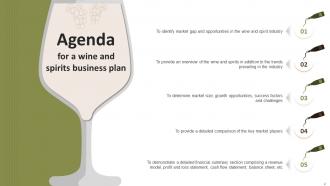
Slide 2: This slide showcase Agenda for a wine and spirits business plan.
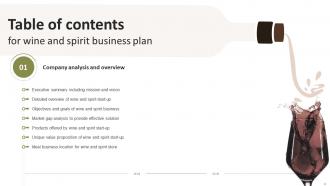
Slide 3: This slide exhibit Table of content.
Slide 4: This slide shows title for topics that are to be covered next in the template.
Slide 5: The slide showcases the synopsis of wine and spirits start-up.
Slide 6: The purpose of the slide is to highlight wine and spirit start-up details including name, incorporation date, web address, start-up investment, services etc.
Slide 7: The slide covers the objectives of wines and spirits business startup.
Slide 8: This slide is to identify market gap and solutions to create opportunities for business growth and innovation.
Slide 9: The slide highlights the products offered by the wines and spirits store.
Slide 10: The slide is to highlight the key success factors of the wine and spirits startup which leverage them with a competitive edge in the market.
Slide 11: The slide is to identify ideal business location for wine and spirits business to minimize the risk of failure.
Slide 12: This slide shows title for topics that are to be covered next in the template.
Slide 13: The purpose of this slide is to conduct a thorough assessment of the alcoholic beverages industry, offering insights into market dynamics.
Slide 14: This slide shows title for topics that are to be covered next in the template.
Slide 15: The slide portrays analysis of global spirits industry.
Slide 16: The slide outlines statistics related to consumption of alcohol. The purpose of slide is to offer insights into the alcohol consumption patterns.
Slide 17: This slide highlights the United States of America wine industry analysis.
Slide 18: This slide highlights the United States of America spirits industry analysis.
Slide 19: This slide highlights the key market trends that have the potential to change the current market scenario, as well as ways that the company can stay ahead of competitors.
Slide 20: The purpose of slide is to identify the challenges faced by the wine and spirits industry to assist stakeholders in developing proactive measures.
Slide 21: The purpose of the slide is to analyze factors that contribute to the expansion and success of wine and spirits industry.
Slide 22: This slide shows title for topics that are to be covered next in the template.
Slide 23: The slide is to assist company to tailor products, services, and marketing strategies to effectively reach target audience.
Slide 24: This slide portrays buyer persona for wine and spirits business.
Slide 25: The purpose of this slide is to depict the market potential of the wine and spirits industry in terms of TAM, SAM, and SOM.
Slide 26: This slide shows title for topics that are to be covered next in the template.
Slide 27: The purpose of this slide is to provide a glimpse of key competitors in the industry to gain insight into their products, services, strengths, and revenue.
Slide 28: This slide shows title for topics that are to be covered next in the template.
Slide 29: The slide includes the strengths, weaknesses, opportunities, and threats analysis of the wine and spirit start-up.
Slide 30: This slide shows title for topics that are to be covered next in the template.
Slide 31: The slide highlights porter’s framework and its implications in the wine and spirits industry.
Slide 32: This slide shows title for topics that are to be covered next in the template.
Slide 33: The purpose of this slide is to implement an effective go-to-market strategy to increase the sales of wine and spirits business.
Slide 34: The slide highlights promotional strategies for wine and spirits buisness to attract new customers.
Slide 35: This slide showcases the pricing strategy for burger startup buisness.
Slide 36: This slide highlights customer journey mapping to track users' actions and key touch points across levels such as awareness, consideration, loyalty, and growth.
Slide 37: This slide shows title for topics that are to be covered next in the template.
Slide 38: This slide highlights the short-term and long-term milestones for five years of operations.
Slide 39: This slide shows title for topics that are to be covered next in the template.
Slide 40: This slide provides a glimpse of important financial assumptions for wine and spirits store.
Slide 41: The slide shows the effective revenue model of the wine and spirit business.
Slide 42: The slide shows the effective revenue model of the wine and spirit business.
Slide 43: The slides highlight the break-even analysis of the wine and spirits firm.
Slide 44: The slides highlight the break-even analysis of the wine and spirits firm.
Slide 45: The slides provide a glimpse of the projected profit and loss statement to visualize the platform’s financial performance for the next five years.
Slide 46: The slides provide a glimpse of the projected profit and loss statement to visualize the financial performance of wine and spirit business for the next five years.
Slide 47: The slide highlight the cash flow statement of the company.
Slide 48: The slide highlight the cash flow statement of the company.
Slide 49: The slides cover the snapshot of the company’s balance sheet to evaluate the financial position of the wine and spirit business.
Slide 50: The slides cover the snapshot of the company’s balance sheet to evaluate the financial position of the wine and spirit buisness.
Slide 51: The purpose of the slide is to examine the effects of potential future events on company's future performance by considering different outcomes.
Slide 52: The slide is to examine the effects of potential future events on company's future performance by considering different outcomes.
Slide 53: The slides cover the snapshot of the business discounted cash flow model at different business years.
Slide 54: This slide shows title for topics that are to be covered next in the template.
Slide 55: The slide highlights the organizational hierarchy of the wine and spirit business.
Slide 56: This slide is to highlight key job roles and responsibilities of the staff to ensure effectiveness and efficiency in the operations.
Slide 57: This slide is to highlight key job roles and responsibilities of the staff to ensure effectiveness and efficiency in the operations.
Slide 58: This slide shows title for topics that are to be covered next in the template.
Slide 59: This slide represents exit strategies for wine and spirits business such as sell-offs, IPOs, mergers, and acquisitions.
Slide 60: This slide shows title for topics that are to be covered next in the template.
Slide 61: This slide outlines key abbreviations used in the buisness plan.
Slide 62: This slide shows all the icons included in the presentation.
Slide 63: This slide is titled as Additional Slides for moving forward.
Slide 64: This slide provides 30 60 90 Days Plan with text boxes.
Slide 65: This slide depicts Venn diagram with text boxes.
Slide 66: This is a financial slide. Show your finance related stuff here.
Slide 67: This slide presents Roadmap with additional textboxes. It can be used to present different series of events.
Slide 68: This slide shows Post It Notes for reminders and deadlines. Post your important notes here.
Slide 69: This slide contains Puzzle with related icons and text.
Slide 70: This is a Thank You slide with address, contact numbers and email address.
Wine And Spirits Business Plan Powerpoint Presentation Slides BP with all 78 slides:
Use our Wine And Spirits Business Plan Powerpoint Presentation Slides BP to effectively help you save your valuable time. They are readymade to fit into any presentation structure.





























FAQs for Wine And Spirits Business Plan Powerpoint
Alright, so you'll need the usual business plan stuff - executive summary, market analysis, competitive research. Figure out who's actually buying wine and spirits in your area first. Product sourcing and supplier relationships are huge, plus inventory management gets weird with all the regulations. Marketing strategy and financials obviously. The operational side covers licensing, storage, distribution - honestly the licensing part is brutal but you can't skip it. Oh and research your state's alcohol laws ASAP because they're all different and some states are just ridiculous about it. That timeline thing isn't a joke.
Look, market trends are basically everything when you're writing your business plan. Track stuff like premiumization, health-conscious drinking, craft spirits - whatever's hot right now. Generational preferences matter too since millennials drink way differently than boomers. Remember hard seltzers? Nobody predicted that explosion until White Claw was suddenly dominating every cooler. These trends affect your target market, pricing, even which distributors you pick. Honestly, I'd spend serious time on industry reports and competitor research before you finalize anything. Your plan's gotta reflect where things are going, not where they've been.
You'll want the usual suspects - cash flow, P&L, and balance sheet projections for 3-5 years minimum. Cash flow is huge here since inventory costs are insane and premium stuff sits around aging forever. Break down production costs, distribution cuts, regulatory fees, and marketing spend. Licensing fees are gonna hurt, fair warning. Don't forget seasonal swings - like, people buy way more during holidays but then January hits and sales tank. Also factor in that weird gap between when you actually make the product and when money starts coming in. Honestly, plan on losing money year one no matter what your optimistic projections say.
Look, studying your competition is huge for finding market gaps and figuring out where you fit. Pick 3-5 wineries doing similar stuff and dive deep into their pricing, who they're targeting, how they distribute, all that. You'll spot opportunities they're totally missing. Plus investors actually take you seriously when you prove you know the industry - trust me on this one. Learning from other people's screwups saves you so much headache later. Once you map out everyone's strengths and weak spots, you can build something that stands out.
Dude, start with your story - people want to know WHY you're making this stuff, not just what's in the bottle. Get samples in front of faces whenever possible because honestly, that's what actually moves product. Instagram's your best friend for the pretty shots. Hit up local bars and restaurants for placement deals. Oh, and those wine influencers? They're worth their weight in gold - sommeliers too. Trade shows cost a fortune but you'll make connections that matter. Build locally first though. Don't try to conquer the world right out the gate.
Dude, regulations will absolutely make or break your wine business plan. You're looking at federal TTB permits, state liquor licenses, local zoning - the whole mess varies crazy amounts depending where you are. Honestly makes other industries seem like a joke in comparison! Your timeline, budget, marketing strategy? All of it depends on nailing down these rules first. Don't even think about writing your business plan yet. Seriously, find a lawyer who knows alcohol law inside and out. They'll save you from major headaches down the road. Trust me on this one.
Dude, you absolutely need to figure out your target audience first - it'll shape literally everything else. Who's buying your stuff? Millennials wanting trendy cocktails or older folks collecting expensive bottles? This research determines your pricing, where you sell, even which products to focus on. I learned this the hard way watching other businesses just wing it and waste tons of cash. Start with some surveys and check out what your competitors are doing. Focus groups help too if you can swing it. Once you nail down those customer personas, the rest of your business plan basically writes itself.
So basically break it down into three main areas: sourcing, operations, and packaging. Partner with eco-certified suppliers or use sustainable vineyard practices first. Then work renewable energy and water conservation into your production setup. Packaging's where you can really make a difference though - lighter bottles, recycled stuff, keeping distribution local cuts tons of carbon AND consumers actually care about this now. Oh, and definitely weave it into your brand story too. Set up a dedicated section in your plan with actual measurable goals and deadlines. Trust me, it'll pay off.
Honestly, it's all about knowing where your people actually shop. Tasting rooms and online sales give you the best margins - that's your bread and butter. Wine clubs are amazing for steady cash flow, plus people love feeling like they're in some exclusive thing. You'll probably need retail distribution too, even though stores take their cut. Restaurants and bars work great for spirits since they order regularly. Don't try to do everything at once though - pick like 2 or 3 channels and nail those first. Most places that actually make money use a mix of everything eventually.
So your unique value proposition is basically your "why should anyone give a damn" moment. The liquor aisle is nuts these days - people need a real reason to grab your bottle over the 50 others. Maybe it's your sustainable angle, some wild backstory, or flavors nobody's doing yet. Could be you're hitting a demographic everyone else ignores. Just don't go with generic "premium quality" BS that literally everyone claims. Test whatever angle you pick with actual customers first - I've seen too many brands build entire campaigns around ideas that sounded good in their heads but fell flat with real people.
You're looking at $500K to $2M+ depending on how big you want to go. Licensing alone runs $5K-$50K (varies like crazy by state), then there's inventory which is the real killer - $100K-$500K just sitting there for months. Plus warehouse space, insurance, all that stuff. I'd honestly add 20-30% to whatever you budget because something always ends up costing more. Oh and don't forget marketing and legal fees. The inventory thing really gets people - you're basically fronting cash for products that might just collect dust. Start with licensing quotes in your target states first, that'll give you a reality check on what you're dealing with.
Oh man, seasonal trends will absolutely destroy your numbers if you're not ready. Holiday spikes are wild - champagne at New Year's, whiskey in winter, rosé disappearing in summer. Wine jumps like 20-30% in Q4 just from parties and gifts alone. Beer's pretty steady but still peaks when it's hot out. Here's the thing though - January is brutal because demand just dies and you're stuck with inventory. I learned that one the hard way. You really need to track 3-4 months of your own sales history to see what patterns hit your specific store.
Honestly, the regulatory stuff is probably your biggest headache - licensing, taxes, distribution laws all change state by state. Supply chain issues will mess you up too. Weather hits crops, shipping gets delayed, then you're sitting there with empty shelves. Competition's insane right now with everyone going craft and premium. Oh, and you'll need serious cash upfront for inventory that sits around forever before it moves. My buddy went through this - definitely get multiple suppliers lined up and a lawyer who actually knows the industry.
Dude, partnerships are honestly game-changers. You get access to distribution networks and marketing budgets you'd never swing solo. Think exclusive restaurant deals, collab bottles with other brands, or working with wine people who actually know their stuff (not just pretty faces holding bottles). Small distilleries I know have blown up overnight just by finding the right distributor who got their vision. Split the costs, double your reach - it's pretty simple math. Figure out what you're missing first though. Distribution? Marketing? Street cred? Then hunt down partners who crush it in those areas.
Dude, start with smart sensors for your fermentation - they'll track temp, pH, all that stuff automatically. Blockchain sounds fancy but customers actually dig seeing where their wine came from. AI inventory management is clutch for predicting what you'll need. The automated bottling systems are expensive upfront but you'll save so much on labor it's crazy. QR codes on bottles linking to tasting notes or AR experiences are pretty slick too. My honest take? Don't go nuts trying everything at once. Pick maybe 2-3 techs that fix your actual problems rather than chasing every shiny new thing.
-
The quality of the templates is as fine as it could get. It was a purchase well made!
-
I came across many PowerPoint presentations with excellent creatives and I believe they would be beneficial to my work.