

Wiper Malware Attack Powerpoint Presentation Slides




Try Before you Buy Download Free Sample Product
 Impress Your
 Audience
 100%
100% Editable
 Save Hours
 of Time


This PowerPoint presentation gives a brief idea about the string of Russias wiper malware attacks against Ukraine, including their impact on Ukraine and western countries. Grab our competently designed Wiper Malware Attack template. We have covered the various Russian malware attacks such as WhisperGate, Hermetic Wiper, Cyclops Blink, website defacement, DDoS attacks, and website clones. Furthermore, this Wiper Malware Attack on Ukraine template caters to the technical analysis of DDoS attacks against Ukrainian websites and Ukraine Russia warfares impact on Ukraine and western countries such as the United States, United Kingdom, and Estonia. In addition, this Wiper Malware Attack PPT contains the effects of defacement attacks and fake news on internet providers, banks, social media users, etc. Lastly, this Malware Attack deck talks about if people should worry about these wiper attacks, steps to prepare for malware attacks by Russia, if any international laws are established for cyber warfare, and the weaknesses of Russian Cyber cells. Book a free demo with our research team now.
People who downloaded this PowerPoint presentation also viewed the following :
Content of this Powerpoint Presentation
Slide 1: This slide introduces Wiper Malware Attack. State Your Company Name and begin.
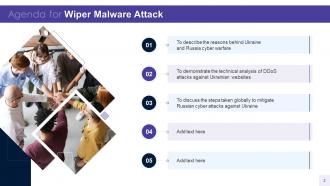
Slide 2: This slide states Agenda of the presentation.
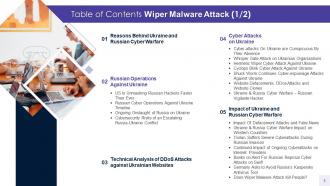
Slide 3: This slide presents Table of Content for the presentation.
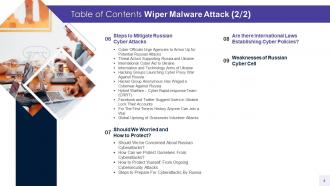
Slide 4: This is another slide continuing Table of Content for the presentation.
Slide 5: This slide highlights title for topics that are to be covered next in the template.
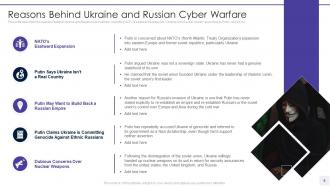
Slide 6: This slide shows Reasons Behind Ukraine and Russia Cyber Warfare.
Slide 7: This slide highlights title for topics that are to be covered next in the template.
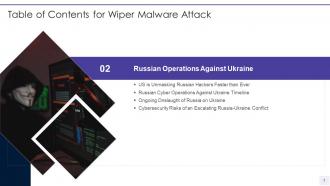
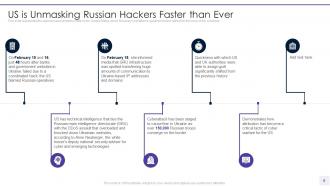
Slide 8: This slide presents US is Unmasking Russian Hackers Faster than Ever.
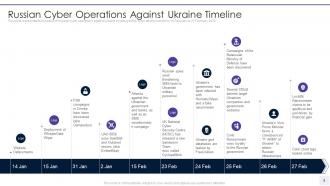
Slide 9: This slide displays Russian Cyber Operations Against Ukraine Timeline.
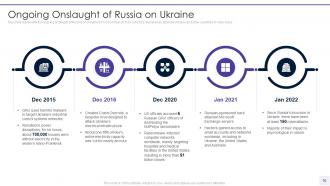
Slide 10: This slide represents the ongoing onslaught of Russia on Ukraine from December 2015 to Jan 2022.
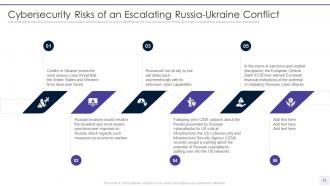
Slide 11: This slide showcases Cybersecurity Risks of an Escalating Russia-Ukraine Conflict.
Slide 12: This slide highlights title for topics that are to be covered next in the template.
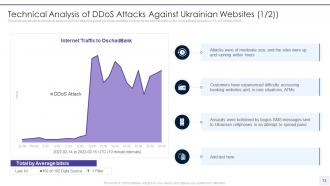
Slide 13: This slide represents the technical analysis of DDoS attacks against Ukrainian websites.
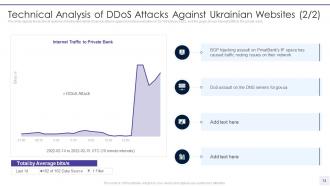
Slide 14: This slide depicts the technical analysis of distributed denial of service attacks against Ukrainian websites.
Slide 15: This slide highlights title for topics that are to be covered next in the template.
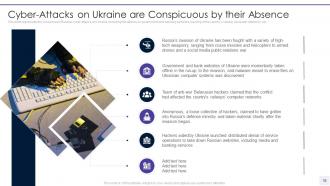
Slide 16: This slide represents the conspicuous Russian cyber-attacks on Ukraine.
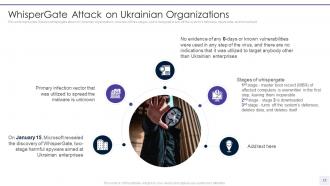
Slide 17: This slide showcases WhisperGate Attack on Ukrainian Organizations.
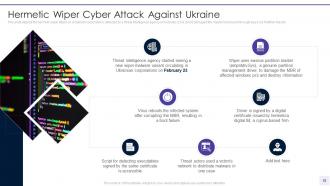
Slide 18: This slide depicts the hermeticwiper attack on Ukrainian corporations, detected by a threat intelligence agency.
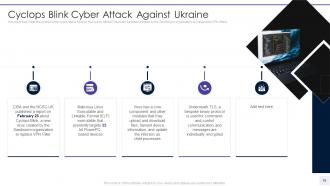
Slide 19: This slide describes the cyclops blink cyber-attack held by Russia on official Ukrainian websites.
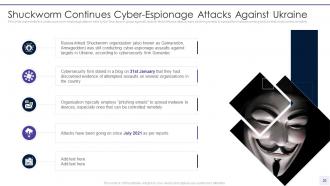
Slide 20: This slide represents the continuous cyber-espionage attacks held by the shuckworm group against Ukraine.
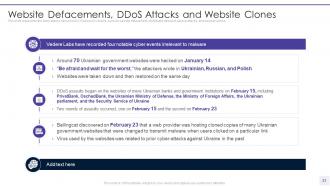
Slide 21: This slide showcases Website Defacements, DDoS Attacks and Website Clones.
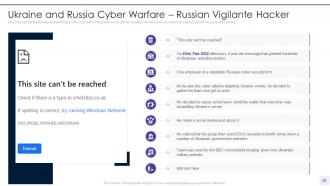
Slide 22: This slide shows Ukraine and Russia Cyber Warfare Russian Vigilante Hacker.
Slide 23: This slide highlights title for topics that are to be covered next in the template.
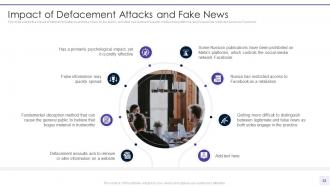
Slide 24: This slide presents Impact of Defacement Attacks and Fake News.
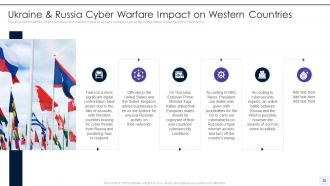
Slide 25: This slide represents the Ukraine & Russia cyber warfare impact on western countries.
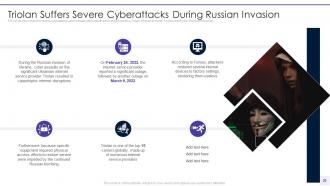
Slide 26: This slide describes the severe cyberattacks and infrastructure destruction experienced by major internet provider.
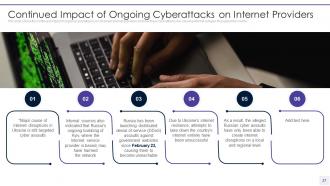
Slide 27: This slide represents Continued Impact of Ongoing Cyberattacks on Internet Providers.
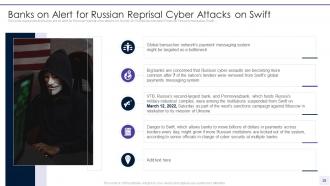
Slide 28: This slide represents that banks are on alert for Russian reprisal cyber attacks.
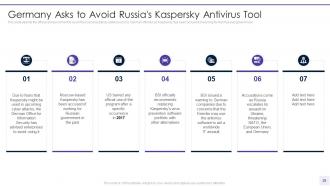
Slide 29: This slide depicts the official announcement to avoid Russia’s Kaspersky antivirus tool.
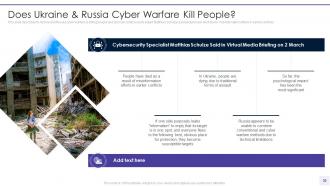
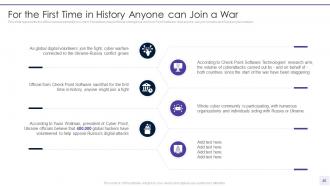
Slide 30: This slide describes if Ukraine and Russia cyber warfare is killing people and German cybersecurity.
Slide 31: This slide highlights title for topics that are to be covered next in the template.
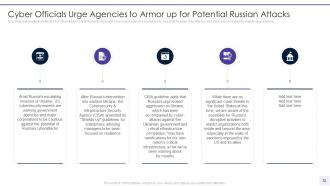
Slide 32: This slide displays Cyber Officials Urge Agencies to Armor up for Potential Russian Attacks.
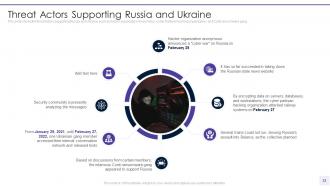
Slide 33: This slide represents Threat Actors Supporting Russia and Ukraine.
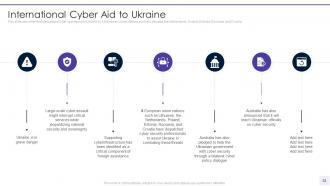
Slide 34: This slide describes the international cyber assistance to Ukraine by 6 European Union nations.
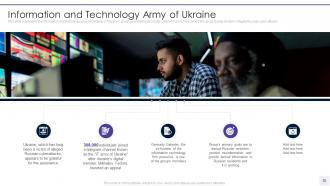
Slide 35: This slide represents the information and technology army of Ukraine, a Telegram group against Russia.
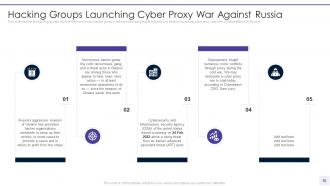
Slide 36: This slide depicts the hacking groups such as the Anonymous hacker group, Conti ransomware gang, etc.
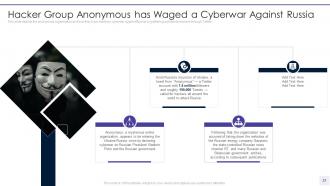
Slide 37: This slide represents anonymous organization and how they have started a cyberwar against Russia.
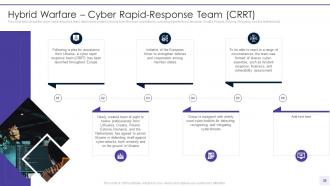
Slide 38: This slide talks about the cyber rapid response team deployed to protect Ukraine from Russian cyber attacks.
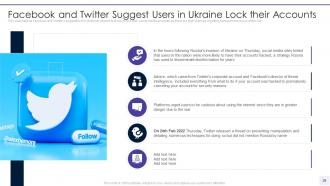
Slide 39: This slide showcases Facebook and Twitter Suggest Users in Ukraine Lock their Accounts
Slide 40: This slide represents the official announcement from Lotem Finkelstein, head of threat intelligence at Check Point Software.
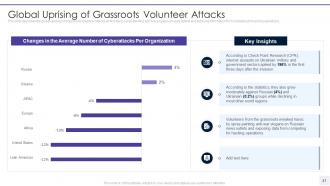
Slide 41: This slide showcases Global Uprising of Grassroots Volunteer Attacks.
Slide 42: This slide highlights title for topics that are to be covered next in the template.
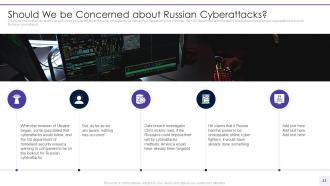
Slide 43: This slide shows that US citizens should not be concerned about Russian cyberattacks as nothing has happened so far.
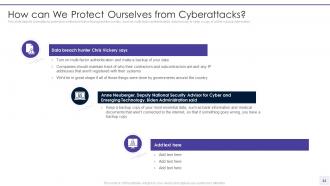
Slide 44: This slide depicts cyberattacks protection methods to follow throughout the country.
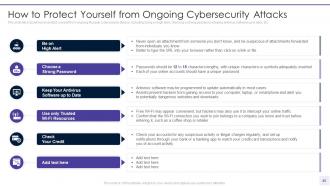
Slide 45: This slide showcases How to Protect Yourself from Ongoing Cybersecurity Attacks.
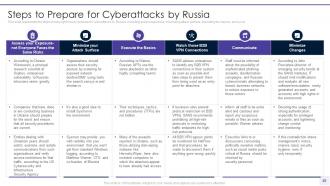
Slide 46: This slide shows Steps to Prepare for Cyberattacks by Russia.
Slide 47: This slide highlights title for topics that are to be covered next in the template.
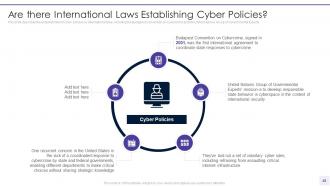
Slide 48: This slide describes the establishment of cyber policies by international laws.
Slide 49: This slide highlights title for topics that are to be covered next in the template.
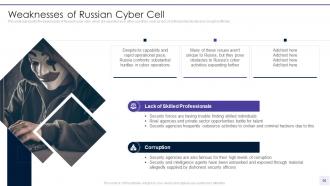
Slide 50: This slide represents the weaknesses of Russian cyber cells, which are expected as in other countries.
Slide 51: This slide showcases Icons for Wiper Malware Attack.
Slide 52: This slide is titled as Additional Slides for moving forward.
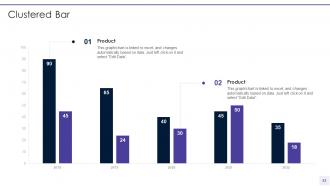
Slide 53: This slide provides Clustered bar chart with two products comparison.
Slide 54: This is Our Mission slide with related imagery and text.
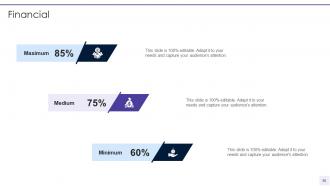
Slide 55: This is a Financial slide. Show your finance related stuff here.
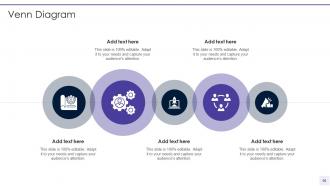
Slide 56: This slide depicts Venn diagram with text boxes.
Slide 57: This slide shows Post It Notes. Post your important notes here.
Slide 58: This slide contains Puzzle with related icons and text.
Slide 59: This is Our Target slide. State your targets here.
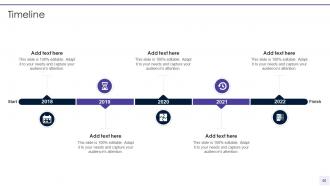
Slide 60: This is a Timeline slide. Show data related to time intervals here.
Slide 61: This slide showcases Magnifying Glass to highlight information, specifications, etc.
Slide 62: This is a Thank You slide with address, contact numbers and email address.
Wiper Malware Attack Powerpoint Presentation Slides with all 67 slides:
Use our Wiper Malware Attack Powerpoint Presentation Slides to effectively help you save your valuable time. They are readymade to fit into any presentation structure.







FAQs for Wiper Malware Attack
So wipers are basically the psychopaths of malware - they just want to destroy everything. No ransom demands, no data theft, just pure chaos. They'll trash your files, corrupt system stuff, sometimes even fry hardware components. It's like digital arson honestly. Regular malware wants something from you (money, passwords, whatever) but wipers? They're on a straight-up destruction mission. Recovery's usually hopeless once they hit since they overwrite everything. That's why offline backups are clutch - probably your only real lifeline if you get hit.
Honestly, wiper malware sneaks in the same way other attacks do - phishing emails, stolen passwords, or through security holes nobody patched yet. What's really scary though is how patient these attackers are. They'll spend months just quietly moving through your network, mapping everything out before they actually deploy the destructive stuff. First they get persistent access, then escalate their privileges, and figure out what your most critical systems are. But instead of stealing data like most hackers, they just want to destroy everything. Watch for weird lateral movement in your network and - this might sound obvious but - keep solid offline backups. That's honestly your best shot at surviving one of these attacks.
Oh man, NotPetya in 2017 was absolutely brutal - wiped out Ukraine's infrastructure and went global, costing billions. Shamoon hit Saudi Aramco twice (2012 and 2016), destroying like 30,000+ computers each time. WhisperGate went after Ukrainian systems right before the invasion last year. Iran's been hitting Israeli targets with similar stuff too. The scary part? These aren't ransomware - there's no getting your data back because destruction is literally the point. Usually state-sponsored too. Your backup game needs to be rock solid since everything can get nuked at once.
Oh man, wiper malware is seriously nasty stuff. It completely destroys data and systems instead of just encrypting them like ransomware does. Power plants, hospitals, water systems - if those get hit, you're talking blackouts and people literally dying. There's no getting that data back once it's wiped, which is what makes it so terrifying honestly. I read about some attacks that took down entire city grids for weeks. Best protection? Keep offline backups that are totally disconnected, and segment your networks so the infection can't spread everywhere at once.
Honestly, start with bulletproof backups - keep them totally separate from your main network because these attacks specifically hunt down backup systems (learned that the hard way). Network segmentation is huge too. Train everyone to spot sketchy emails since that's where most of this stuff begins. Keep everything patched, set up good monitoring to catch weird activity early. Oh, and definitely have an incident response plan that you actually practice - not just some document collecting dust. Basic rule: assume you're gonna get hit someday and work backwards from there.
Think of threat intelligence as your heads-up before wiper malware hits. You'll want to feed those IOCs and attack patterns into your SIEM so it can spot suspicious file hashes and block sketchy domains automatically. Your SOC team needs to jump on those alerts fast - wipers don't mess around. The intel also shows you which threat actors are eyeing your industry and their go-to wiper flavors. Honestly, most people underestimate how much context this stuff provides. Start with integrating a few solid TI feeds and make sure your detection rules actually use the data you're paying for.
Ugh, wiper attacks are absolutely devastating psychologically. Your team feels completely helpless because unlike ransomware, there's literally no getting that data back - it's just gone. People panic knowing their work vanished forever, which honestly makes sense. Trust in IT systems gets shattered, productivity tanks because everyone's paranoid about every little glitch. You'll probably see more sick days from stressed-out employees too. The whole office becomes hypersensitive to any tech hiccup afterward. Solid backups are crucial, obviously, but clear communication helps rebuild confidence faster than you'd think.
Ugh, wiper attacks are the absolute worst. Unlike ransomware where hackers want money, wipers just destroy everything - they literally overwrite your files with garbage data. There's no paying to get it back because nothing's encrypted, it's just gone. Most companies think they have decent backups until something like this hits, then realize half their stuff wasn't being backed up properly or the backups are connected to the same network that got wiped. Even with good backups, you're looking at weeks to restore everything. And honestly? You'll probably still lose some recent work. Get offline backups now - seriously.
Focus on hardening your backup strategies first - wiper malware is all about destroying data, so that's your lifeline. These attacks are sneaky since they often look like normal system tools, which makes detection a pain. Set up real-time file monitoring and behavioral analysis to catch weird activity. Your incident response needs faster isolation procedures too. The big thing though? Test your backup restoration regularly under attack simulations. I've seen too many companies discover their backups were already compromised when they actually needed them. Air-gapped backups are clutch here - can't wipe what isn't connected, right?
So basically ransomware wants your money - they'll encrypt your stuff but might actually give it back if you pay (don't though, seriously). Wiper malware? That's just pure destruction. No negotiation, no getting files back. It's like they're trying to nuke everything just because they can. Nation-states love this stuff for sabotage since there's no financial motive to trace. Here's the really messed up part - some wipers pretend to be ransomware at first to throw you off. If anything looks sketchy, disconnect everything ASAP before it spreads.
Watch out for mass file deletions or stuff getting overwritten with garbage data. Processes with sketchy names are a dead giveaway - wipers try to look like legit system tools but they're usually pretty obvious once you know what to look for. Network traffic can spike weirdly before they nuke everything, which honestly makes no sense but whatever. The real pain is they stay quiet until boom, everything's toast. You'll want file integrity monitoring running 24/7. Rapid changes across multiple folders? That's your red flag right there. Boot sector corruption is another classic sign too.
Get your cross-functional team together first - IT, security, legal, business folks. Document the whole timeline: what got hit, how you caught it, what you did about it. Actually talk to the people who lived through it too, they remember stuff that never makes it into the logs. Your backup and recovery process needs serious attention since that's where wiper attacks do the most damage. Look hard at where your detection failed and what gaps exist in your response procedures. Honestly? Being brutally honest about what sucked is the only way you'll actually fix things for next time.
Oof, this could get expensive fast. GDPR hits you with 4% of revenue if you're handling personal data - healthcare gets slammed with HIPAA violations worth millions. Financial companies? SOX and PCI DSS compliance issues on top of everything else. Here's the worst part though: regulators want breach reports within 72 hours, which is basically impossible when your systems are down. Customer lawsuits will start rolling in, plus SEC investigations if you're publicly traded. Criminal liability's even possible if they think you were negligent. Document everything you can right now and call your lawyers immediately.
Honestly, train your people first - it's your biggest bang for buck. Most wiper attacks start with phishing emails or sketchy downloads that someone clicks. Teach them to spot suspicious attachments and weird links. Quick security sessions work way better than those mind-numbing annual trainings everyone zones out during. Show them social engineering tricks too. And here's the thing - make sure they actually report strange stuff instead of trying to be heroes and fix it themselves. Safe browsing habits are huge. I've watched too many companies get wrecked because Bob from accounting thought that "urgent invoice" looked legit.
So basically, AI behavioral analysis is what's saving everyone's ass right now - it catches wiper malware before it destroys everything. Machine learning spots weird deletion patterns, plus memory forensics tools nail malware when it tries hiding evidence. These attacks are still scary fast though, not gonna lie. Real-time sandboxing helps by quarantining sketchy processes immediately. Endpoint detection keeps getting better too. But honestly? You still need bulletproof backups layered underneath all this tech stuff. Detection's cool and all, but being able to actually recover your data is what keeps businesses alive.
-
Attractive design and informative presentation.
-
Great quality slides in rapid time.