

Wireless Mesh Networks Hybrid Mesh Network Architecture Design





Try Before you Buy Download Free Sample Product
 Impress Your
Audience
 100%
Editable
 Save Hours
of Time


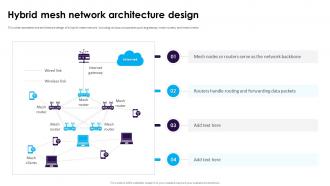
This slide represents the architecture design of a hybrid mesh network, including various components such as gateway, mesh routers, and mesh clients.
People who downloaded this PowerPoint presentation also viewed the following :
Wireless Mesh Networks Hybrid Mesh Network Architecture Design with all 9 slides:
Use our Wireless Mesh Networks Hybrid Mesh Network Architecture Design to effectively help you save your valuable time. They are readymade to fit into any presentation structure.








FAQs for Wireless Mesh Networks Hybrid Mesh
Wireless mesh networks are decentralized communication systems where each node connects to multiple other nodes, creating redundant pathways for data transmission, unlike traditional hub-and-spoke or linear topologies that rely on central access points. These networks enhance reliability and coverage by automatically routing traffic through the strongest available paths, with many organizations in manufacturing, retail, and smart cities finding that mesh architectures deliver superior scalability and fault tolerance.
Wireless mesh networks in urban environments deliver enhanced coverage, automatic healing capabilities, cost-effective scalability, reduced infrastructure dependency, and improved network resilience. These systems streamline connectivity by eliminating dead zones, automatically routing around failed nodes, and enabling rapid deployment across dense populations, with many smart cities finding that mesh networks significantly reduce installation costs while enhancing public services and emergency communications.
Wireless mesh networks enhance rural connectivity by creating self-healing networks where each node acts as a relay point, extending coverage without traditional infrastructure like cell towers or fiber cables. These networks enable remote communities to establish internet access, telemedicine services, and educational resources cost-effectively, with many rural cooperatives finding that mesh technology delivers reliable connectivity while minimizing infrastructure investment.
Wireless mesh networks in smart cities typically support traffic management systems, environmental monitoring sensors, public safety communications, smart lighting infrastructure, and waste management optimization. These interconnected networks enable municipalities to streamline urban operations by providing real-time data collection, enhancing emergency response coordination, and reducing operational costs, ultimately delivering improved citizen services and sustainable resource management.
The self-healing capability enables wireless mesh networks to automatically reroute traffic around failed nodes or congested pathways, maintaining continuous connectivity without manual intervention. This dynamic adaptation significantly reduces downtime for critical applications like emergency services, smart city infrastructure, and industrial operations, ultimately delivering enhanced reliability and operational efficiency while minimizing costly network disruptions.
Wireless mesh networking protocols include OLSR (Optimized Link State Routing), AODV (Ad-hoc On-Demand Distance Vector), DSR (Dynamic Source Routing), HWMP (Hybrid Wireless Mesh Protocol), and Babel. These protocols enhance network reliability by enabling dynamic routing, automatic path discovery, and seamless failover capabilities, with many organizations finding that strategic protocol selection delivers improved coverage and operational efficiency.
Wireless mesh networks face security challenges including node vulnerability, data interception risks, authentication complexities, encryption key management, and potential eavesdropping at multiple access points. While these networks present both challenges and opportunities, many organizations find that implementing robust encryption protocols, regular security updates, and network monitoring ultimately delivers enhanced protection and operational resilience across distributed environments.
Nodes in wireless mesh networks communicate through direct radio connections, creating multiple pathways where each node acts as both endpoint and relay. Through dynamic routing protocols, data automatically finds optimal paths by hopping between nodes, with many telecommunications and smart city deployments finding that this redundancy eliminates single points of failure while delivering seamless coverage and enhanced network reliability.
Radio frequency technologies serve as the fundamental backbone of wireless mesh networks, determining data transmission rates, signal propagation, interference management, and overall network reliability. These RF technologies enable seamless connectivity by optimizing frequency bands, managing power levels, and implementing advanced modulation techniques, with many telecommunications companies and smart city initiatives finding that strategic RF deployment significantly enhances network coverage, reduces latency, and delivers superior performance across distributed IoT applications.
Wireless mesh networks support IoT devices by providing self-healing connectivity, automatic routing, and seamless scalability across distributed environments. Through decentralized node communication, organizations can deploy thousands of sensors, smart meters, and connected devices without single points of failure, while ensuring reliable data transmission and reduced infrastructure costs, ultimately delivering enhanced operational efficiency.
Scalability factors include node density limitations, bandwidth degradation with multiple hops, routing protocol efficiency, interference management, and power consumption constraints. These challenges significantly impact network performance as organizations expand coverage, with many enterprises finding that strategic node placement, quality-of-service protocols, and hybrid architectures ultimately deliver enhanced connectivity while maintaining operational efficiency across larger deployments.
Network congestion significantly impacts wireless mesh network performance by reducing throughput, increasing latency, and causing packet loss as multiple nodes compete for limited bandwidth. Through intelligent routing algorithms and load balancing, organizations in sectors like manufacturing and smart cities can minimize congestion effects, ultimately delivering more reliable connectivity and enhanced operational efficiency.
**INPUT**: What are some best practices for deploying a successful wireless mesh network? **OUTPUT**: Best practices include conducting thorough site surveys, strategically positioning nodes for optimal coverage, ensuring sufficient bandwidth allocation, implementing robust security protocols, and planning for scalability requirements. These approaches streamline deployment by minimizing interference, maximizing signal strength, and enabling seamless connectivity, with many organizations finding that proper planning ultimately delivers enhanced network performance and reduced operational costs. [Word count: 58 words]
Wireless mesh networks facilitate disaster recovery by providing resilient communication infrastructure when traditional systems fail, enabling real-time coordination between emergency responders, rapid deployment of temporary connectivity, and seamless data sharing across affected areas. These self-healing networks automatically reroute communications around damaged nodes, with emergency services, hospitals, and relief organizations finding they can maintain critical operations while delivering faster response times and improved resource coordination.
Wireless mesh networks integrate with existing infrastructure through strategic node placement, backbone connectivity via ethernet or fiber links, and hybrid configurations that leverage current access points. Organizations in manufacturing, healthcare, and retail find that this approach extends coverage to dead zones, reduces cabling costs, and provides redundant pathways, ultimately delivering seamless connectivity and improved network resilience.
-
I was never satisfied with my own presentation design but SlideTeam has solved that problem for me. Thank you SlideTeam!
-
What an exhaustive collection of templates you guys have there in slideteam. Impressive!!!