


Work life balance facts powerpoint guide




Try Before you Buy Download Free Sample Product
 Impress Your
 Audience
 100%
100% Editable
 Save Hours
 of Time


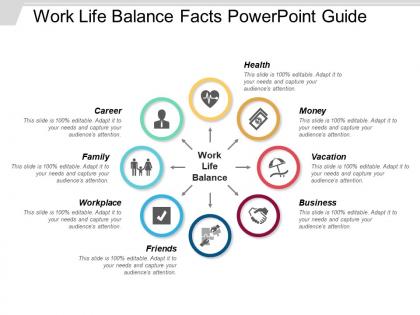
Get this work life balance facts PowerPoint guide to portray a state of equilibrium in various aspects of life. You can use it to depict the stability at your work front. This work life balance PPT layout can help you maintain the required balance in both work and personal life. Determine various facets of your business that need to be managed. Give an attractive appeal to your presentation with the balance PowerPoint presentation. Include leisure and rest in your life while working for fulfilling the financial needs of the family. Motivate your employees to take timely vacations to relax amidst the busy work schedules. Be it life or business, everything requires sense of balance. Lay emphasis on the fact that how any imbalance can create chaos in or day to day lives. Make use of this balance PPT slide to weigh and measure the pros and cons concerning your business. Create an impressive presentation with a professionally designed, high quality and ready to use balance PowerPoint template. Earn a lot of credit with our Work Life Balance Facts Powerpoint Guide. Folks will be forthcoming with their applause.
People who downloaded this PowerPoint presentation also viewed the following :
Work life balance facts powerpoint guide with all 5 slides:
Frowns give way to grins with our Work Life Balance Facts Powerpoint Guide. They ensure happy expressions.


FAQs for Work life balance
Honestly, boundaries are everything but you gotta actually follow through. I used to answer emails at like 11 PM for months - terrible idea. Turn off those work notifications after hours and maybe create a specific work spot at home if you're remote. Tell your coworkers upfront when you're available. The transition ritual thing really works too - I change clothes or walk around the block after work to mentally switch gears. Protect your personal time like it's a meeting you can't miss. Pick one boundary this week and start there, don't try to fix everything at once.
Look, if your boss is blasting out emails at 11 PM, everyone's gonna think they need to respond ASAP. Leadership has to walk the walk first. Actually enforce those communication hours you set - don't just put them in the handbook and ignore them. When people take vacation, don't make weird passive-aggressive comments about timing (seriously, why do managers still do this?). Flexible schedules help too, but honestly? The biggest thing is making sure people won't get side-eyed for logging off at 5. Maybe start by just asking your team what's actually stressing them out. They'll tell you.
Ugh, tech is so annoying for this. Like yeah, working from home is great and calendar apps actually help me stay organized. But then I'm literally answering Slack messages while brushing my teeth at night - it's ridiculous. You gotta draw hard lines somewhere. I put my work phone in another room after 7pm (okay, sometimes 8pm). Also deleted all work apps from my personal phone which was honestly life-changing. Small stuff but it actually works. The flexibility is worth it if you can avoid becoming a 24/7 email zombie.
So I'd do a quick time audit first - just track what you're actually doing vs what you want to be doing for like a week. Are you working late constantly? Checking emails at 9pm? I usually rate different stuff (work, family, health, whatever) from 1-10 to see what's getting ignored. Your energy and mood are probably the biggest tells though. Honestly, once you figure out the problem spots, just pick one or two things to fix. Don't try to revolutionize your entire life overnight - that never works anyway.
Honestly, time-blocking changed my life - just put everything on your calendar, even breaks. I was terrible at this before and constantly stressed. That urgent vs important thing actually works too, stops you from just reacting to whatever's loudest. Oh and batch your emails! Like twice a day instead of checking constantly (guilty of this still sometimes). Notifications are the worst - turn off anything that's not critical. Don't try to do everything at once though. Pick one thing, maybe start with blocking out your calendar, and see how it goes first.
Dude, flexible hours changed everything for me. I used to stress constantly about leaving for appointments or picking up my kid. Now I can shift my schedule around without that guilt trip, you know? Like yesterday I started late because of a dentist thing, then just worked until 7. Life happens - doctor visits, your car breaking down, whatever. Being able to roll with it instead of panicking about "official" hours is such a relief. You avoid rush hour traffic too which is honestly a nice bonus. If your manager's cool, definitely worth bringing up. Even partial flexibility helps tons.
Oh man, mindfulness is a total game-changer for work-life balance! It keeps you actually present instead of having your brain scattered everywhere. You'll be way more focused during work hours, which means less mental baggage following you home. The best part? You start catching stress before it spirals - like, why didn't anyone tell me this sooner lol. It teaches you how to genuinely "clock out" mentally instead of rehashing that awkward meeting while you're trying to eat dinner. Honestly just try 5 minutes of deep breathing when you walk through your door. Works every time.
Dude, bad work-life balance is seriously toxic for teams. People make way more mistakes when they're burnt out, and honestly? Working crazy hours doesn't even get you better results. I've watched whole departments turn into zombies - no creativity, constant sick days, everyone secretly job hunting. The worst part is how it spreads through the office like a virus. Short breaks actually help productivity (who knew, right?). If you're seeing these warning signs, maybe start small - like actually letting people take lunch or not texting them at 9pm about random stuff.
Ask your people what they actually want first - surveys, one-on-ones, whatever works. Don't just guess. Flexible stuff usually wins: remote options, weird hours, mental health days, different leave types. Most companies honestly just steal ideas from others without thinking. Your team's different though, so build around that. Pilot small things first, see what sticks, then expand. Oh and train your managers properly - they're the ones who'll make or break this whole thing. Nothing worse than great policies that get implemented terribly.
Oh man, you'll know when it hits. Like constantly checking emails way past dinner time, or feeling wiped out even after sleeping in on Saturday. I always notice it first when I start getting irritated at random stuff - my family asks one question and I just snap, you know? Your sleep goes to hell, you're grabbing energy bars instead of actual meals. And honestly? The dead giveaway is realizing you haven't done anything fun in weeks. Not even like a hobby or hanging with friends. Work just swallows everything. Try setting one simple rule today - maybe no work texts after 9pm or something.
Honestly, you've gotta be ruthless about blocking time for both. I literally put "family dinner" on my work calendar now - sounds crazy but it works. Weekly balance beats daily perfection, trust me on this. Some days work's gonna win, others the kids need you more. That's just life. Oh and I learned this lesson the expensive way - missed way too many school events before I figured it out. Start with your absolute must-haves for work and family, then squeeze everything else around those. Don't try to be superhuman every single day, you'll burn out fast.
Honestly, start with tracking where your time actually goes - RescueTime or Toggl are pretty good for that. You'll probably be horrified by how much time disappears into email, lol. For books, "Digital Minimalism" really opened my eyes, and "Boundaries" is solid too. Check if your company has those employee assistance programs - free counseling sessions can be a game changer. Coursera has decent courses on time management stuff if you're into that. My advice? Pick literally one thing to try first. Otherwise you'll just stress yourself out trying to fix everything at once.
Honestly, you've gotta practice what you preach here. Leave at normal hours, actually take your vacation days, and for the love of god stop sending those midnight emails - nothing's that urgent. When someone's constantly working late, ask about their workload instead of acting like they're some hero. Show your team it's cool to disconnect by being transparent about your own limits. Oh, and here's the big one - don't promote the people who burn themselves out. That sends the worst message. Your team pays way more attention to what you do than whatever you say in those weekly meetings anyway.
Honestly, you can't have good work-life balance if you're constantly stressed or burnt out. Your mental and physical health come first - when those are solid, you'll actually have energy left after work instead of dragging yourself home every day. Companies with decent well-being programs? Their employees can actually log off at 5pm without guilt. It's wild how much easier boundaries become when you're not overwhelmed 24/7. Figure out what well-being looks like for you specifically (sleep? exercise? therapy?) then start asking for it. Don't wait for permission.
Honestly, I've found that sneaking hobbies into work breaks is a total game-changer. Like, I'll sketch for 10 minutes between meetings or listen to podcasts during lunch walks. Photography completely resets my brain - way better than scrolling social media. The cool thing is your hobbies actually build real skills too. Guitar practice develops patience, sketching boosts creativity. You don't need this perfect work-life balance thing everyone talks about. Just find tiny pockets of time. Block out 15 minutes tomorrow for something you actually enjoy and see how it feels.
-
Innovative and Colorful designs.
-
Designs have enough space to add content.