


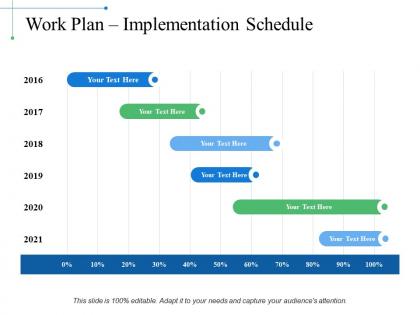
Work plan implementation schedule ppt example file




Try Before you Buy Download Free Sample Product
 Impress Your
 Audience
 100%
100% Editable
 Save Hours
 of Time


Concentrate your efforts with our Work Plan Implementation Schedule Ppt Example File. Get all forces acting coherently.
People who downloaded this PowerPoint presentation also viewed the following :
Work plan implementation schedule ppt example file with all 5 slides:
Assess the inputs with our Work Plan Implementation Schedule Ppt Example File. Ascertain the credibility of the data.




FAQs for Work plan implementation schedule
Key components of an effective work plan implementation schedule include clearly defined milestones, realistic timelines, resource allocation frameworks, progress tracking mechanisms, and contingency buffers. These elements work together by establishing accountability structures, enabling proactive risk management, and facilitating seamless coordination across teams, ultimately delivering project success and operational efficiency.
Project milestones integrate into work plan implementation schedules through strategic checkpoint placement, dependency mapping, resource allocation alignment, and progress measurement frameworks. These milestone markers streamline project tracking by establishing clear deliverable deadlines, enabling proactive risk management, and facilitating stakeholder communication, with many organizations finding that well-integrated milestones ultimately enhance project visibility and delivery success rates.
**INPUT**: What tools or software are recommended for tracking the progress of a work plan implementation schedule? **OUTPUT**: Recommended tools include Microsoft Project, Asana, Trello, Monday.com, and Smartsheet for comprehensive schedule tracking and team coordination. These platforms streamline progress monitoring by enabling real-time updates, automated reporting, and resource allocation visibility, with many organizations finding that integrated dashboards ultimately deliver enhanced project transparency and faster milestone completion.
Responsibilities should be assigned based on team members' expertise, availability, and skill alignment with specific tasks, while considering workload balance and project dependencies. Clear accountability structures with defined owners, backup resources, and escalation paths ensure seamless execution, with many organizations finding that matching technical complexity to experience levels ultimately delivers faster completion times and higher quality outcomes.
Effective stakeholder engagement strategies include regular progress updates, structured feedback sessions, collaborative decision-making processes, clear communication channels, and milestone celebrations. These approaches streamline implementation by maintaining transparency, addressing concerns proactively, and fostering ownership, with many organizations finding that engaged stakeholders ultimately deliver faster project completion and enhanced buy-in across all organizational levels.
Accounting for risks and delays involves building buffer time into project timelines, conducting thorough risk assessments, and establishing contingency plans for critical milestones. Organizations typically use risk matrices to identify potential bottlenecks, maintain flexible resource allocation, and implement regular checkpoint reviews, ultimately delivering more realistic schedules and enhanced project success rates.
Communication serves as the backbone of successful work plan implementation, ensuring alignment between teams, stakeholders, and project milestones through regular updates, feedback loops, and transparent progress reporting. Effective communication channels enable organizations to address bottlenecks quickly, maintain accountability across departments, and adapt schedules dynamically, with many finding that structured communication protocols reduce project delays by up to 40%.
Teams can adapt work plan schedules by implementing flexible milestone frameworks, maintaining buffer periods for scope adjustments, establishing clear change management protocols, and utilizing agile methodology principles. Through regular sprint reviews and stakeholder check-ins, organizations streamline scope modifications while preserving project timelines, with many teams finding that proactive communication and modular task structures ultimately deliver enhanced project adaptability and stakeholder satisfaction.
Common pitfalls include underestimating task durations, failing to identify dependencies between activities, inadequate resource allocation, lack of buffer time for unexpected delays, and insufficient stakeholder communication. These scheduling challenges can derail project timelines significantly, with many organizations finding that building realistic timeframes, conducting thorough dependency mapping, and maintaining regular progress reviews ultimately delivers more successful implementations and better stakeholder confidence.
Success of an implemented work plan is measured through key performance indicators, milestone completion rates, budget adherence, timeline accuracy, and quality outcomes. These metrics enable organizations to track progress systematically, identify areas requiring adjustment, and demonstrate tangible results, with many finding that regular monitoring enhances operational efficiency and delivers competitive advantage.
Regular reviews and revisions ensure work plan implementation schedules remain aligned with changing business priorities, resource constraints, and market conditions through systematic monitoring, performance assessment, and adaptive adjustments. This iterative approach enables organizations to identify bottlenecks early, reallocate resources strategically, and maintain project momentum, ultimately delivering improved outcomes and competitive advantage in increasingly dynamic environments.
A work plan implementation schedule enhances project transparency by providing clear timelines, milestone visibility, progress tracking mechanisms, and stakeholder accountability measures. Through detailed scheduling frameworks, organizations can monitor deliverables, communicate updates effectively, and identify potential bottlenecks early, with many project teams finding that structured schedules ultimately deliver improved collaboration and stakeholder confidence.
**INPUT**: What techniques can be used to forecast resource allocation in a work plan implementation schedule? **OUTPUT**: Resource forecasting techniques include historical data analysis, capacity planning models, Monte Carlo simulations, expert judgment assessments, and workload distribution algorithms. These methods enable organizations to optimize staffing levels, anticipate budget requirements, and minimize project delays, with many companies finding that strategic resource forecasting delivers improved operational efficiency and competitive advantage.
Task prioritization in work plan implementation involves assessing urgency, impact, resource requirements, dependencies, and stakeholder needs to create a strategic sequence. Organizations typically use frameworks like critical path analysis and resource allocation matrices to identify high-priority activities, while ensuring team capacity and deadline alignment ultimately delivers efficient project execution and measurable outcomes.
Team dynamics significantly impact work plan implementation efficiency through communication quality, collaboration levels, conflict resolution capabilities, and shared accountability structures. Strong team cohesion streamlines decision-making processes, accelerates task completion, and minimizes delays, while dysfunctional dynamics create bottlenecks and missed deadlines, with many organizations finding that investing in team development ultimately delivers faster project timelines and improved resource utilization.
-
Innovative and attractive designs.
-
Unique and attractive product design.