


World map of the continents image




Try Before you Buy Download Free Sample Product
 Impress Your
 Audience
 100%
100% Editable
 Save Hours
 of Time


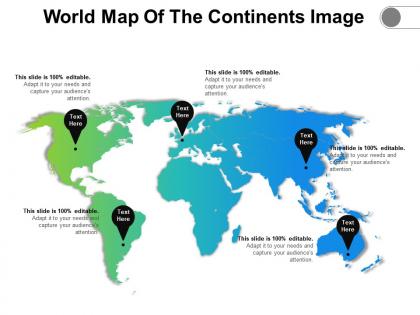
Introducing World Map Of The Continents Image PPT slide design. You can showcase the territories or economies where your business centers are located with the help of this location diagram PowerPoint template. The importance of infrastructure to support everyday economic activity can also be described using this business map PowerPoint graphic. Showcase the comparison of male and female users who consume a specific product in a particular country with this geographical base PowerPoint infographic. Also, showcase the factors which business needs to decide on the best location. Implement a unique strategy for selecting the right country for your existing or new business unit utilizing this effective PPT template. Identify potential customers and understand the preferences and consumption patterns of the target group by downloading our readily available world map PowerPoint presentation.
People who downloaded this PowerPoint presentation also viewed the following :
World map of the continents image with all 5 slides:
Add to the feathers in you cap with our World Map Of The Continents Image. Be able to bag greater glory.



FAQs for World map of
Okay so for your geography thing - Asia's got those crazy tall Himalayas plus huge rivers like the Ganges. Africa's all about the Sahara and that massive Great Rift Valley (which is honestly pretty wild when you see pics). The Rockies and Great Lakes define North America pretty well. Europe's weirdly flat compared to others, just some mountain ranges here and there. South America's easy - Andes mountains run straight down like a backbone, plus you've got the Amazon. Australia's mostly desert with mountains along the coasts. Antarctica... yeah, it's just ice lol. Focus on the big mountain ranges and river systems - they basically shape everything else about each continent's weather and stuff.
Oh man, cultural differences are wild when you think about it! Like in business meetings, Asians tend to focus way more on building relationships first, while Americans just want to get straight to the point. Communication styles are totally different too - being direct might be normal here but super rude somewhere else. Time concepts, religious stuff, social hierarchies... it's crazy how geography basically shapes how we see everything. Sure, it causes misunderstandings sometimes, but honestly? That's also where the coolest innovations happen when different perspectives mix. Just do your homework on local customs before any international stuff.
So basically, continents are like giant heat sinks that mess with air pressure systems everywhere. Mountains block moisture - that's why one side gets dumped on while the other stays dry. Ocean currents have to flow around these massive landmasses too, which is actually why Europe doesn't freeze despite being super far north. The Gulf Stream gets pushed their way. It's crazy how much your local weather depends on some mountain range hundreds of miles away. Even deserts exist partly because of how continents sit. Geography literally controls everything weather-wise.
Wars and colonization basically redrew the entire world map. European powers just sliced up Africa and Asia however they wanted - totally ignored where different groups actually lived. Both World Wars completely changed Europe and the Middle East too. Then in the 20th century, decolonization created tons of new countries across Africa and Asia. It's honestly crazy how different old maps look compared to today. A lot of current conflicts still stem from these artificial borders that were drawn by outsiders who didn't understand (or care about) local cultures.
So basically geography runs the show when it comes to trade routes. Look at how ships hug coastlines and squeeze through places like the Suez Canal - that's continents forcing traffic into chokepoints. Port cities get crazy rich because mountains and deserts push everything toward the water. Europe lucked out with all those natural harbors, while Africa got kinda screwed by being cut off geographically. Asia's so huge that overland routes like the Silk Road were make-or-break for connecting regions. Honestly, just pull up a map when you're studying this stuff - the physical barriers explain most of why trade goes where it does.
Honestly, English pretty much owns North America and Australia. Spanish takes over most of South America, Arabic dominates the Middle East and North Africa. Europe's a bit messy - German, French, and English are your big three there. Asia's where it gets crazy though. Mandarin has the most speakers worldwide, but don't sleep on Hindi and Japanese - they're massive too. Africa blew my mind when I looked into it - over 2,000 languages! Though Arabic, Swahili, and leftover colonial languages like French still get you pretty far. If you're thinking travel or business stuff, I'd start with whichever major ones hit your target areas first.
So basically, different continents = totally different evolutionary playgrounds. South American and African rainforests are absolutely packed with species - like, insanely diverse. Australia's been isolated forever, which is why they've got all those weird marsupials you won't find anywhere else. Asia's climate range is nuts - from frozen tundra to hot tropics - so you get pandas AND tigers somehow coexisting on the same continent. North America's temperate stuff creates its own thing entirely. Even Antarctica has specialized marine creatures! Geographic separation just lets evolution go wild in different directions. Pretty cool how location shapes everything, honestly.
So basically, tectonic plates are what cause most of the big earthquakes and volcanic eruptions you see. Plates crash into each other, pull apart, or grind past one another - that's where you get fault lines and spots where magma breaks through. Look at the Ring of Fire around the Pacific, it's crazy how much activity happens there because so many plates meet up. Japan gets hammered constantly, same with California and Indonesia. Meanwhile Australia's middle? Pretty quiet since it's not near any major boundaries. If you're ever thinking about living or investing in those active zones, I'd definitely research the geological risks first.
So Africa and Asia are urbanizing crazy fast right now, while Europe and North America are pretty much already there. The real mess happens when cities grow too quickly - like, their infrastructure just can't keep up. You've got Africa dealing with huge slums and water issues, Asia choking on pollution and overcrowding (Delhi's traffic is literally a nightmare). Meanwhile developed countries are stuck with crumbling old infrastructure and endless suburban sprawl. Cities that plan ahead and invest in good infrastructure early do way better than the ones scrambling to catch up later.
So basically, Africa and Asia are adding billions of people in the coming decades - it's crazy when you see the projections. Meanwhile Europe and Japan are actually shrinking because people aren't having kids and everyone's getting older. North America's growing too, but mostly from immigration rather than births. Latin America's interesting though - their growth is way slower than it used to be. If you're doing anything global, this stuff matters a ton since it affects markets, workers, resources... all that. I was just reading about this for a work thing actually.
Dude, resources are so unevenly spread it's crazy. Asia's got manufacturing locked down plus huge coal reserves. Middle East obviously controls most oil. Africa has incredible minerals - cobalt, diamonds, you name it - but their infrastructure for getting it out is still pretty rough which sucks. North America's actually pretty lucky with diverse energy, from shale to renewables. Europe imports tons but they're killing it with renewable tech. Australia ships out massive amounts of iron ore and coal. Oh and South America has Venezuela's oil plus all that lithium everyone wants now. Basically check which continent has what you need first.
So basically each continent has its own mess to deal with. Amazon deforestation is huge in South America, while China and India are pumping out crazy industrial pollution. Africa's got desertification plus all that resource extraction happening. North Americans (yeah, us) are terrible per capita for carbon emissions - honestly pretty embarrassing. Europe's got better regulations now but they're still dealing with old pollution problems. Australia's wildlife is getting hammered in unique ways. The tricky part? None of this stays put - it all affects global weather patterns that hit everyone. UN Environment Programme tracks this stuff if you want real data.
Dude, it's wild how much things have changed. We went from those crazy long sea voyages that took months to hopping on a plane and being anywhere in like 8 hours. Now you can FaceTime someone in Japan while ordering stuff from Germany that'll show up next week. Container ships are insanely huge these days, but honestly planes were the real game-changer. Then the internet made distance basically meaningless for most stuff. Oh, but shipping times and time zones will still mess with your plans if you're doing anything international - learned that the hard way!
Honestly, National Geographic's continent guides are where I'd start - they break down all the physical features and climate stuff really well. Google Earth Education is pretty cool too, plus the BBC geography section shows how mountains mess with weather patterns (that's actually fascinating once you get into it). Smithsonian has decent online materials for the tectonic plate stuff. Pick one continent that interests you and just go deep on it first. You'll start seeing the same patterns everywhere else - like how geography totally shapes where people live and how trade routes developed. The interactive tools really help it click.
So basically, climate change is hitting different places in totally different ways. Europe's getting slammed with energy costs from all the crazy weather. Africa's dealing with crop failures and water issues that are tanking their GDP. Asia's got those huge coastal factories - imagine if sea levels mess up all those supply chains. Pretty scary stuff. North America's weird though - yeah they're getting disasters, but some northern areas actually benefit from longer growing seasons. South America's losing rainforest money while droughts wreck everything else. Australia's tourism and farming are just getting destroyed by fires and heat. Definitely something to think about for any long-term business stuff you're planning.
-
The Designed Graphic are very professional and classic.
-
Excellent design and quick turnaround.