

Advanced Technologies Powerpoint Presentation Slides





Try Before you Buy Download Free Sample Product
 Impress Your
Audience
 100%
Editable
 Save Hours
of Time


One of the newest technological revolutions, AI, is already well known for being superior to humans. Check out our professionally designed Advanced Technologies template. It briefly overviews Artificial Intelligence AI and Machine Learning. In our Cutting-edge technologies deck, we have demonstrated Extended Reality, which refers to all simulation-based technologies, including Virtual Reality, Augmented Reality, Mixed Reality, and Everything in between. Prototyping with 3D printing is a crucial breakthrough and technological trend which has Impacted biomedical and industrial fields. In addition, our Emerging Technologies PPT contains Robotic Process Automation RPA with its market study and growth. Also, the New Technology PPT includes Quantum Computing, a type of computation that uses quantum phenomena like quantum entanglement and superposition. Lastly, it exhibits topics like Blockchain Technology, the Internet of Things IoT, 5G, Hyper automation technology, Cognitive computing, Cyber security, Everything as a Service XaaS, and Edge Computing. Download our 100 percent editable and customizable template, also compatible with Google Slides.
People who downloaded this PowerPoint presentation also viewed the following :
Content of this Powerpoint Presentation
Slide 1: This slide introduces Advanced Technologies. Commence by stating Your Company Name.
Slide 2: This slide depicts the Agenda of the presentation.
Slide 3: This slide incorporates the Table of contents.
Slide 4: This is yet another slide continuing the Table of contents.
Slide 5: This slide highlights the Title for the Topics to be covered further.
Slide 6: This slide explains overview of various latest technologies with its description and use case.
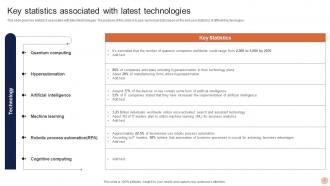
Slide 7: This slide states the Key statistics associated with latest technologies.
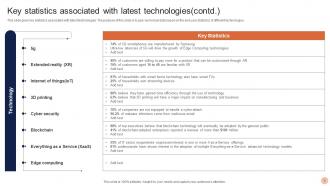
Slide 8: This slide continues the key statistics associated with latest technologies.
Slide 9: This slide presents the Heading for the Contents to be discussed next.
Slide 10: This slide showcases the Global market overview of quantum computing.
Slide 11: This slide explains overview of quantum computing and its application such as artificial intelligence, machine learning, etc.
Slide 12: This slide depicts the Quantum computing elements and working.
Slide 13: This slide showcases types of quantum computing systems.
Slide 14: This slide elaborates on how quantum computing transforms businesses in different sectors.
Slide 15: This slide displays the implementation checklist for quantum computing in the workplace.
Slide 16: This slide portrays the Title for the Ideas to be covered in the following template.
Slide 17: This slide shows Market overview of hyper automation technology covering year from 2022 till 2030 with estimated compound annual growth rate.
Slide 18: This slide gives an overview of hyperautomation technology which covers various technology.
Slide 19: This slide explains use cases of hyperautomation in various industries sector.
Slide 20: This slide shows predicted market growth of artificial intelligence by providing insights on customer satisfaction.
Slide 21: This slide gives an overview of artificial intelligence with its working.
Slide 22: This slide explains two major types of artificial intelligence (AI) which are strong and weak artificial intelligence.
Slide 23: This slide presents the Artificial intelligence use case in business.
Slide 24: This slide outlines the global market overview of machine learning.
Slide 25: This slide briefly talks about machine learning and its working.
Slide 26: This slide talks about the Applications of machine learning in different domains.
Slide 27: This slide showcases the Role of machine learning in business transformation.
Slide 28: This slide discusses the Global robotic process automation market overview.
Slide 29: This slide gives a glimpse of robotic process automation with its working and benefits.
Slide 30: This slide explains the important business impact of robotic process automation.
Slide 31: This slide includes the Heading for the Ideas to be discussed in the upcoming template.
Slide 32: This slide discusses the Global market overview of cognitive computing.
Slide 33: This slide gives an overview and working of cognitive computing.
Slide 34: This slide explains important features of cognitive computing.
Slide 35: This slide indicates the Title for the Contents to be covered further.
Slide 36: This slide explains the Global market overview of 5G networks from 2022 to 2030.
Slide 37: This slide showcases 5 Generation network in telecommunication.
Slide 38: This slide explains the use cases of 5G network across different sectors.
Slide 39: This slide explains global economic impact of 5G network in various industries.
Slide 40: This slide contains the Heading for the Topics to be discussed next.
Slide 41: This slide explains the Market overview of internet of things.
Slide 42: This slide provides an overview of the internet of things and its components.
Slide 43: This slide explains the Use case of internet of things in various industries in various industries.
Slide 44: This slide presents the Title for the Contents to be covered next.
Slide 45: This slide explains global market overview of extended reality (XR) for the year 2021.
Slide 46: This slide reveals the Introduction to extended reality (XR) technology.
Slide 47: This slide explains the journey of extended reality technology using a timeline from 1968 to 2020.
Slide 48: This slide depicts the Roadmap to implement extended reality technology.
Slide 49: This slide gives an overview of virtual reality technology with its three types non-immersive, semi-immersive and full immersive.
Slide 50: This slide gives a brief overview of augmented reality technology and how it works.
Slide 51: This slide explains the difference between augmented reality and virtual reality.
Slide 52: This slide displays the Overview of mixed reality(MR) technology.
Slide 53: This slide incorporates the Heading for the Topics to be discussed further.
Slide 54: This slide gives an idea about the size of the global 3D printing market along with the market's value in recent years.
Slide 55: This slide provides an introduction to three-dimensional printing in detail.
Slide 56: This slide states the Various types of 3D printing technology.
Slide 57: This slide talks about the 3D printing applications in various industry.
Slide 58: This slide displays the Title for the Contents to be covered next.
Slide 59: This slide explains Cyber security technology market overview with top players in the year 2021.
Slide 60: This slide gives an overview of cyber security technology.
Slide 61: This slide explains the objectives of cyber security technology such as confidentiality, integrity and availability.
Slide 62: This slide states the Various types of cyber attacks on system.
Slide 63: This slide includes the Heading for the Contents to be discussed further.
Slide 64: This slide showcase market overview of blockchain from year 2022 till 2030 with compound annual growth rate.
Slide 65: This slide gives an introduction and working of blockchain technology.
Slide 66: This slide explains various types of blockchain technology such as public, private, hybrid and consortium.
Slide 67: This slide displays the Title for the Ideas to be covered in the following template.
Slide 68: This slide shows market overview of Everything as a Service covering year from 2022 till 2030 with estimated compound annual growth rate.
Slide 69: This slide states the Various components of everything as a service (xaas).
Slide 70: This slide exhibits the Benefits of everything as a service technology.
Slide 71: This slide shows the timeline of Everything as a Service.
Slide 72: This slide portrays the Heading for the Ideas to be discussed in the next template.
Slide 73: This slide shows market overview of edge computing covering year from 2022 till 2027 with estimated compound annual growth rate.
Slide 74: This slide gives the introduction to edge computing with its working.
Slide 75: This slide describes the cloud architecture in edge computing, including its three layers: cloud, fog, and edge.
Slide 76: This slide explains business use-case of different segments of edge computing.
Slide 77: This is the Icons slide containing all the Icons used in the plan.
Slide 78: This slide is used for depicting some Additional information.
Slide 79: This slide illustrates the Emerging technology hype cycle.
Slide 80: This slide exhibits the company's Timeline.
Slide 81: This slide represents the SWOT analysis.
Slide 82: This is Our team slide. State your team-related information here.
Slide 83: This is the Venn diagram slide.
Slide 84: This is the Idea generation slide for encouraging fresh ideas.
Slide 85: This is the Target slide. State your organziation's targets here.
Slide 86: This is the 30,60,90 days plan slide for effective planning.
Slide 87: This slide contains the Post notes for reminders and deadlines.
Slide 88: This is the Magnifying glass with minute details.
Slide 89: This is the Thank You slide for acknowledgement.
Advanced Technologies Powerpoint Presentation Slides with all 93 slides:
Use our Advanced Technologies Powerpoint Presentation Slides to effectively help you save your valuable time. They are readymade to fit into any presentation structure.












FAQs for Advanced Technologies
Honestly, tech is what's making sustainability actually work for businesses these days. Companies are using AI to cut energy costs, IoT sensors to track waste, blockchain for supply chain stuff - you know, the works. Smart buildings alone can slash energy bills by 30% which is pretty wild. The thing is, this isn't just about being eco-friendly anymore. It's straight up giving companies an edge over competitors. If your team's thinking about sustainability projects, I'd start by figuring out where you can collect data first. You'll probably find inefficiencies you had no clue about.
Look for actual problems AI can fix in your workflow first - don't just jump on the hype train. Customer service bots, inventory predictions, automated data stuff... that's where you'll actually see returns. Honestly? So many companies blow money on "AI transformations" that solve nothing. My neighbor's startup did this and wasted like 6 months. Start small with pilot projects using Microsoft's AI tools or Google's APIs instead of building everything yourself. But here's the thing - train your people first. Best tech in the world won't help if your team doesn't know how to use it properly.
Honestly, the big ethical mess with workplace automation comes down to three things: job displacement, fairness, and whether we're treating people with basic dignity. Companies get more productive, but who actually benefits from that? Meanwhile, workers get tossed aside even though they need those paychecks to survive. It's pretty messed up when you think about it. The trick is using automation to make human workers better at their jobs instead of just replacing them outright. If your company's going down this road, definitely push for retraining programs and gradual rollouts - not just cold turkey layoffs.
Honestly, quantum computing's gonna change everything. Complex problems that take forever now - drug discovery, financial modeling - will get solved crazy fast. But here's what's actually scary: it'll demolish our current encryption. All that RSA and AES stuff protecting your data? Basically worthless against a decent quantum machine. I mean, we're talking about cracking codes like butter. Good thing researchers are already working on quantum-resistant encryption methods. You should probably start learning about "post-quantum cryptography" now - sounds nerdy but it's gonna be huge for keeping systems secure down the road.
Dude, the stuff happening in medicine right now is insane. CRISPR lets doctors literally edit your DNA to fix genetic problems - like science fiction but real. Your treatments can now be customized based on your specific genes instead of generic approaches. They're growing actual organs in labs (my cousin's doing research on this, it's mind-blowing). AI is catching diseases way faster than doctors could before. Oh, and immunotherapy basically trains your immune system to hunt down cancer cells. Honestly, if you're in healthcare you should probably keep up with this stuff because it'll change everything soon.
Dude, the whole education thing is getting wild. AI tutors now adjust to however fast you learn. VR lets you literally walk around ancient Rome instead of just reading about it. AR can make your kitchen table into a science lab - which honestly still blows my mind. That old classroom setup where everyone just sits there? Pretty much dead. Students get custom learning plans and feedback right away. Even tools like ChatGPT changed how people dig into research. My advice? Play around with some of these yourself. Your students are probably already using half this stuff anyway, so you might as well know what you're dealing with.
Dude, network coverage is gonna be your biggest pain - getting reliable signals across dense urban areas while keeping all that personal data secure. The money side gets insane fast when you're looking at citywide rollouts. Legacy systems are ancient and hate talking to new tech, which creates massive integration headaches. Residents freak out about privacy stuff too, which I totally get but it slows everything down. Oh, and don't even get me started on the political BS - that alone could tank your whole timeline. Start small with pilot programs in a few districts first. Prove it works and makes money before going citywide.
So AR and VR are basically changing how we interact with stuff - making it way more hands-on instead of just staring at screens. Surgeons practice crazy procedures in VR before the real deal. You can try on clothes virtually or see how that couch looks in your living room. Students walk through ancient Rome instead of just reading about it (honestly way cooler than textbooks). Manufacturing workers get digital instructions overlaid on actual equipment. The thing is, they're finally moving past the "wow factor" into actually useful territory. If you're thinking about either one, just focus on fixing a real problem rather than adding tech because it looks impressive.
Look, blockchain's basically a shared ledger that can't be faked - no central authority needed. Pretty cool for supply chains, healthcare records, voting stuff. The hype gets annoying sometimes though. Main thing is it cuts out middlemen and stops fraud between parties who don't trust each other. Food tracking from farm to fork, digital IDs, that sort of thing. If you're thinking about using it, just figure out where you've got trust issues first - like where do people currently lie or where verification sucks? Start there.
Honestly, the tech stuff can totally change how you handle your supply chain. IoT sensors automatically track shipments and inventory - no more guessing games. AI figures out demand patterns and finds better routes. You get crazy visibility compared to the old phone tag days with carriers (blockchain helps with transparency too). Machine learning spots bottlenecks before they screw you over. My advice? Don't go all-in at once. Pick one annoying problem - maybe inventory tracking or delivery headaches - and start there. The algorithms will suggest alternatives when things go sideways.
So right now everyone's talking about AI threat detection and zero-trust security - which is basically "trust nobody until they prove themselves." Quantum-resistant encryption is getting big too because quantum computers will eventually crack everything we use now. XDR platforms are popping up everywhere, probably because we all have way too many security tools that don't talk to each other. Cloud and IoT security is huge since those are where most attacks happen now. Honestly, I'd just do a quick audit of what you're currently using and see where the obvious holes are.
Honestly, big data is like having superpowers for your business - you can actually see patterns in customer behavior and market stuff that would be impossible to catch otherwise. Predicting demand becomes way easier. You'll know which products are gonna tank before you even launch them, plus figure out exactly where money's going down the drain. The trick is not getting obsessed with every single data point (I've seen people go crazy with spreadsheets). Pick one specific problem you need to solve first, then expand once you start seeing real results. Way better than guessing your way through decisions.
Floating solar is pretty cool - they put panels on water which keeps them cooler and more efficient while solving the whole "where do we put all these panels" problem. Perovskite cells are the big breakthrough everyone's watching, way cheaper and more flexible than silicon, but they're still figuring out how to make them last (typical research stuff). Offshore wind is crushing it though, ocean winds are just so much stronger and consistent than onshore. Oh and definitely watch energy storage too - that's honestly what'll make or break renewables going mainstream. Battery tech is moving fast.
Honestly, tech has flipped everything upside down for how people shop now. AI suggestions, AR try-ons, voice ordering - customers just expect all that personalized stuff everywhere they go online. Marketers are scrambling to use data and automation to hit people with the right message at exactly the right time. Social media algorithms basically run the show now, and influencers have way more pull than traditional ads ever did. Oh, and you can't just blast content hoping people come to you anymore. You've got to actually show up where your audience already hangs out digitally. It's wild how much has changed in just a few years.
Honestly, the biggest thing to watch out for is bias getting worse - AI just amplifies whatever unfair patterns are already in your data. Then you've got the black box issue where nobody can explain why it made a decision, which is terrifying for stuff like hiring or loans. People also trust these systems way too much without questioning anything. Oh, and the transparency thing is huge right now with all the regulations coming down. I'd say always keep humans in the loop, check regularly for biased outcomes, and make sure you can actually explain the big decisions to whoever's asking.
-
Use of different colors is good. It's simple and attractive.
-
World-class PowerPoint designs that are fully customizable!