


Affiliate Marketing Plan Proposal Powerpoint Presentation Slides





Try Before you Buy Download Free Sample Product
 Impress Your
 Audience
 100%
100% Editable
 Save Hours
 of Time


Affiliate marketing plays a vital role in increasing brand awareness by generating traffic or leads. Most of the organizations use this process to sell their products online that attracts the target audience. Introduce different affiliate marketing strategies and ensure optimum performance of your website by using our topic-specific Affiliate Marketing Plan Proposal PowerPoint Presentation Slides. With the help of this engaging proposal PPT layout, you can showcase your affordable affiliate program management services that make it easy for the clients to know about their budget and expenses. Use our well-informed affiliate marketing plan proposal presentation template to mention your project context, costing model, client testimonials, terms and conditions, work structure, etc. Employ this professionally designed affiliate marketing strategy PowerPoint theme to showcase your plan promotional methods that include pay per click, search engine optimization, coupon code or cashback websites, and loyalty programs. To gain the confidence of your new clients, you can also highlight your costing model of the affiliate marketing plan that involves cost per action, cost per lead, cost per click, and cost per thousand impressions. With the aid of this content ready affiliate marketing proposal PPT slide, you can explain briefly to your clients about the investment plan for the costing model and cost per lead generation. Describe briefly about the terms and conditions of your marketing proposal that consists of some important points like order processing, fee payment, computation of fees, enrollment in the program, and many more. Take the help of this visually-attractive affiliate marketing proposal PPT template to portray the appreciation and recognition you have received from your previous clients over the past years. You can elaborate on the affiliate marketing plan process that makes your proposal even more impactful. Download our ready-to-use affiliate marketing plan proposal PowerPoint presentation template and create a convincing proposal.
People who downloaded this PowerPoint presentation also viewed the following :
Content of this Powerpoint Presentation
Slide 1: This slide introduces Affiliate Marketing Plan Proposal. State Client name, Designation, Company name.
Slide 2: This slide showcases Cover letter.
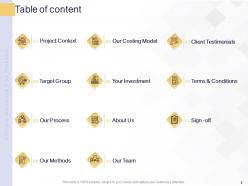
Slide 3: This slide displays table of content of presentation
Slide 4: This slide displays project context
Slide 5: This slide shows Target group for affiliating marketing proposal.
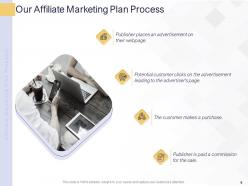
Slide 6: This slide depicts Our Affiliating marketing plan process.
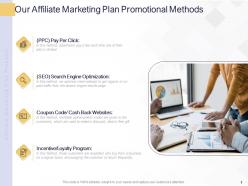
Slide 7: This slide depicts Our Affiliating marketing plan promotional methods.
Slide 8: This slide represents Our Costing Model.
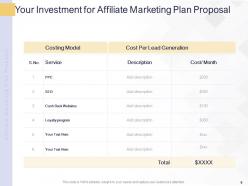
Slide 9: This slide shows Your investment for Affiliate Marketing proposal.
Slide 10: This is About us slide to showcase Company Specifications.
Slide 11: This is Our Team slide with Names and Designations.
Slide 12: This is Our Team slide with Names and Designations.
Slide 13: This slide displays Client Testimonials.
Slide 14: This slide displays Terms & Conditions.
Slide 15: This is Sign-Off slide.
Slide 16: This is Contact us slide with Address, Email address and Contact number.
Slide 17: This slide is titled as Additional Slides for Moving forward.
Slide 18: This is Our Mission slide with Mission, Vision and Goal.
Slide 19: This is 30 60 90 Days Plan slide.
Slide 20: This slide displays Roadmap process.
Slide 21: This slide displays Roadmap process.
Slide 22: This slide displays Roadmap process.
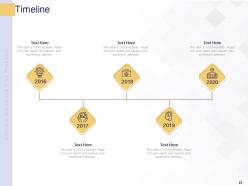
Slide 23: This slide shows Timeline process.
Affiliate Marketing Plan Proposal Powerpoint Presentation Slides with all 23 slides:
Use our Affiliate Marketing Plan Proposal Powerpoint Presentation Slides to effectively help you save your valuable time. They are readymade to fit into any presentation structure.


















FAQs for Affiliate Marketing Plan Proposal
An effective affiliate marketing plan proposal includes target audience analysis, commission structure design, promotional strategy framework, performance tracking metrics, and compliance guidelines. These components work together by defining clear partnership terms, establishing measurable goals, and outlining promotional channels, with many businesses finding that comprehensive proposals attract higher-quality affiliates and ultimately deliver stronger ROI and sustainable partnership growth.
Identifying the right affiliates involves evaluating audience alignment, content quality, engagement rates, brand values compatibility, and promotional methods authenticity. Research potential partners through affiliate networks, competitor analysis, and social media platforms, focusing on those whose followers match your target demographics, while ensuring their content style aligns with your brand messaging, ultimately delivering higher conversion rates and stronger long-term partnerships.
Key metrics include conversion rates, cost per acquisition (CPA), return on ad spend (ROAS), average order value, and lifetime customer value, alongside tracking affiliate performance and attribution accuracy. These measurements enable businesses to optimize partner relationships, identify top-performing channels, and calculate true ROI, with many organizations finding that comprehensive tracking ultimately delivers enhanced campaign efficiency and sustainable revenue growth.
Creating a competitive commission structure involves researching industry benchmarks, analyzing competitor rates, and offering tiered rewards based on performance metrics like sales volume, conversion rates, and affiliate tenure. Successful programs in e-commerce, SaaS, and financial services often combine base commissions with performance bonuses, recurring revenue shares, and exclusive incentives, ultimately delivering higher affiliate retention and increased program profitability.
Affiliate management platforms include ShareASale, Commission Junction, PartnerStack, Impact Radius, and Refersion, alongside CRM systems and analytics tools. These technologies streamline operations by automating commission tracking, centralizing partner communications, and providing real-time performance insights, with many e-commerce businesses finding that integrated platforms reduce administrative overhead while enhancing partner relationships and revenue optimization.
Content marketing serves as the foundation for successful affiliate marketing by building audience trust, establishing expertise, and providing valuable information that naturally integrates affiliate recommendations. Through strategic blog posts, video reviews, and educational resources, affiliates can showcase products authentically while delivering genuine value, with many finding that high-quality content significantly increases conversion rates and long-term customer relationships.
Effective affiliate communication involves regular performance updates, dedicated support channels, transparent commission structures, and personalized outreach strategies. Through automated email sequences and relationship managers, companies streamline onboarding processes, address concerns promptly, and provide marketing resources, with many organizations finding that consistent communication and incentive programs ultimately enhance affiliate loyalty and drive higher conversion rates.
Legal considerations include compliance with FTC disclosure requirements, GDPR data protection regulations, affiliate agreement terms, intellectual property rights, and tax reporting obligations. These frameworks streamline partnerships by establishing clear commission structures, usage guidelines, and liability protections, with many businesses finding that comprehensive legal documentation ultimately delivers reduced disputes and enhanced regulatory compliance across multiple jurisdictions.
Leverage social media for affiliate marketing by creating authentic product reviews, sharing valuable tutorials, engaging consistently with your audience, and utilizing platform-specific features like Instagram Stories or YouTube demonstrations. Focus on building genuine relationships rather than aggressive selling, with successful affiliates finding that educational content and transparent recommendations generate higher conversion rates and sustained audience trust across multiple platforms.
**INPUT**: What strategies can I implement to motivate and engage my affiliates? **OUTPUT**: Effective affiliate engagement strategies include tiered commission structures, exclusive promotional materials, regular performance bonuses, dedicated support channels, and early access to new products or campaigns. These approaches streamline partner relationships by providing clear incentives, enhancing communication transparency, and delivering competitive advantages, with many e-commerce businesses finding that personalized outreach and gamified reward systems ultimately boost affiliate retention and revenue generation. [Word count: 60 words]
Assessing affiliate partners involves evaluating their audience quality, content authenticity, engagement rates, conversion history, and brand alignment with your values. Through analytics tools and performance tracking, businesses can examine traffic sources, demographic match, and past campaign results, while conducting background checks on social media presence, ultimately ensuring partnerships deliver qualified leads and protect brand reputation.
Effective affiliate training includes comprehensive product knowledge, marketing materials, commission structures, compliance guidelines, and performance tracking tools. These resources enhance affiliate success by providing clear messaging frameworks, promotional assets, and ongoing support, with many organizations finding that well-trained affiliates generate significantly higher conversion rates and stronger brand representation.
Incorporating SEO into affiliate marketing involves keyword research for product reviews, creating high-quality content around target keywords, optimizing product comparison pages, and building authoritative backlinks through guest posting. This strategic combination enhances organic visibility, drives qualified traffic to affiliate offers, and reduces dependency on paid advertising, with many affiliate marketers finding that SEO-optimized content delivers sustained revenue growth.
Common pitfalls include unclear commission structures, vague performance metrics, insufficient competitor analysis, unrealistic timeline expectations, and inadequate legal compliance frameworks. These oversights undermine credibility and partnership potential, with many businesses finding that thorough market research, transparent compensation models, and detailed tracking mechanisms ultimately deliver stronger affiliate relationships and measurable revenue growth.
Incorporate affiliate feedback through regular surveys, performance reviews, and direct communication channels to identify pain points, successful strategies, and market insights. This collaborative approach enables you to refine commission structures, optimize promotional materials, and adjust targeting strategies, ultimately enhancing affiliate satisfaction and program performance while delivering stronger ROI.
-
Easily Editable.