

Analysis Of Global Food And Beverages Industry Powerpoint Presentation Slides




Try Before you Buy Download Free Sample Product
 Impress Your
 Audience
 100%
100% Editable
 Save Hours
 of Time


The Analysis of Global Food and Beverages Industry presentation provides a complete overview of the global food and beverage industry with its trends, statistics, and market revenue by country. It includes slides that offer insights about market segmentation of products such as dairy, cold storage, food retail, online grocery, and food service. The PPT describes F and B sector segmentation based on regions such as North America, Asia Pacific, Europe, and the Rest of the World. This template also offers access to market share by distribution channels, i.e., supermarkets, e commerce, and convenience stores. The industry report also highlights insight into USAs F and B market along with this sectors contribution to their economy. Furthermore, the complete deck contains slides that can help researchers or marketers determine COVID19 impact on this sector relating to the supply chain, subsectors, etc. Moreover, it offers slides detailing the market size and growth of the food and beverage sector along with its growth drivers, restraints, and opportunities. Lastly, the PPT industry snapshot includes SWOT, PESTLE, and Porters 5 forces analysis alongside company profile along with comparative analysis of 5 major companies PepsiCo., Tyson Foods, Nestle, Suntory beverage and food ltd, and Bidco Africa.
People who downloaded this PowerPoint presentation also viewed the following :
Content of this Powerpoint Presentation
Slide 1: This slide introduces Analysis of Global Food and Beverage Industry. State your company name and begin.
Slide 2: This slide states Agenda of the presentation.
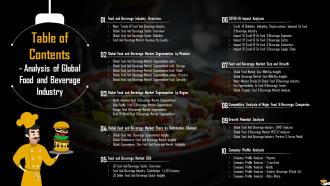
Slide 3: This slide presents Table of Content for the presentation.
Slide 4: This slide highlights title for topics that are to be covered next in the template.
Slide 5: This slide displays Major Trends of Food and Beverage Industry.
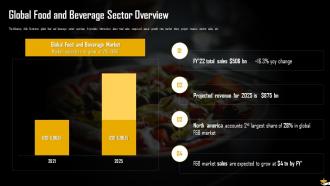
Slide 6: This slide represents Global Food and Beverage Sector Overview.
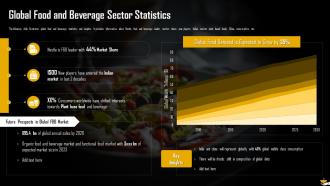
Slide 7: This slide showcases Global Food and Beverage Sector Statistics.
Slide 8: This slide shows Food and Beverage Market Revenue by Country.
Slide 9: This slide highlights title for topics that are to be covered next in the template.
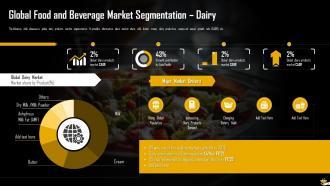
Slide 10: This slide presents global dairy products market segmentation.
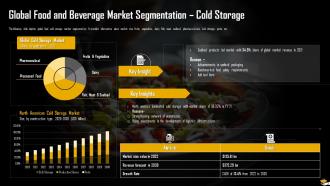
Slide 11: This slide displays Global Food and Beverage Market Segmentation – Cold Storage.
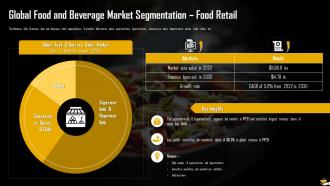
Slide 12: This slide represents Global Food and Beverage Market Segmentation – Food Retail.
Slide 13: This slide showcases Global Food and Beverage Market Segmentation – Online Grocery.
Slide 14: This slide shows Global food and beverage market segmentation – Food service.
Slide 15: This slide highlights title for topics that are to be covered next in the template.
Slide 16: This slide presents North America Food & Beverage Market Segment.
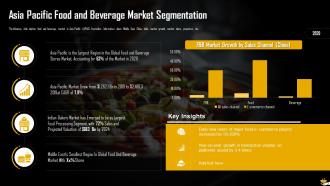
Slide 17: This slide displays Asia Pacific Food and Beverage Market Segmentation.
Slide 18: This slide represents Europe Food and Beverage Market Segmentation.
Slide 19: This slide showcases Rest of World Food and Beverage Market Segmentation.
Slide 20: This slide highlights title for topics that are to be covered next in the template.
Slide 21: This slide shows Global Food and Beverage Market Share by Distribution Channel.
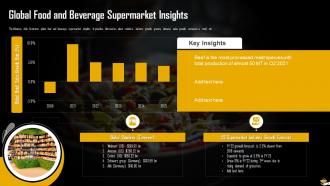
Slide 22: This slide presents Global Food and Beverage Supermarket Insights.
Slide 23: This slide displays Global Ecommerce Food and Beverage Market Insights.
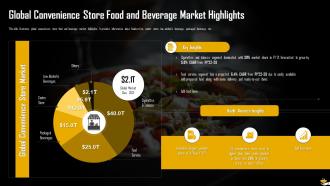
Slide 24: This slide represents Global Convenience Store Food and Beverage Market Highlights.
Slide 25: This slide highlights title for topics that are to be covered next in the template.
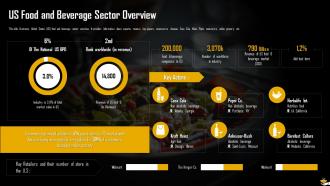
Slide 26: This slide showcases US Food and Beverage Sector Overview.
Slide 27: This slide shows Food and Beverage Industry Contribution to US Economy.
Slide 28: This slide presents US Online Food and Beverage Sector Insights.
Slide 29: This slide highlights title for topics that are to be covered next in the template.
Slide 30: This slide displays COVID-19 Statistics Indicating Repercussions Imposed on Food & Beverage Industry.
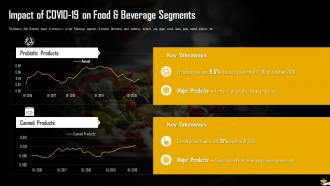
Slide 31: This slide represents Impact of COVID-19 on Food & Beverage Segments.
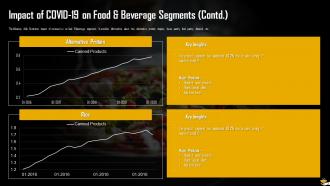
Slide 32: This is another slide continuing Impact of COVID-19 on Food & Beverage Segments.
Slide 33: This slide showcases Impact of COVID-19 on US Food & Beverage Sector.
Slide 34: This slide shows Impact of COVID-19 on Food & Beverage Subsectors.
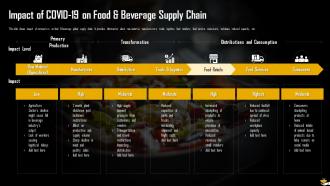
Slide 35: This slide presents Impact of COVID-19 on Food & Beverage Supply Chain.
Slide 36: This slide highlights title for topics that are to be covered next in the template.
Slide 37: This slide displays Global Food Market Size with Key Insights.
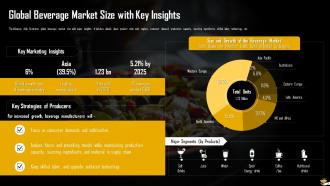
Slide 38: This slide represents Global Beverage Market Size with Key Insights.
Slide 39: This slide showcases Major Market Drivers of Global Food & Beverage Industry.
Slide 40: This slide shows Major Restraints Affecting Food & Beverage Industry.
Slide 41: This slide presents Key Opportunities in Food & Beverage Sector.
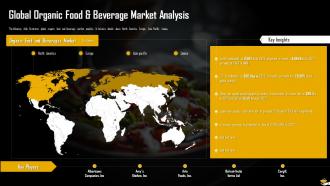
Slide 42: This slide displays Global Organic Food & Beverage Market Analysis.
Slide 43: This slide highlights title for topics that are to be covered next in the template.
Slide 44: This slide represents Competitive Analysis of Major Food & Beverage Companies.
Slide 45: This slide highlights title for topics that are to be covered next in the template.
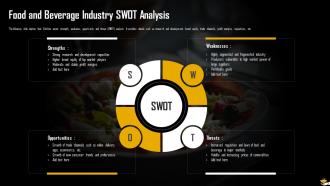
Slide 46: This slide showcases Food and Beverage Industry SWOT Analysis.
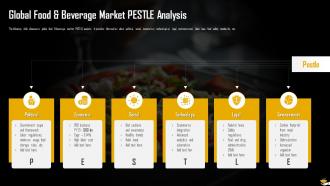
Slide 47: This slide shows Global Food & Beverage Market PESTLE Analysis.
Slide 48: This slide presents Global Food and Beverage Industry Porters 5 Forces Model.
Slide 49: This slide highlights title for topics that are to be covered next in the template.
Slide 50: The following slide showcases company profile of PepsiCo.
Slide 51: This slide displays company profile of Tyson foods ltd.
Slide 52: The following slide showcases company profile of nestle.
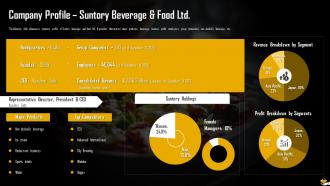
Slide 53: This slide represents company profile of Suntory beverage and food ltd.
Slide 54: This slide illustrates company profile of Bidco Africa.
Slide 55: This slide contains all the icons used in this presentation.
Slide 56: This slide is titled as Additional Slides for moving forward.
Slide 57: This slide depicts Venn diagram with text boxes.
Slide 58: This slide shows Circular Diagram with additional textboxes.
Slide 59: This is a Timeline slide. Show data related to time intervals here.
Slide 60: This is Our Target slide. State your targets here.
Slide 61: This slide shows Post It Notes. Post your important notes here.
Slide 62: This slide contains Puzzle with related icons and text.
Slide 63: This is an Idea Generation slide to state a new idea or highlight information, specifications etc.
Slide 64: This slide provides 30 60 90 Days Plan with text boxes.
Slide 65: This is Our Mission slide with related imagery and text.
Slide 66: This is a Thank You slide with address, contact numbers and email address.
Analysis Of Global Food And Beverages Industry Powerpoint Presentation Slides with all 71 slides:
Use our Analysis Of Global Food And Beverages Industry Powerpoint Presentation Slides to effectively help you save your valuable time. They are readymade to fit into any presentation structure.
































FAQs for Analysis Of Global Food And Beverages Industry
Honestly, everything's about health and sustainability right now. Plant-based stuff is everywhere - even my dad bought oat milk last week which was wild. Clean labels are huge. People actually read ingredients now and want brands that don't trash the planet. Direct-to-consumer sales totally blew up after COVID, obviously. Functional foods are having a moment too - probiotics, adaptogens, all that wellness stuff. Oh, and traditional brands are scrambling to keep up. They're either innovating like crazy or partnering with smaller companies. For your analysis, I'd definitely look at how this is changing supply chains.
Your customers are basically driving everything now - it's all about health, sustainability, and making life easier. Plant-based stuff is huge. Clean labels too. People want functional foods that actually do something for them. Don't even get me started on the Instagram packaging trend (though honestly, it works). Your R&D teams should focus on being transparent about ingredients and environmental impact. Personalization matters more than ever. If you're not already doing regular consumer sentiment analysis, start there. Build some flexibility into your product roadmap because this pace isn't letting up anytime soon. The companies that adapt fastest are gonna win.
Dude, sustainability isn't just trendy anymore - it's literally how food companies win now. People pick brands based on environmental stuff, not just if it tastes good. Plant-based everything, fancy regenerative farming, packaging that doesn't destroy the planet... honestly the shift happened so fast it's crazy. Companies ignoring this? They're getting crushed by competitors who actually care. I was just reading about how even big chains are scrambling to catch up. If you're looking at investments or whatever, definitely check how serious they are about going green.
Dude, it's wild how much AI changed food supply chains. Farms now use drones and sensors to nail their crop yields perfectly. Processing plants? Totally automated - sorting, packaging, the whole deal. McDonald's even has AI taking drive-thru orders which honestly seems unnecessary but whatever. The real game-changer is demand prediction though. Companies can cut waste big time and stock stores right when they need it. Supply chains got crazy transparent too - you spot problems instantly and adjust fast. If you're working in this industry, definitely check what your competitors are doing with predictive stuff.
Dude, the food industry is rough for small businesses. Capital's always tight when you're trying to scale up production. Then there's all these crazy international safety regulations to deal with - honestly such a pain. Big corporations have way deeper pockets, so you're constantly getting outspent on marketing and distribution. Getting shelf space? Good luck with that. Supply chain costs will destroy your margins if you're not careful. Oh, and consumer trends change like every five minutes now, but you don't have Google's R&D budget. I'd say pick a specific niche first. Build up loyal customers there before taking on the giants.
Regulatory stuff completely changes the game - what goes in your products, how you market them, everything. Europe's crazy strict about additives and labels. The US cares more about safety and FDA stuff. Asia's honestly a mess - some countries love new tech, others stick to old-school food rules. It all hits your supply chains and R&D timelines hard. Oh, and market entry gets way more complicated too. You should probably set up some kind of alert system for your main markets. Trust me, you don't want to be caught off guard when new regulations suddenly appear.
So basically people are way more health-obsessed now and want drinks that actually do something - like probiotics or whatever those adaptogen things are. Sustainability's massive too. Nobody wants to feel bad about their packaging choices. Have you noticed oat milk is literally everywhere? That whole plant-based thing isn't slowing down. People will drop serious cash on craft stuff that feels special. Oh, and tech's getting crazy good at preservation methods and personalized nutrition. Honestly, if you're eyeing this market, look for brands hitting multiple trends at once rather than just one.
E-commerce is totally changing how food moves around - companies are going direct to customers and skipping stores completely. The whole supply chain has to be way more flexible now since you can see what people want in real time. COVID definitely sped things up, but this was happening anyway. Traditional companies are playing catch-up trying to build decent online systems. If you're getting into this area, focus on last-mile delivery and keeping stuff cold during shipping. Those two things will make or break you. Oh, and the data aspect is pretty wild - you can actually see demand patterns forming instead of just guessing.
Oh man, COVID totally flipped everything upside down with food. Restaurant sales crashed while grocery stores couldn't keep up - I'm sure you remember the empty shelves. Everyone suddenly became obsessed with cooking at home and buying "immunity boosting" stuff (whatever that means lol). Online grocery went from something your lazy neighbor did to absolutely necessary overnight. Local sourcing got huge too. The weird part? Most people are still doing this stuff even though restaurants are back. So if you're looking at any food business data, definitely split it into before 2020 vs after - they're basically two different worlds now.
Yeah, food costs are pretty brutal right now - everything's getting more expensive because of shipping mess-ups, labor issues, and all that global chaos stuff. Coffee beans, cooking oils, you name it. Some things just vanish from stores completely (that sriracha thing was wild). Drinks are especially screwed because they can't get packaging materials. Honestly, I'd budget for like 15-20% higher prices on your main ingredients and maybe find backup suppliers now, especially for anything specialty. Better to be prepared than scrambling later when you can't find what you need.
Honestly, start by mapping out where your biggest risks are - that's gonna save you so much time. Get a solid HACCP system going to nail down those critical control points. Your testing game needs to be on point too - invest in rapid pathogen detection if you can swing it. Training is massive, like every single person needs to know the protocols inside and out. Third-party audits are worth their weight in gold for catching stuff you miss. Oh and traceability systems - they seem boring but trust me, when recalls happen you'll thank yourself. Don't forget about vetting your suppliers properly either.
Dude, emerging markets are absolutely crushing it right now. India, Southeast Asia, parts of Africa - there's this whole new middle class with actual spending money for the first time. They're not just buying whatever we eat though, which is kinda cool. Local flavors are huge, plus they want healthier stuff that actually fits how they live. The growth happening there is honestly insane - like nothing I've seen before. Companies that aren't paying attention are basically leaving money on the table. It's wild how fast things are changing.
Yeah, it's crazy how fast these companies are pivoting! Like Tyson - who would've thought they'd be making plant burgers? Dairy brands are jumping into oat milk too. Traditional stuff isn't dead, but the market share is definitely shrinking. Younger people especially are all about anything that sounds healthier. Honestly, I think some of it's just marketing hype, but whatever works I guess. If you're following this space, watch which legacy brands are actually changing versus the ones just sticking to what they know. That'll tell you everything.
Most food companies track satisfaction through surveys and online reviews - pretty standard stuff. They also watch social media closely and dig into loyalty program data. Smart move is measuring things like Net Promoter Scores and how often people buy again. Taste tests matter too, obviously - I mean, bad food kills everything else you're trying to do. For improvements, they focus on keeping quality consistent and speeding up customer service. Oh, and personalizing based on what you've bought before. Honestly though? Just start collecting feedback regularly and actually do something with it.
So the big companies are hitting three main things: less packaging waste with recyclable stuff, cutting carbon emissions, and better ingredient sourcing. Unilever and Nestlé are doing tons of regenerative agriculture partnerships now. Water's becoming massive too - beverage companies are trying to go water-positive, which honestly sounds pretty ambitious. It's definitely real commitment mixed with consumer pressure though. Oh and if you're looking at specific brands, their actual sustainability reports will tell you way more than their flashy marketing campaigns ever will.
-
The designs are very attractive and easy to edit. Looking forward to downloading more of your PowerPoint Presentations.
-
The slides are remarkable with creative designs and interesting information. I am pleased to see how functional and adaptive the design is. Would highly recommend this purchase!