

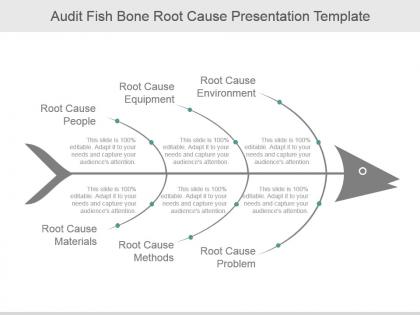
Audit fish bone root cause presentation template




Try Before you Buy Download Free Sample Product
 Impress Your
 Audience
 100%
100% Editable
 Save Hours
 of Time


Build everlasting attractions with our Audit Fish Bone Root Cause Presentation Template. Folks will get drawn to your thought.
People who downloaded this PowerPoint presentation also viewed the following :
Audit fish bone root cause presentation template with all 5 slides:
Explain intensive care with our Audit Fish Bone Root Cause Presentation Template. Educate fresh health care assistants.



FAQs for Audit fish bone root
The primary components of an audit fishbone diagram include the problem statement (fish head), major cause categories (main bones), subcauses (smaller bones), and the central spine connecting all elements. These components work together by systematically organizing potential audit findings, categorizing compliance issues, procedural gaps, and control weaknesses, with many auditing teams finding that this structured approach streamlines investigation processes and delivers more comprehensive root cause identification.
Fishbone diagrams help auditors identify systemic issues by systematically mapping all potential root causes across categories like people, processes, technology, and environment, revealing interconnected organizational weaknesses. Through this structured approach, audit teams can trace surface-level findings back to underlying systemic problems, enabling comprehensive remediation strategies that address core issues rather than symptoms, ultimately delivering more effective risk management.
**INPUT**: What specific attributes should be included in a fishbone root cause analysis template for effective auditing? **OUTPUT**: Effective audit fishbone templates should include categories for people, processes, technology, environment, materials, and measurement systems, with standardized data fields for evidence documentation and risk scoring. These comprehensive frameworks enable audit teams to systematically trace problems across operational areas, ultimately delivering thorough root cause identification and actionable remediation plans that enhance organizational compliance and control effectiveness. [Word count: 58 words]
The visual nature of fishbone diagrams enhances stakeholder understanding by presenting complex audit findings through clear, branching structures that map cause-and-effect relationships intuitively, enabling non-technical stakeholders to quickly grasp interconnected issues. This visual approach streamlines audit discussions, facilitates collaborative problem-solving across departments, and ultimately delivers faster consensus on corrective actions, with many organizations finding that visual mapping significantly improves audit follow-through rates.
Teams collaborate effectively using fishbone diagrams by conducting structured brainstorming sessions where each member contributes to different cause categories, such as processes, people, technology, and compliance gaps. This collaborative approach enables cross-functional perspectives from audit, operations, and compliance teams to surface interconnected issues, streamline root cause identification, and ultimately deliver comprehensive solutions that address systemic audit challenges.
Common audit fishbone pitfalls include focusing on symptoms rather than root causes, limiting stakeholder participation, rushing the analysis process, failing to validate findings with evidence, and creating overly complex diagrams that obscure key issues. Through systematic validation and cross-functional collaboration, audit teams streamline investigations, enhance accuracy, and deliver more credible findings, with many organizations finding that structured root cause analysis significantly improves audit quality and stakeholder confidence.
Fishbone templates can be tailored by customizing the main bone categories to reflect industry-specific processes, regulations, and risk factors relevant to each sector's operational environment. For example, healthcare audits might emphasize patient safety, compliance, and clinical workflows, while manufacturing focuses on equipment, supply chain, and quality control processes, ultimately enabling auditors to identify root causes more accurately and deliver targeted recommendations that enhance operational efficiency.
Data collection serves as the foundation for effective fishbone analyses by providing factual evidence to validate or refute potential root causes across each category, ensuring hypotheses are supported by concrete audit findings rather than assumptions. Through systematic gathering of transaction records, process documentation, and stakeholder interviews, auditors can prioritize the most impactful causes and develop targeted corrective actions, ultimately delivering more accurate audit conclusions and sustainable process improvements.
Fishbone diagrams integrate seamlessly with audit methodologies through combination with risk matrices, control testing, and process mapping, creating multi-layered analysis frameworks. This strategic integration enables auditors to visualize root causes while simultaneously documenting control weaknesses and compliance gaps, with many financial institutions and healthcare organizations finding that this comprehensive approach ultimately delivers faster issue resolution and more robust audit trails.
Financial services audits use fishbone analysis to investigate compliance failures by examining people, processes, technology, and regulatory factors, while manufacturing audits apply it to identify quality control breakdowns through equipment, materials, methods, and environmental causes. These applications enable auditors to systematically uncover root causes rather than symptoms, ultimately delivering more comprehensive findings and actionable recommendations for sustained organizational improvement.
Technology enables interactive fishbone diagrams through cloud-based collaboration platforms, real-time editing software, digital whiteboarding tools, video conferencing integrations, and automated data visualization systems. These solutions streamline remote audit workflows by facilitating simultaneous team input, enabling instant updates across locations, and providing comprehensive audit trails, with many financial services and healthcare organizations finding that digital fishbone analysis enhances audit efficiency while maintaining rigorous compliance standards.
Metrics derived from fishbone analysis include defect reduction rates, process cycle time improvements, compliance score increases, cost savings achieved, and recommendation implementation timelines. Through systematic tracking across the six major categories—people, process, equipment, materials, environment, and methods—audit teams can quantify operational efficiency gains, risk mitigation effectiveness, and overall organizational performance improvements, ultimately delivering measurable ROI on audit investments.
Fishbone root cause analyses should be revisited quarterly or after significant process changes, with many audit teams conducting annual comprehensive reviews to maintain effectiveness. This regular reassessment enables organizations to identify emerging risk patterns, validate previous corrective actions, and adapt methodologies to evolving operational challenges, ultimately ensuring audit processes remain robust and aligned with current business environments.
Teams new to fishbone diagrams in audits benefit from structured training programs covering root cause analysis fundamentals, quality management principles, and audit-specific applications through workshops, online courses, and certification programs. Many organizations find success combining formal Six Sigma or lean methodology training with hands-on practice sessions, mentorship from experienced auditors, and access to template libraries, ultimately enabling teams to conduct more thorough investigations and deliver actionable audit findings.
Organizations can ensure continuous improvement by systematically implementing fishbone analysis findings through corrective action plans, regular monitoring systems, and cross-departmental knowledge sharing protocols. By establishing feedback loops that track implemented solutions and creating standardized documentation processes, companies like manufacturing firms and healthcare institutions find that recurring issues decrease significantly, operational efficiency increases, and audit compliance improves consistently over time.
-
Thanks for all your great templates they have saved me lots of time and accelerate my presentations. Great product, keep them up!
-
Designs have enough space to add content.