

Azure Cloud SaaS Platform Implementation Guide Powerpoint PPT Template Bundles CL MM




Try Before you Buy Download Free Sample Product
 Impress Your
 Audience
 100%
100% Editable
 Save Hours
 of Time


Our Azure Cloud SaaS Platform Implementation Guide Powerpoint PPT Template Bundles CL MM are topically designed to provide an attractive backdrop to any subject. Use them to look like a presentation pro.
People who downloaded this PowerPoint presentation also viewed the following :
Content of this Powerpoint Presentation
Slide 1: This slide introduces Azure Cloud SaaS Platform Implementation Guide. State Your Company Name and begin.
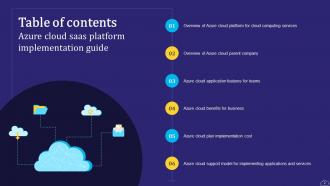
Slide 2: This slide shows a Table of Contents for the presentation.
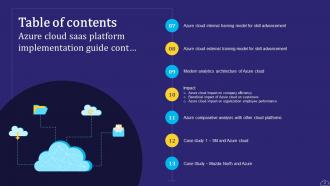
Slide 3: This slide is in continuation with the previous slide.
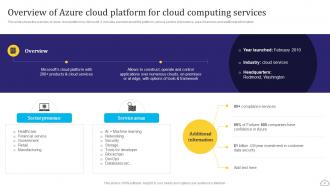
Slide 4: This slide shows the overview of Azure cloud platform by Microsoft.
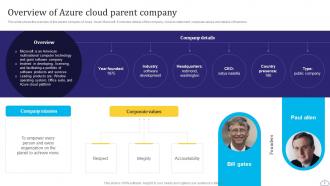
Slide 5: This slide showcases the overview of the parent company of Azure cloud, Microsoft.
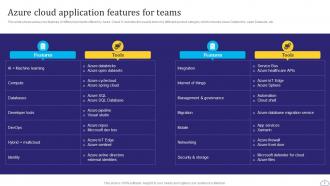
Slide 6: This slide entails various key features of different products offered by Azure Cloud.
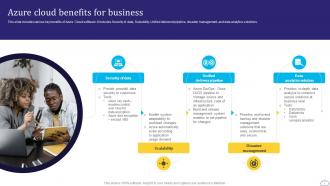
Slide 7: This slide includes various key benefits of Azure Cloud software.
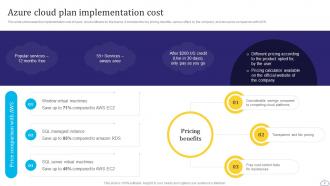
Slide 8: This slide mentions the implementation cost of Azure cloud software for the teams.
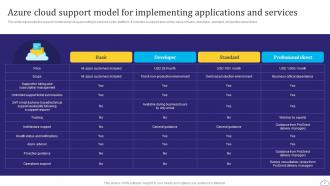
Slide 9: This slide represents the support model and pricing according to services by the platform.
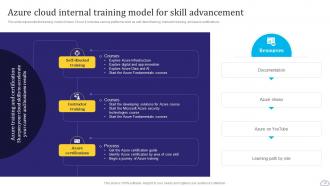
Slide 10: This slide presents the training model of Azure Cloud.
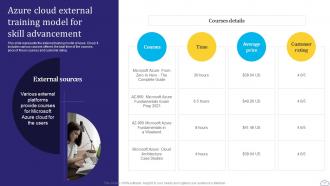
Slide 11: This slide caters to the external training model of Azure Cloud.
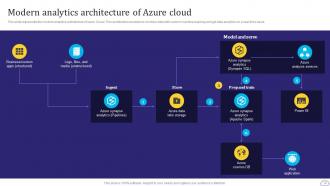
Slide 12: This slide contains the modern analytics architecture of Azure Cloud.
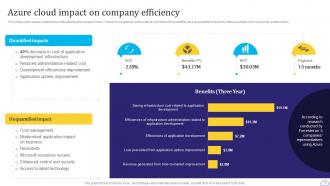
Slide 13: This slide covers various statistical points defining the impact of Azure Cloud on companies’ performance.
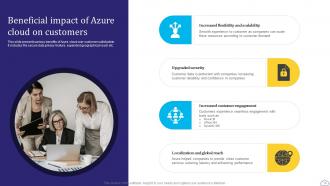
Slide 14: This slide puts various benefits of Azure cloud over customer satisfaction.
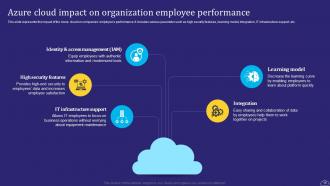
Slide 15: This slide elucidates the impact of the Azure cloud on companies’ employee's performance.
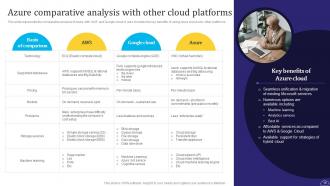
Slide 16: This slide depicts the comparative analysis of Azure with AWS and Google cloud.
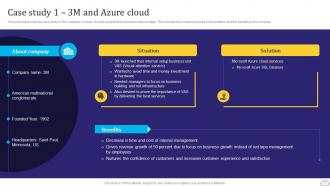
Slide 17: This slide denotes the case study of 3M’s adoption of Azure cloud to support their business internal setup.
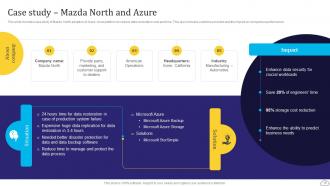
Slide 18: This slide describes case study of Mazda North adoption of Azure cloud platform to reduce data restoration cost and time.
Slide 19: This slide shows all the icons included in the presentation.
Slide 20: This slide is a thank-you slide with address, contact numbers, and email address.
Azure Cloud SaaS Platform Implementation Guide Powerpoint PPT Template Bundles CL MM with all 28 slides:
Use our Azure Cloud SaaS Platform Implementation Guide Powerpoint PPT Template Bundles CL MM to effectively help you save your valuable time. They are readymade to fit into any presentation structure.









FAQs for Azure Cloud SaaS Platform Implementation Guide Powerpoint PPT Template
Azure SaaS deployment offers superior integration with Microsoft ecosystems, advanced security compliance, flexible scaling options, comprehensive analytics tools, and robust hybrid cloud capabilities. These advantages enable organizations to streamline operations, reduce infrastructure costs, and accelerate time-to-market, with many enterprises finding that Azure's native Office 365 integration delivers seamless user experiences and operational efficiency.
Azure ensures SaaS security and compliance through multi-layered protection including built-in threat detection, identity management, data encryption, network security controls, and automated compliance monitoring. Through Azure Security Center and compliance frameworks like SOC, ISO, and GDPR, organizations streamline regulatory adherence while maintaining robust security postures, ultimately delivering enhanced customer trust and operational efficiency.
Azure provides several integration mechanisms including Azure Service Bus, Logic Apps, API Management, Event Grid, and Azure Data Factory for connecting on-premises systems with SaaS applications. These services streamline hybrid connectivity by enabling secure data synchronization, automated workflows, and real-time messaging, with many organizations finding that this strategic combination ultimately delivers seamless operations and enhanced scalability.
Businesses leverage Azure's analytics capabilities through Azure Synapse Analytics, Power BI integration, real-time streaming analytics, machine learning services, and cognitive APIs to enhance SaaS offerings. These tools enable deeper customer insights, predictive functionality, and automated decision-making within applications, with many SaaS providers finding that embedded analytics significantly improves user engagement and competitive differentiation.
Azure Active Directory serves as the central identity management hub for SaaS applications, providing single sign-on, multi-factor authentication, user provisioning, and access controls across multiple platforms. Through seamless integration with thousands of SaaS applications, organizations streamline user management, enhance security protocols, and reduce administrative overhead, with many enterprises finding that centralized identity governance significantly improves both user experience and compliance outcomes.
Azure for SaaS development presents both cost opportunities and considerations, including pay-as-you-scale pricing, reduced infrastructure investment, automated resource management, and built-in compliance tools. While initial setup costs can vary, many organizations find that Azure's operational efficiency, faster time-to-market, and reduced maintenance overhead ultimately deliver significant cost advantages and competitive positioning.
Azure's scalability features support SaaS growth through auto-scaling, load balancing, global distribution networks, elastic resource allocation, and seamless capacity management. These technologies enable SaaS providers to handle fluctuating user demands, expand into new markets efficiently, and maintain optimal performance during peak usage, with many organizations finding that Azure's infrastructure delivers cost optimization and enhanced customer experiences while scaling globally.
Developers should follow security-first architecture, implement multi-tenancy design patterns, leverage Azure's native services for scalability, optimize cost management through resource monitoring, and ensure robust data backup strategies. These practices enable organizations across healthcare, finance, and retail to deliver reliable, secure applications while minimizing operational overhead and maximizing performance, ultimately providing competitive advantages in increasingly demanding markets.
Azure DevOps tools streamline SaaS development through integrated CI/CD pipelines, automated testing frameworks, version control systems, and collaborative project management capabilities. These tools enable organizations to accelerate deployment cycles, reduce manual errors, and enhance team collaboration, with many software companies finding that Azure's integrated approach delivers faster time-to-market and improved application quality.
Azure's global infrastructure significantly enhances SaaS application performance through reduced latency, improved reliability, and seamless scalability across 60+ regions worldwide. By leveraging Microsoft's distributed data centers, organizations deliver faster load times, minimize downtime through geographic redundancy, and ensure consistent user experiences regardless of location, ultimately enabling businesses to serve global customers more effectively while reducing operational costs.
Azure supports multi-tenancy through Azure SQL Database with row-level security, Azure Active Directory for tenant isolation, App Service environments for application separation, and Azure Resource Manager for resource governance. Through these integrated services, organizations can efficiently isolate tenant data, manage user authentication, and scale resources dynamically, while reducing infrastructure costs and maintaining robust security across multiple client environments.
Azure provides comprehensive monitoring tools including Azure Monitor, Application Insights, Log Analytics, Azure Advisor, and Performance Diagnostics for SaaS applications. These technologies streamline performance optimization by tracking real-time metrics, identifying bottlenecks, and automating resource scaling, with many organizations finding enhanced operational efficiency and reduced downtime across their cloud infrastructure.
SLAs for Azure-hosted SaaS products establish guaranteed uptime percentages, typically 99.9% or higher, with automatic credits or remediation when thresholds aren't met. These agreements combine Azure's infrastructure reliability with application-specific performance metrics, enabling businesses in healthcare, finance, and retail to maintain consistent service delivery while minimizing downtime risks and ensuring predictable operational costs.
Migrating SaaS applications to Azure involves assessment and planning, architecture redesign for cloud-native services, data migration with minimal downtime, application refactoring, and comprehensive testing phases. Through Azure's migration tools and services, organizations streamline deployment, enhance scalability, and reduce infrastructure costs, with many enterprises finding that phased migrations minimize risks while delivering improved performance and operational efficiency.
Azure Machine Learning integrates into SaaS applications through APIs, pre-built models, automated ML pipelines, and custom algorithms that enhance predictive analytics, user personalization, and automated decision-making. Through seamless cloud integration, SaaS providers can deliver intelligent features like fraud detection in financial platforms, personalized recommendations in retail applications, and predictive maintenance in manufacturing tools, ultimately streamlining operations while delivering competitive advantage.
-
Use of icon with content is very relateable, informative and appealing.
-
It is my first time working with them and that too on a friend's recommendation. I would say, I am not expecting such a worldly service at this low price.