


![How to Write a Boutique Business Plan [Free PDF]](https://www.slideteam.net/wp/wp-content/uploads/2024/01/BANNER-1.jpg)


 0 Comment
 Customer Reviews

What is a Boutique Business Plan?
If you have an idea about a boutique and you are confident that you will pull it off, then this Boutique Business Plan is the starting point!
A business plan is an introduction to your business. This document is a way to get investors invested in your business, get loans, and execute your plans.
Just like a blueprint of a working machine, a business plan is the blueprint of your business covering and expressing your Ideas, Vision, and Business Goals. Reading this plan will be the first thing any investor looks at, and see if what you have brought to the table aligns with their interests.
Expert investors have even commented that looking at a business plan is how they decide whether it is worth meeting the owner, whether a first-time entrepreneur or an established business person. Any out-of-the-box idea is welcomed if the concept is executed so that the investors believe in it, and a well-structured business plan will make them feel enough to invest their money in your dream.
In 2023, the US clothing boutique market is expected to be valued at $32 billion, and the value of the market is increasing. The National Retail Federation reports that internet sales for boutiques increased by 36.3% in 2020. So, if you are thinking about getting into the business, this is the right time!

This professionally created Boutique Business Plan is a well-structured document that will help you make a positive first impression on the investors and get them to invest in your Company.
Let’s see what should be included in a Boutique Business Plan, the perfect pitch for your business!
- Executive Summary
- Company Overview
- Industry Analysis
- Customer Analysis
- Competitor Analysis
- SWOT Analysis
- Porter’s Framework
- Marketing Plan
- Operational Plan
- Financial Plan
- Graphical Representation of Financials
- Management Summary
- Exit Strategy
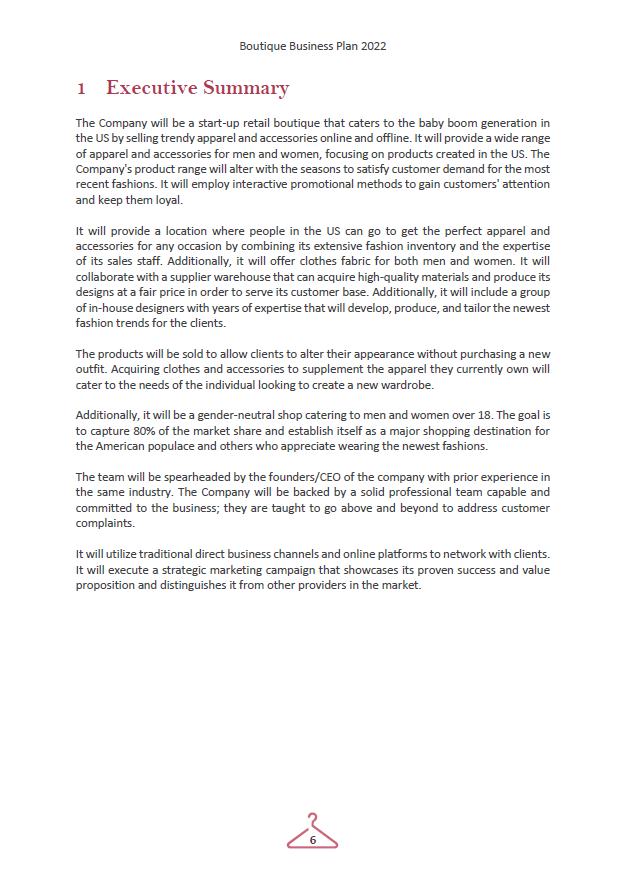
1. Executive Summary
The Executive Summary of a business plan is a brief overview that describes the key concepts covered in the document. It should include all the essential details about your business.
What would you want someone to see if they told you they would just read this one section of your plan? You can use this to help you choose what to add.
It functions as a brief but adequate summary that gives readers—many of whom are potential stakeholders or investors—an initial understanding of the type and goal of the business.
It includes a Quick Pitch and Entity.
The Quick Pitch is an attention grabber for the reader as it includes a brief overview of this business plan and why and how your idea is unique.
The Entity in the business plan displays the legal structure of the business. It includes the company's name, address, website, location, products, etc.
This is the introduction of your Boutique Business Plan and will make a first impression on the reader. It would be best if you pointed out the uniqueness of your idea and how effective it will work in the market space.

Download this Business Plan Now!
2. Company Overview
Company Overview presents the identity of the business and presents an in-depth guide for the same. Ask yourselves, what are the fundamentals of your business and what are those qualities which make it stand out?
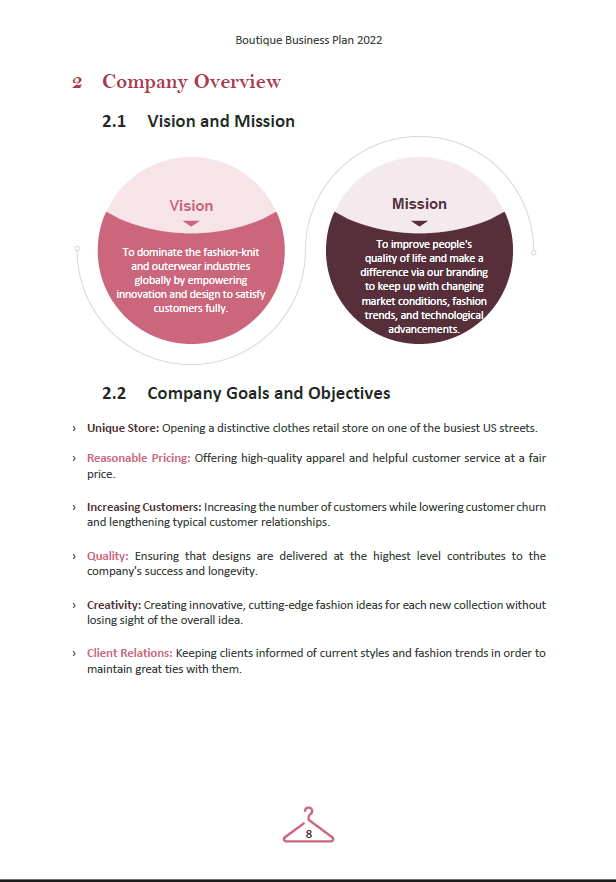
Start by pointing out your Vision and Mission for your business, which tells about your business's aspirations, goals, and core values.
It is a strategic process that influences the business's culture, direction, and success rather than merely being a formality. These draw in stakeholders who share and understand the business's general ideals.
Remember, a Business Plan is not just a Pitch Deck; it will always be the framework for your business.
Next, you can present the Company Goals and Objectives. It can include points such as Unique Store, Reasonable Pricing, Increasing Customers, Quality, Creativity, Client Relations, etc.
The investors would be keen to look at the Start-up Summary, as it provides the detailed expenses that will be needed and why.
Make sure to keep it to the point and clearly explain your business requirements.
Now, when you have stated your finances, you need to justify your business and why anyone should invest their money in it. Therefore, the next point should be about Market Gap and Business Statement.
Market Gap describes an unmet need in the market. The Business Statement provides a concise summary of the venture's objective and value proposition. Taken together, they clarify why the business is in a special position to satisfy demand and succeed in the industry.
To hammer in the point, you can include Business Solutions, Products Offered, and Key Success Factors. These points will help you to create a unique image for your brand and will help to catch the investor’s interest.
Download this Business Plan Now!
3. Industry Analysis
Every business plan must include an Industry Analysis that addresses market trends, obstacles to growth, factors promoting regional insights, and growth drivers.
This analysis will make it easier to grasp the right opportunities and help the business make an informed decision moving forward. This will also support your idea of opening your business and highlight your uniqueness.
This should include Market Analysis and Market Trends. Here, you can back up your claims with facts and graphs such as:
› Revenue in the Accessories market amounts to $551.10 billion in 2023. The market is expected to grow annually by 4.24% (CAGR 2023-2026).
The graphs included in the Boutique Business Plan are professionally displayed and 100% editable.
Furthermore, it should include Major Challenges. This will help keep and make realistic plans and create creative solutions to overcome any challenges.
Additionally, the Boutique Business Plan displays Growth Drivers and Geographical Analysis. Adding such pointers is helpful as it shows excellent planning for the future on your behalf.
Growth Drivers help look forward to future possibilities. It includes factors fuelling the expansion of the business.
Geographical Analysis helps create and assess a location's pros and cons and the best way to capitalize on it.


Download this Business Plan Now!
4. Customer Analysis
The next step is Customer Analysis. Just like understanding the industry overview, it is essential to check if there are customers who support and share the same feelings with you for the business.
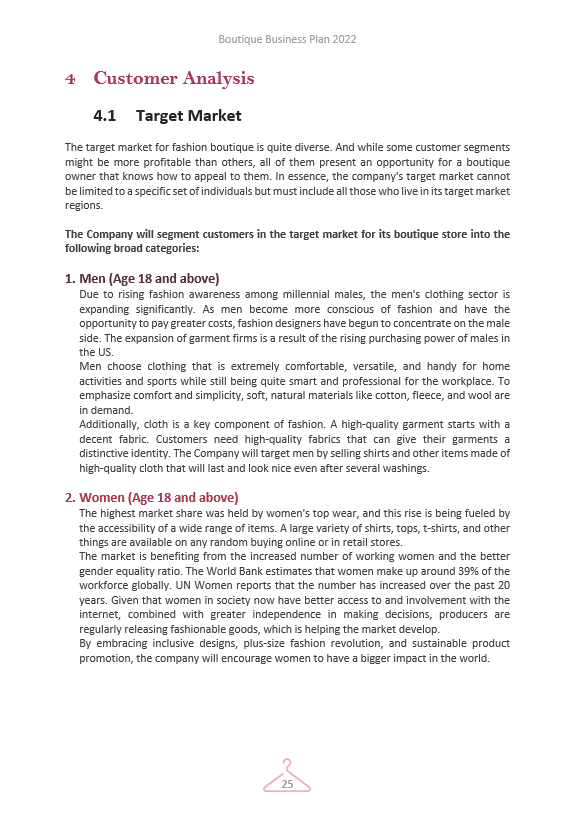
Target Market will help you discover where your audience is and if there are any needs in such geographical places.
Creating Buyer Personas is also a helpful exercise. It will help you to connect with your niche customers and assist with product development in the future. It will also be handy during product promotion strategies.
Market Size indicates the total potential market for your product.
Pointing out these facts would help streamline the merchandise production, which will be a hit among the customers!

Download this Business Plan Now!
5. Competitor Analysis
Understanding your customers is crucial, but knowing about your competition is just as important.
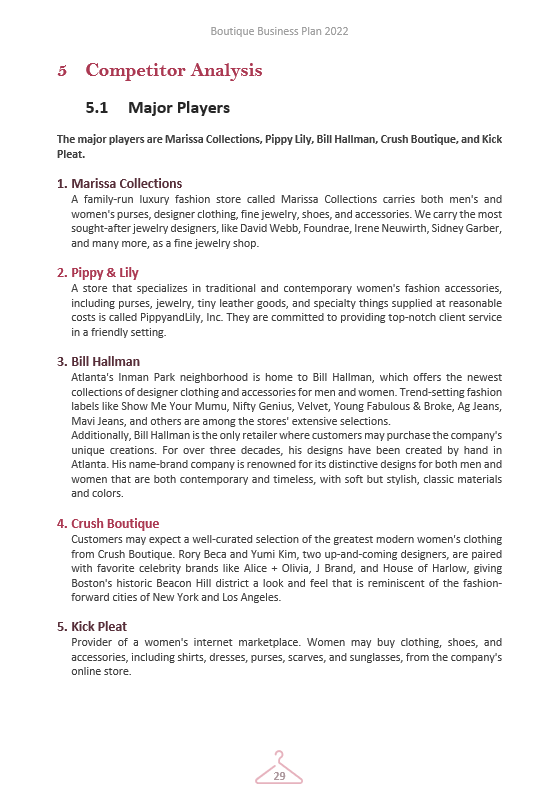
Including a Competitors Analysis in a business plan is essential as it explains what your competitors are doing and how you can stand out.
This will incentivize the investors to invest in your business rather than others.
To do this, focus on the Major Players in the market. Learn about their size, strengths, weaknesses, and how they position themselves in the market.
Add a section for Attributes Comparison. This will include essential comparison points like the features of their products, how they price them, their marketing tactics, and how satisfied their customers are.
Such analysis helps you see where to stand out, enables you to see what is missing in the market, and provides you with more opportunities to create more products for customer needs, increasing the profit!
Download this Business Plan Now!
6. SWOT Analysis
Being confident about yourself is good, but being overconfident isn't. Therefore, knowing your limitations is essential as it will allow you to do better.
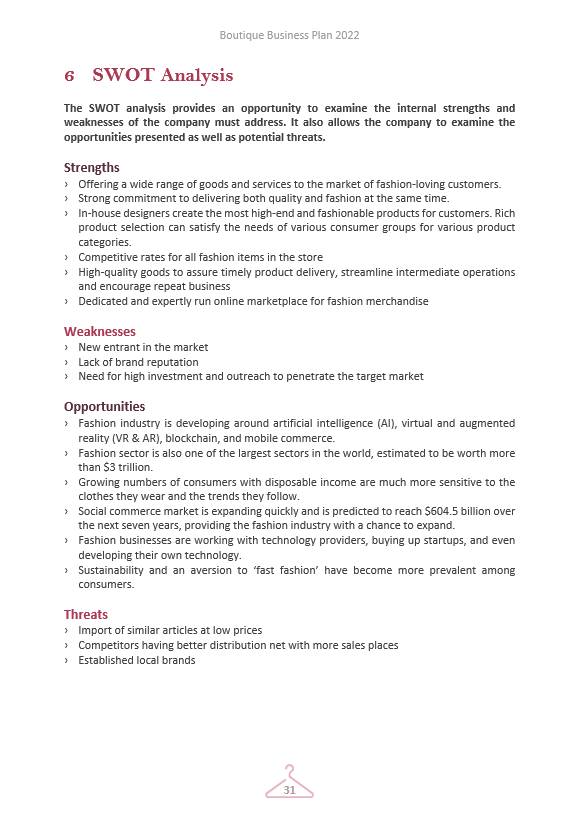
That is why, in a business plan, including a SWOT (Strengths, Weaknesses, Opportunities, Threats) Analysis is important. It makes it feasible to look at the internal strengths and weaknesses of the business. It also helps the company evaluate the possibilities and challenges it faces.
SWOT makes an impression on the investors, showing you sincerity and a realistic attitude towards your business, which will encourage them to invest in your business, and the same goes for any future collaborations.
Download this Business Plan Now!
7. Porter’s Framework
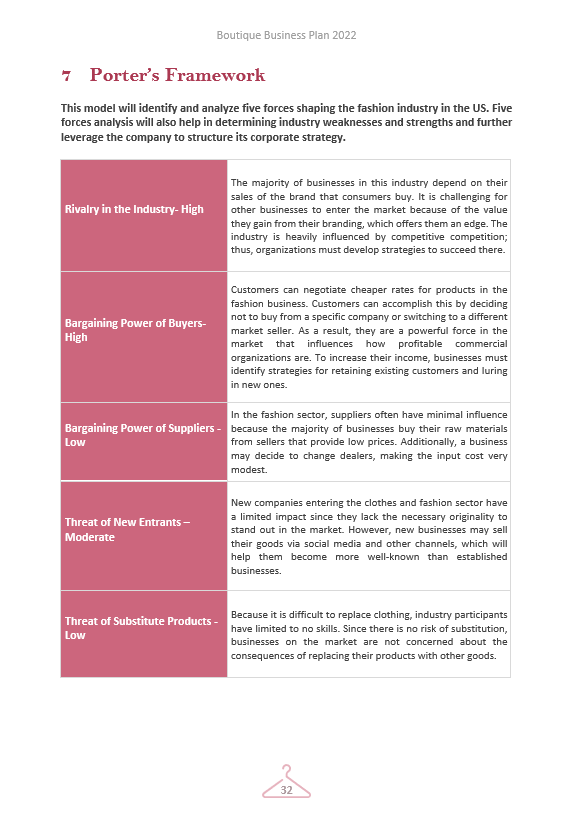
Porter's Framework is a tool that helps businesses understand their competitive environment. It looks at five fundamental forces:
- The threat of new entrants
- Bargaining power of buyers
- Bargaining power of suppliers
- Threat of substitute products or services
- Rivalry among existing competitors
Porter's Framework is essential to any business's plan since it makes industry analysis and strategic decision-making easier. It gives insight into potential challenges and how your business compares to competitors.
This Framework demonstrates to investors that you have done a thorough analysis of your market, are aware of your competitors, and have a plan. It shows that you are dedicated to making wise choices, which will increase investor's trust in your company.
Download this Business Plan Now!
8. Marketing Plan
No matter how many products you develop, marketing is one of the most essential. Social media has made marketing extremely accessible but has increased the competition.
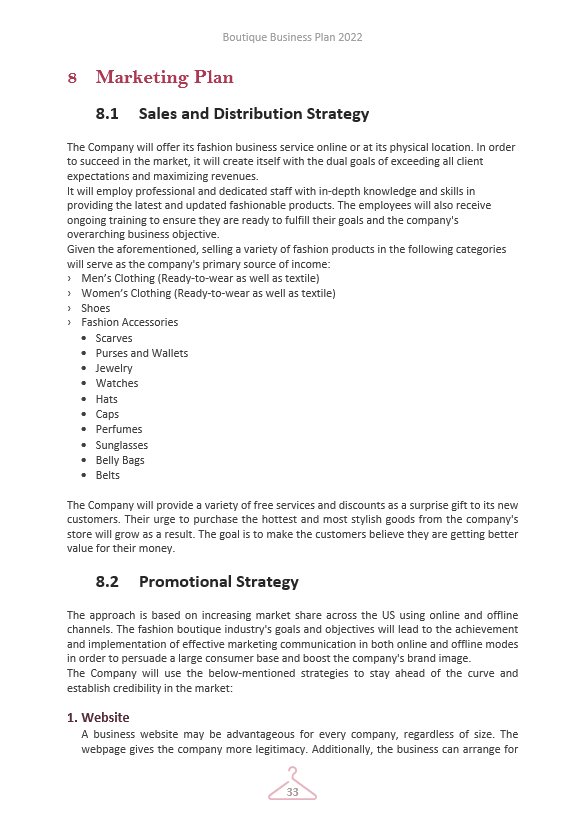
A Marketing Plan describes a company's strategy for selling and promoting its goods and services. It contains methods for interacting with consumers, advancing the brand, and hitting revenue targets.
It assists with strategic decisions and provides a roadmap to spread the news about the new products.
A well-structured marketing plan will attract investors as it demonstrates growth (the business wants to expand, which means they are confident about their chances of success) and shows that you are ready to mitigate any risks.
You can include a Sales and Distribution Strategy, Promotional Strategy, and Pricing Strategy in the marketing plan.
In this Boutique Business Plan, we have also included a Sales Funnel that charts the consumer's path from awareness to purchase, assisting in optimizing each phase for increased conversions. Professionally designed visuals accompany it, making the information more presentable.

Download this Business Plan Now!
9. Operational Plan
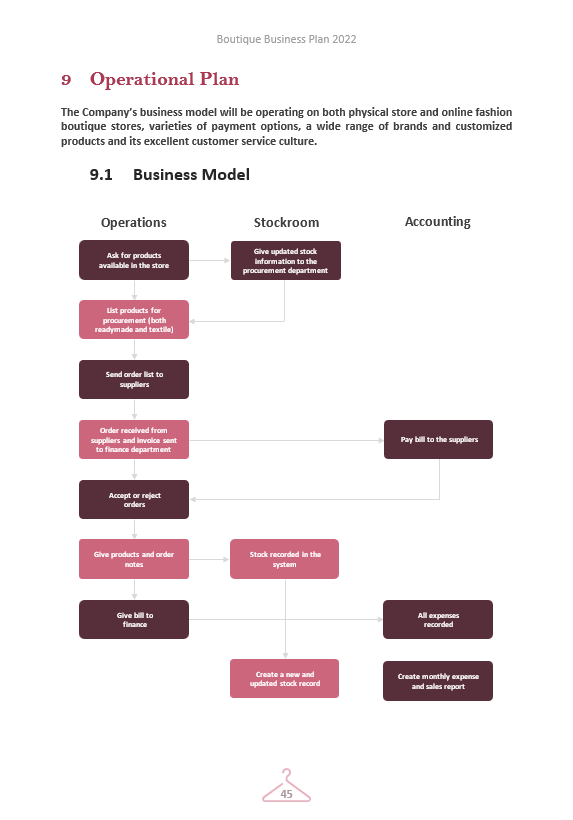
An Operational Plan outlines the daily steps a business will take to accomplish its objectives. It consists of duties, resources, and procedures. This should include a business model and milestones.
A Business Model outlines the operations and revenue-generating strategies of the company.
Milestones are noteworthy accomplishments that signal important turning points in a company's growth. They support goal-setting and progress monitoring.
It is valuable to add the Operational Plan as it demonstrates the practicality and sustainability of the business and indicates potential for growth and expansion.
Download this Business Plan Now!
10. Financial Plan
Let’s talk money!
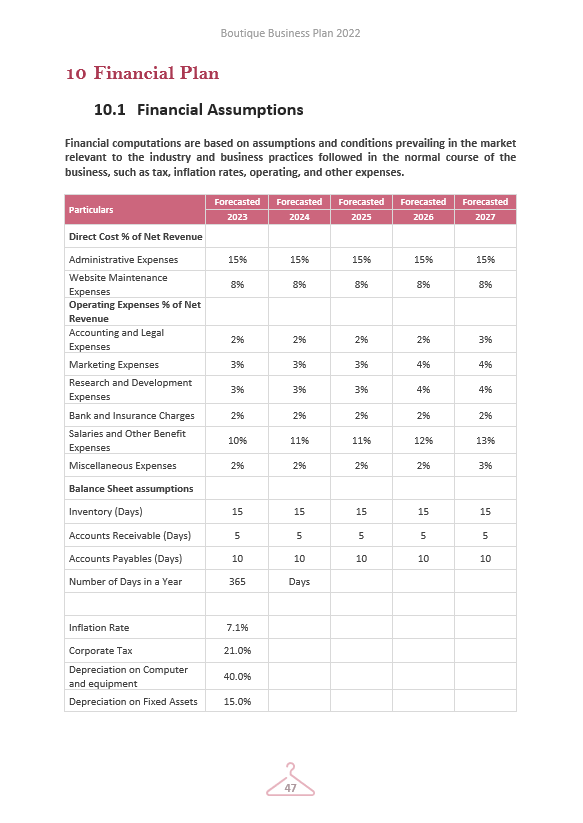
The next section of a Boutique Business Plan should be a Financial Plan. It explains the company's financial status and assists in risk management, decision-making, and attracting investors.
You can include the following in a Financial Plan-
Financial Assumptions: This lays out the main economic assumptions and expectations that underpin the plan and serves as a basis for additional financial estimates.
Revenue Model and Sales Forecast: Explains the company's revenue-generating processes and projects future sales using market research and historical data.
Break-Even Analysis: Determines the point at which revenues cover costs and helps identify the minimum sales needed to avoid losses.
Projected Profit and Loss Account: Estimates anticipated income, spending, and costs for a given period and summarizes the company's profitability.
Projected Cash Flow Statement: Monitors the cash influx and outflow over time and evaluates the company's capacity to pay its debts.
Projected Balance Sheet: Provides a snapshot of the company's finances at a particular moment and comprises shareholders' equity, liabilities, and assets.
Scenario Analysis: Analyse various situations that could impact the financial results and improve risk management by considering several factors.
DCF Valuation (Discounted Cash Flow): Helps to ascertain the company's intrinsic value by estimating the current value of future cash flows.
All these points mentioned are added to the Boutique Business Plan. All the information is added only after thorough research.
Download this Business Plan Now!
11. Graphical Representation of Financials
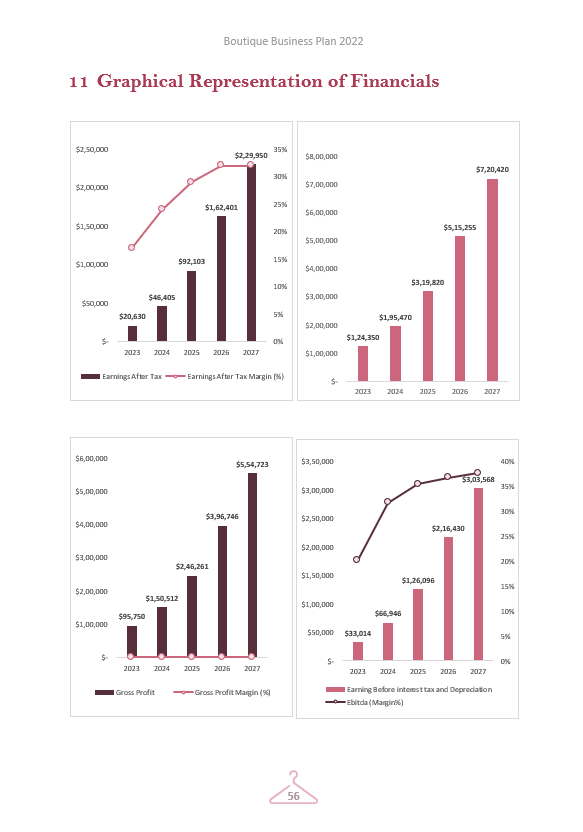
A Graphical Representation of Financials in a business plan is significant. It provides visual clarity and helps to highlight patterns. It is an effective communication tool.
Such graphical representation improves the business plan's professionalism, particularly when looking for partnerships or investments.
Download this Business Plan Now!
12. Management Summary
What should be added next in the Business Plan? Think as an investor. What would you like to know about a Company?
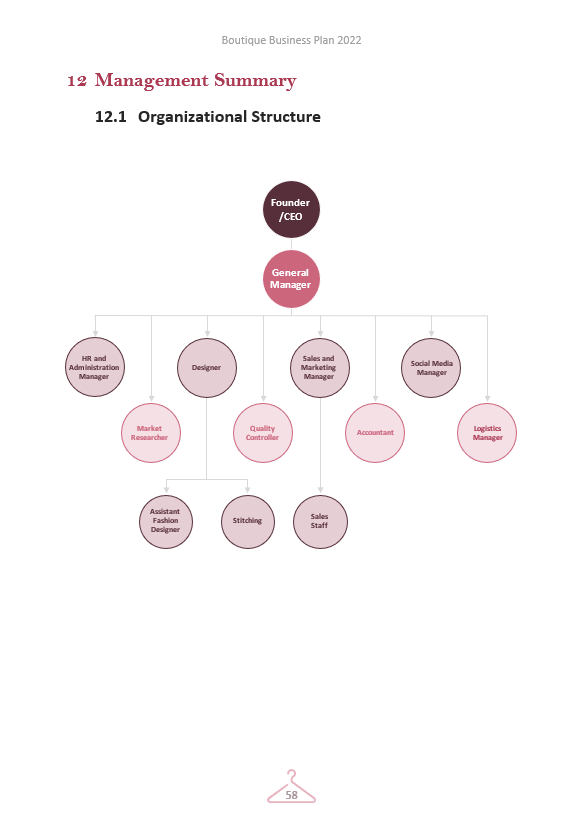
The next topic to add to the business plan should be Management Summary. It describes the structure, duties, and roles of the leadership team. It guarantees responsible behavior and effective operations within the company.
Investors will be interested in this section as it will allow them to evaluate the team's skill level and determine the company's likelihood of success. It provides confidence in the leadership.
You can add Organizational Structure, Professional Summary, and Job Roles and Responsibilities.
This will help you build credibility (by showcasing the expertise and qualifications of the management team) with the investors.
Download this Business Plan Now!
13. Exit Strategy
Lastly, include an Exit Strategy in your Boutique Business Plan.
An Exit Strategy describes the process by which entrepreneurs withdraw their capital. It covers choices including going public, combining, or selling the business.
It is essential for a business plan because it instills trust in investors by presenting a clear vision, a well-defined plan, and a plan of action for handling unanticipated circumstances or changes in the industry.
An exit strategy reduces uncertainty by reassuring investors that a plan is in place and defining how and when they may expect a return on their investment.
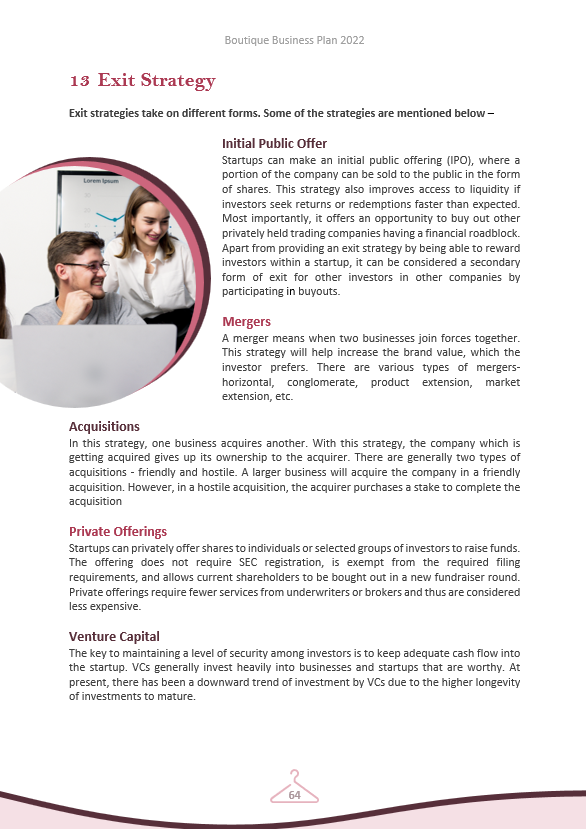
Download this Business Plan Now!
In a Nutshell
Crafting a Boutique Business Plan is like building a sturdy foundation for a strong structure. Every part, from the Executive Summary to the Exit Strategy, is crucial to properly communicating your vision, strategy, and potential to investors.
Remember, your Boutique Business Plan is not just a document; it's your pitch, roadmap, and commitment to success. The market is ripe for boutique businesses, and your well-structured plan positions you to seize new opportunities.
Now, it's your turn!
Click here for a Free PDF!
Download Boutique Business Plan Now!
We'd love to hear your thoughts! Comment below if you found this blog helpful or have any insights to share!
Access ten original start-ups and sector-specific investor presentations and documents by purchasing our membership. The price of a membership is only $49.99!
FAQs
Q: Why is a Boutique Business Plan necessary for starting a boutique?
A: A Boutique Business Plan serves as a roadmap for your business, helping you articulate your vision, set goals, and attract investors or secure loans. It provides a strategic framework, ensuring efficient operations and fostering investor confidence.
Q: What makes the Executive Summary crucial in a Boutique Business Plan?
A: The Executive Summary is the first impression investors get of your business. It succinctly highlights key concepts, including a Quick Pitch that grabs attention and an Entity section outlining the legal structure, setting the tone for the entire business plan.
Q: How does the Financial Plan contribute to the success of a boutique?
A: The Financial Plan outlines the company's financial status, aids in risk management, guides decision-making, and attracts investors. It includes crucial elements like revenue models, sales forecasts, and break-even analysis, offering a comprehensive view of the business's economic viability.
Q: Why is a Competitor Analysis essential for a boutique business plan?
A: A Competitor Analysis helps understand what other businesses in the market are doing. By identifying major players, their strengths, weaknesses, and market positioning, you can differentiate your boutique and incentivize investors to choose your business over others.



![Top Slides on Effective Marketing: Customer Segmentation Targeting and Positioning Guide [Free PPT & PDF]](https://www.slideteam.net/wp/wp-content/uploads/2023/12/BANNER-2.jpg)
![How to Craft a Daycare Business Plan! [For Entrepreneurs] -Free PDF](https://www.slideteam.net/wp/wp-content/uploads/2023/12/BANNER-10.jpg)
![Top 10 slides on Google Bard! Future of Generative AI [Free PPT and PDF]](https://www.slideteam.net/wp/wp-content/uploads/2023/09/BANNER-3.png)
![Best Slides on Developing Buyers Persona to Tailor Marketing Efforts [Free PPT and PDF]](https://www.slideteam.net/wp/wp-content/uploads/2023/12/BANNER-6.jpg)