

Coffee House Business Plan Powerpoint Presentation Slides




Try Before you Buy Download Free Sample Product
 Impress Your
 Audience
 100%
100% Editable
 Save Hours
 of Time


Starting a business, such as a coffee shop, may appear to be simple, but the truth is that if you want to avoid stress, you must make the necessary preparations to ensure that it will withstand the test of time. Therefore, our team has crafted this Coffee House Business Plan PPT to provide you with detailed insight into the coffee industry. It lists all the essential elements, including market research, industry trends, growth and revenue drivers, target market, competitive landscape, etc. In addition to it, the document also includes porters framework and its impact on the coffee industry, market gap, and opportunities, go-to marketing strategy, sales funnel, etc. Entity details, executive summary, products and services, mission and vision, exit strategy, etc., are also covered in this business plan. Furthermore, to give users an insight into the financial aspect, the coffee shop business plan also portrays a financial summary section in which a detailed 5-year analysis has been executed considering the market scenarios. It covers the revenue model, profit and loss statement, cash flow statement, break-even analysis, DCF valuation, balance sheet, etc. Download this 100 percent editable presentation and get access to our highly researched and skillfully designed product.
People who downloaded this PowerPoint presentation also viewed the following :
Content of this Powerpoint Presentation
Slide 1: This slide introduces Coffee House Business Plan. State your company name and begin.
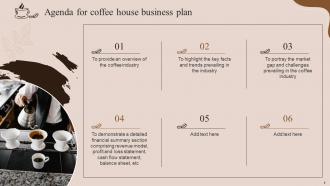
Slide 2: This slide states Agenda of the presentation.
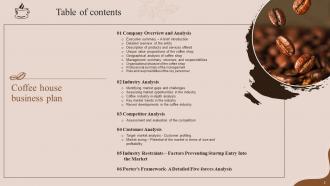
Slide 3: This slide presents Table of Content for the presentation.
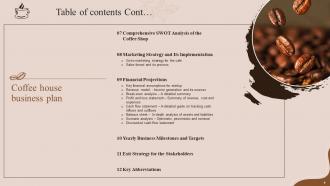
Slide 4: This is another slide continuing Table of Content for the presentation.
Slide 5: This slide highlights title for topics that are to be covered next in the template.
Slide 6: This slide showcases Executive summary – A brief introduction.
Slide 7: This slide presents Detailed overview of the entity.
Slide 8: This slide displays Description of products and services offered.
Slide 9: This slide represents Unique value propositions of the coffee shop.
Slide 10: This slide showcases Geographical analysis of coffee shop.
Slide 11: This slide shows Organization structure of the coffee shop.
Slide 12: This slide presents Professional summary of the management.
Slide 13: This slide displays Role and responsibilities of the key personnel.
Slide 14: This slide highlights title for topics that are to be covered next in the template.
Slide 15: This slide represents Identifying market gaps and challenges.
Slide 16: This slide showcases Assessing market opportunities in the industry.
Slide 17: This is another slide continuing Coffee industry in-depth analysis.
Slide 18: This slide shows Coffee industry in-depth analysis.
Slide 19: This slide presents Key market trends in the industry.
Slide 20: This slide displays Recent developments in the coffee industry.
Slide 21: This slide highlights title for topics that are to be covered next in the template.
Slide 22: This slide represents Assessment and evaluation of the competition.
Slide 23: This slide highlights title for topics that are to be covered next in the template.
Slide 24: The slide covers target market analysis.
Slide 25: The slide highlights the market sizing of the coffee industry.
Slide 26: This slide highlights title for topics that are to be covered next in the template.
Slide 27: The purpose of this slide is to guide stakeholders about the problems prevailing in the industry.
Slide 28: This slide highlights title for topics that are to be covered next in the template.
Slide 29: This slide shows Porter’s framework- A detailed five-forces analysis.
Slide 30: This slide highlights title for topics that are to be covered next in the template.
Slide 31: This slide presents Comprehensive SWOT analysis of the coffee shop.
Slide 32: This slide highlights title for topics that are to be covered next in the template.
Slide 33: This slide displays Go-to-marketing strategy for the cafe.
Slide 34: This slide represents Sales funnel and its process.
Slide 35: This slide highlights title for topics that are to be covered next in the template.
Slide 36: This slide showcases Key Financial Assumptions for Start up.
Slide 37: This slide shows Revenue model - Income generation and its sources.
Slide 38: This slide presents Break-even analysis – A detailed summary.
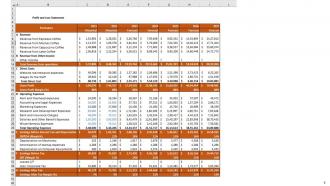
Slide 39: This slide displays Profit and loss statement – Summary of revenue cost and expenses.
Slide 40: The slides highlight the profit and loss statement of the firm.
Slide 41: This is another slide continuing the profit and loss statement of the firm.
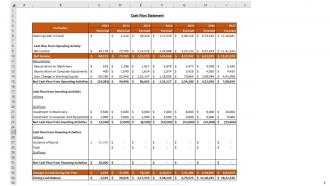
Slide 42: This slide showcases cash flow statement of the company.
Slide 43: This slide shows the cash flow statement of the company.
Slide 44: The slides highlight the balance sheet statement of the firm.
Slide 45: This slide presents the balance sheet statement of the firm.
Slide 46: The slides represent a scenario analysis of the firm.
Slide 47: This slide showcases a scenario analysis of the firm.
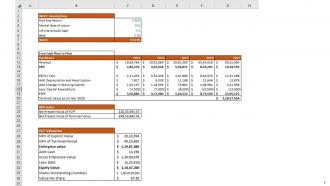
Slide 48: This slide shows Discounted cash flow statement.
Slide 49: This slide highlights title for topics that are to be covered next in the template.
Slide 50: This slide presents Yearly business milestones and targets.
Slide 51: This slide highlights title for topics that are to be covered next in the template.
Slide 52: This slide displays Exit strategy for the stakeholders.
Slide 53: This slide highlights title for topics that are to be covered next in the template.
Slide 54: This slide represents key abbreviations used in the business plan.
Slide 55: This slide contains all the icons used in this presentation.
Slide 56: This slide is titled as Additional Slides for moving forward.
Slide 57: This slide shows Post It Notes. Post your important notes here.
Slide 58: This is a Timeline slide. Show data related to time intervals here.
Slide 59: This is Our Goal slide. State your firm's goals here.
Slide 60: This is a Financial slide. Show your finance related stuff here.
Slide 61: This slide presents Roadmap with additional textboxes.
Slide 62: This slide provides 30 60 90 Days Plan with text boxes.
Slide 63: This slide represents Stacked chart with two products comparison.
Slide 64: This slide contains Puzzle with related icons and text.
Slide 65: This is a Thank You slide with address, contact numbers and email address.
Coffee House Business Plan Powerpoint Presentation Slides with all 70 slides:
Use our Coffee House Business Plan Powerpoint Presentation Slides to effectively help you save your valuable time. They are readymade to fit into any presentation structure.










FAQs for Coffee House Business Plan
Okay so you need to focus on five main things: figure out your competition and who you're targeting, pick the right location, get your financials straight (and seriously don't underestimate costs - that's where people screw up), nail down your concept and menu, plus work out staffing and operations. Marketing strategy is huge too since you need locals to actually show up. Oh and start researching permits early because the health department stuff takes forever and can totally mess up your timeline. Having backup plans for slow months will save you later.
Look, market research sounds boring but it's literally what saves you from picking a terrible spot. Check out foot traffic patterns and scope your competition first. Demographics matter too - age, income, how people actually live in that area. I've watched so many cute cafes fail because they opened somewhere trendy but wrong for their vibe. Also dig into peak hours and parking situations. Yeah, rent costs versus what you could realistically make is huge. Trust me, the data keeps you from dropping serious cash on a location where people just walk by without buying anything.
Look at who's actually living and working around there - age, income, daily routines. Millennials and Gen Z buy most specialty coffee, older folks usually want basic stuff. Income's key since you're basically selling $5 coffee as a treat, so you need people who can swing daily visits. Office workers hit different than students or remote people - totally different schedules and spending. Actually, just go hang out near your spot at various times and watch the foot traffic. That'll tell you way more than any demographic report, trust me. Employment patterns in the area matter too for timing your busy periods.
Dude, your menu is basically the first thing people see when they walk in, so don't mess it up. Most customers are half-asleep anyway and need their caffeine fix ASAP - make it scannable. Clean fonts, group similar stuff together, show prices clearly. Nothing worse than a cluttered menu that makes people squint and hold up the line during morning rush (trust me, I've been that annoyed person behind them). Oh and test it out on some friends first - if they're confused or asking "wait, how much is a latte?" then you've got problems. Keep it simple but make sure it matches your whole vibe.
Okay so you'll definitely need sales forecasts and startup costs for the first two years minimum. Break down revenue streams - espresso, food, retail beans, maybe catering. Coffee margins are honestly pretty solid once you hit your stride! Don't forget the boring expenses like rent, utilities, payroll, equipment. Cash flow projections matter too since coffee shops get hit hard during slow seasons. Most investors expect break-even analysis. Oh, and start conservative with your numbers - way better to surprise people than scramble when reality hits.
Your USP is basically your "why pick us over Starbucks" pitch. Find something competitors aren't doing - maybe you're sourcing beans directly from specific farms, or you've got this amazing book exchange thing going on. Honestly, the oat milk craze is real right now, so even being THE oat milk place could work. Pick whatever problem you can actually solve better than everyone else. Then make it super obvious in everything - your signage, social media, how staff talks about it. Don't try to be everything to everyone though. One solid thing beats three mediocre promises.
Dude, you HAVE to get your branding right first - I can't stress this enough. It's literally what makes people choose you over the Starbucks next door. Are you the cozy study vibe? The Instagram-worthy spot? The place where regulars chat with baristas? Figure that out because it affects everything - your logo, how you price drinks, what your space looks like, even how your staff dresses. I've watched great coffee shops crash because they couldn't decide what they were. Oh, and once you nail it down, stick to it religiously.
Honestly, digital marketing could be a game-changer for your coffee shop. Instagram's perfect for those drool-worthy latte art pics - seriously, people go crazy for that stuff. Build up your social media presence to create a real community vibe around your place. Email marketing works great too, especially for loyalty programs that keep people coming back. Oh, and don't sleep on local SEO - when someone googles "coffee near me," you want to pop up first. The cool thing is you can actually track what's working with analytics. I'd say pick one platform first and really nail it before spreading yourself too thin.
Start with your busiest times - mornings are absolutely insane so you'll need way more people then. Map out your daily customer flow first, then figure out roles like baristas, cashiers, managers, maybe food prep if you're doing pastries. Full-time vs part-time depends on your budget honestly. Don't forget people WILL call out sick constantly, plus breaks and vacation coverage. I'd calculate your bare minimum staffing, then add extra bodies for rush periods. Oh and afternoons are usually dead compared to mornings, so you can cut back then.
Honestly, start with fair-trade beans if you can swing it – makes a huge difference. Compostable cups are a must these days. Energy-efficient equipment saves you money long-term anyway, so that's a no-brainer. Coffee shops that let customers take used grounds for their gardens? Pure genius. People go crazy for that stuff. Discount for bringing reusable cups, partner with local bakeries instead of big suppliers. Oh, and composting programs are easier than you'd think. Don't try everything at once though – pick like 2-3 things you can actually handle from the start, then build from there.
Oh man, the paperwork is gonna be a nightmare honestly. You'll need the usual stuff - business license, food permits, health dept approval. Workers comp and liability insurance are pretty much mandatory everywhere. Timing varies like crazy though. Some cities take weeks, others drag it out for months which is super annoying. Don't forget about the random extras like outdoor seating permits or music licenses if you're doing that. Oh, and there's weird school proximity rules sometimes. Start with your local SBA office - they have all the regional specifics and can save you from running around to wrong departments first.
Honestly, just listen to what your customers are actually telling you and adjust fast. Reviews, random chats, even watching how people move around your space - it all matters. Set up ways to collect feedback regularly, then act on the real patterns you're seeing. Maybe you're obsessed with that fancy Ethiopian blend, but if half your customers keep asking for oat milk options, that's your answer right there. Don't just react to the loudest complainers though. Focus on tweaking your menu, pricing, hours, whatever based on what people genuinely want, not what you think they should want.
Start with a good POS system - Square or Toast are solid choices. They'll handle payments, inventory, customer stuff all in one spot. Mobile ordering is essential now, especially for morning rush people (I literally won't go somewhere if I can't order ahead lol). After that, think about loyalty program software to keep people coming back. Oh, and those tablet scheduling tools are lifesavers for managing employees. Some inventory systems will even auto-reorder supplies when you're running low, which is pretty sweet. But yeah, nail down the POS first - everything else connects to it anyway.
Look, your coffee supply chain basically sets your pricing floor through cost of goods sold. Multiple middlemen = higher costs, so you'll have to charge more to stay profitable. Direct trade can help but requires bigger upfront orders. Seasonal swings and global coffee markets mess with your costs too - I learned this the hard way when prices spiked last year. Build in some buffer room when you set menu prices. Track supplier costs every month so you're not caught off guard. It really can tank your margins if you're not watching it closely.
Honestly, I'd start with the obvious ones - bakeries for pastries, maybe team up with that yoga place down the street. Remote workers are your goldmine, so hit up coworking spaces for sure. Local roasters could do exclusive blends with you, which is pretty cool. Universities are great for student discount programs. Don't forget about nearby offices - they're always ordering coffee for meetings and stuff. Bookstores might want to do events together too. Oh, and food trucks! They need catering sometimes. Just walk around your neighborhood and see what makes sense, you know?
-
I’ve been your client for a few years now. Couldn’t be more than happy after using your templates. Thank you!
-
Amazing variety of PowerPoint slides. Really helpful in designing professional presentations.