


Hotel Start Up Business Plan Powerpoint Presentation Slides




Try Before you Buy Download Free Sample Product
 Impress Your
 Audience
 100%
100% Editable
 Save Hours
 of Time


To make your hotel business reach new heights, download our professionally crafted Hotel Start up Business Plan PPT that covers all the crucial elements required for writing a b plan. It includes various sections, including a company summary that includes entity details, mission and vision, goals, objectives, etc. It also covers the executive summary section. Furthermore, it highlights a detailed industry analysis segment comprising all the facts and trends related to the hotel and hospitality industry. Customer profiling, competitor analysis, SWOT analysis, porters framework, and marketing plan covering pricing, promotional, and sales strategies in addition to the sales funnel are also covered in the b plan. Furthermore, it also portrays a financial plan which includes a Profit and loss statement, revenue model, cash flow analysis, balance sheet statement, DCF valuation, etc. Lastly, it also covers possible exit options for the stakeholders. Get access to this powerful template now.
People who downloaded this PowerPoint presentation also viewed the following :
Content of this Powerpoint Presentation
Slide 1: This slide displays the title Hotel Start-up Business Plan.
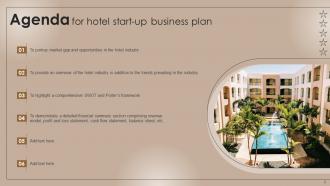
Slide 2: This slide displays the title Agenda for hotel start-up business plan.
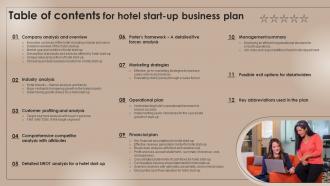
Slide 3: This slide exhibit table of content.
Slide 4: This slide exhibit table of content- Company analysis and overview.
Slide 5: The purpose of this slide is to provide a broader overview of the hotel industry.
Slide 6: The purpose of the slide is to portray organization details including name, incorporation date, web address, start-up investment, services etc.
Slide 7: The purpose of this slide is to highlight market gap and focus on devising solution to overcome those challenges.
Slide 8: The purpose of this slide is to express the benefits the hotel provides to its customers or clients.
Slide 9: The purpose of this slide is to highlight the key success factors of the hotel which leverage them with competitive edge in the market.
Slide 10: This slide portrays an ideal business location for hotel start-up that minimize the risk of failure.
Slide 11: This slide exhibit table of content- Industry analysis.
Slide 12: The purpose of this slide is to conduct a thorough assessment of a hotel industry in addition to its market trends.
Slide 13: The purpose of this slide is to conduct a thorough assessment of a hotel industry in addition to its market trends.
Slide 14: The purpose of this slide is to guide stakeholders about the problems prevailing in the industry.
Slide 15: This slide caters to details about various growth drivers resulting in hotel progress.
Slide 16: This slide exhibit table of content- Customer profiling and analysis.
Slide 17: This slide covers an assessment of how the hotel products and services will fit into a certain market and where they will acquire the most traction with customers.
Slide 18: The purpose of this slide is to depict the market potential of the hotel industry in terms of TAM, SAM, and SOM.
Slide 19: This slide exhibit table of content- Comprehensive competitor analysis with attributes.
Slide 20: The purpose of this slide is to provide a glimpse of key competitors in the industry to gain insight into their product services, sales, and marketing tactic.
Slide 21: The purpose of this slide is to provide a glimpse of key competitors in the industry to gain insight into their product services, sales, and marketing tactic.
Slide 22: This slide exhibit table of content- Detailed SWOT analysis for a hotel start-up.
Slide 23: The slide includes the strengths, weaknesses, opportunities, and threats analysis of the hotel.
Slide 24: This slide exhibit table of content: Porter’s framework – A detailed five forces analysis.
Slide 25: The slide highlights porter’s framework and its implications in the hotel industry.
Slide 26: This slide exhibit table of content- Marketing strategies.
Slide 27: The purpose of this slide is to implement an effective go-to-market strategy for bringing the hotel products or services to an end customer.
Slide 28: This slide highlights customer journey mapping to track users' actions and key touch points across levels such as awareness, conversion, loyalty, and retention.
Slide 29: This slide exhibit table of content- Operational plan.
Slide 30: The purpose of this slide is to outline the key objectives and goals of an organization and how to reach them by crafting an operational plan.
Slide 31: The purpose of this slide is to facilitate managers to convey project progress updates to stakeholders and get their approvals.
Slide 32: This slide exhibit table of content- Financial plan.
Slide 33: This slide provides a glimpse of important financial assumptions that are to be made while setting e-commerce platform.
Slide 34: The slide shows the effective revenue model of the hotel start-up, which displays the cost incurred and the various sources of income.
Slide 35: The slides highlight the break-even analysis of the firm.
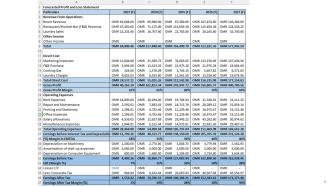
Slide 36: The slides provide a glimpse of the projected profit and loss statement to visualize the platform’s financial performance for the next five years.
Slide 37: The slides provide a glimpse of the projected profit and loss statement to visualize the platform’s financial performance for the next five years.
Slide 38: The slides provide a glimpse of the projected profit and loss statement to visualize the platform’s financial performance for the next five years.
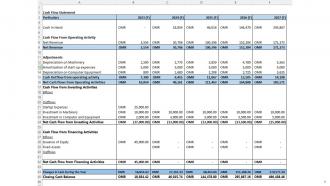
Slide 39: The slides highlight the cash flow statement of the company.
Slide 40: The slides highlight the cash flow statement of the company.
Slide 41: The slides cover the snapshot of the company's financial position at a specific time.
Slide 42: The slides highlight the cash flow statement of the company.
Slide 43: The purpose of this slide is to examine the effects of potential future events on the hotel’s performance by considering numerous different outcomes.
Slide 44: The purpose of this slide is to examine the effects of potential future events on the hotel’s performance by considering numerous different outcomes.
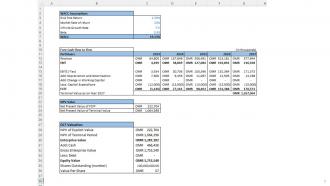
Slide 45: The purpose of this slide is to calculate the amount of money an investor would get from an investment after adjusting for the time value of money.
Slide 46: This slide exhibit table of content- Management summary.
Slide 47: The purpose of this slide is to craft a successful hierarchical framework for the hotel to ensure smooth operations.
Slide 48: The purpose of this slide is to highlight key job roles and responsibilities of the hotel staff to ensure effectiveness and efficiency in the operations.
Slide 49: The purpose of this slide is to highlight key job roles and responsibilities of the hotel staff to ensure effectiveness and efficiency in the operations.
Slide 50: This slide exhibit table of content- Possible exit options for stakeholders.
Slide 51: This slide represents exit strategy for stakeholders such as IPO, Mergers, Acquisitions, Private offerings, and Venture Capital.
Slide 52: This slide exhibit table of content- Key abbreviations used in the plan.
Slide 53: The purpose of this slide is to highlight the shorter version of existing words to save time and take up less space.
Slide 54: This is the icons slide.
Slide 55: This slide presents title for additional slides.
Slide 56: This slide depicts 30-60-90 days plan for projects.
Slide 57: This slide exhibits yearly timeline of company.
Slide 58: This slide display Financial.
Slide 59: This slide exhibits ideas generated.
Slide 60: This slide display Circular process.
Slide 61: This slide display Magnifying glass.
Slide 62: This slide display Our target.
Slide 63: This slide depicts posts for past experiences of clients.
Slide 64: This slide displays Venn.
Slide 65: This is thank you slide & contains contact details of company like office address, phone no., etc.
Hotel Start Up Business Plan Powerpoint Presentation Slides with all 70 slides:
Use our Hotel Start Up Business Plan Powerpoint Presentation Slides to effectively help you save your valuable time. They are readymade to fit into any presentation structure.






FAQs for Hotel Start Up Business Plan
Okay so you'll definitely need market analysis and who you're targeting - plus all the location stuff and what competitors are doing. Financial projections are obvious but tedious. The fun part is actually figuring out your hotel's vibe - boutique, budget, business travelers, whatever. Don't skip the operational stuff like staffing and services. Your financial section needs startup costs, revenue forecasts, break-even analysis - the whole nine yards. Marketing strategy matters tons too. Oh, and start with a killer executive summary that actually gets investors interested, then back everything up with real data not just wishful thinking.
Market analysis is huge for your hotel business plan - it shows you realistic room rates and what amenities guests actually want. You'll discover your main competitors too, which honestly can be pretty surprising when you see how bad (or good) some places are. This research drives everything: revenue forecasts, marketing plans, even design decisions. I'd start with occupancy rates and daily rates in your area first, then work outward. The whole thing helps you figure out what makes your place different. Oh, and it reveals actual demand - not just what you hope exists.
You'll definitely need room rates and occupancy projections, plus all your operating costs - staff, utilities, maintenance, marketing, the works. Cash flow forecasts for 3-5 years minimum. Hotels have crazy seasonal swings too, so factor that in. Don't lowball your startup costs either - renovation always costs more than you think, and you need working capital for those first slow months. Break-even analysis shows when you'll actually turn profitable. Honestly, investors prefer conservative numbers over pie-in-the-sky projections, so pad those expense estimates. Better to underpromise than crash and burn later.
Dude, location is literally everything for hotels. Pick the wrong spot and you're screwed before you even open. Think about it - where you are decides if you're targeting business people, tourists, or whoever. Plus it affects your pricing big time. I learned this the hard way when I saw a beautiful hotel fail because it was just... nowhere useful. You gotta check out foot traffic, what's nearby, how people get around. Competition too. Honestly, figure out your location first, then build everything else around what actually makes sense for that area.
Look, before you jump into all the nitty-gritty planning stuff, do a SWOT analysis first. It's like giving your hotel idea a reality check. Map out your strengths - could be your killer location or seasoned staff. Then hit the weaknesses honestly (crappy parking, rooms that need work). Don't forget opportunities - maybe there's tons of business travel picking up in your area. Threats too, like that shiny new hotel chain moving in. Brainstorm with your team because they'll catch things you totally missed. Trust me, it beats discovering problems after you've blown your budget.
Start with whoever fits your hotel's vibe and location best. Airport business hotel? Go after corporate travelers first. Downtown boutique spot? Think leisure guests and people in town for events. Honestly, trying to appeal to everyone just makes your marketing messy and confusing. Get specific about the demographics - a 45-year-old business exec books totally different than young couples on vacation. Their spending habits, when they book, all of it matters. Once you've got your main audience down, maybe add one or two other segments that make sense. But don't spread yourself too thin.
Definitely go digital since everyone's booking online now. Get your Google My Business dialed in first - that's huge for local searches. Instagram and TikTok are where it's at for showing off your property. Partnership deals with local restaurants absolutely crush it. I've watched hotels boost their bookings like crazy just doing dinner packages with nearby spots. Oh, and don't forget about email marketing to past guests - they're way easier to convert than random strangers. My advice? Pick one thing and get good at it before jumping around everywhere.
Look, seasonal swings will absolutely destroy your cash flow if you don't plan for them. I learned this the hard way - February can drop your occupancy 40% overnight. Build conservative projections for slow months and honestly, don't get too excited about peak rates. Everyone thinks they'll grab more market share than reality allows. You need fat cash reserves from good months to cover fixed costs when it's dead quiet. Pull 3-5 years of local data first to spot your patterns. Trust me, that legwork saves you from scrambling later when bills are due.
For your hotel business plan, start with revenue management - basically adjusting prices based on demand and what's happening in town. Check what competitors are charging too, obviously. If you've got something special to offer, don't be afraid to price higher. This pricing stuff is honestly where most people mess up their projections. Oh, and definitely include 2-3 different pricing scenarios in your plan. Shows investors you've thought through various occupancy rates and market positions. Trust me, it makes a huge difference when the numbers actually make sense.
Dude, tech can totally change how your hotel runs - automate check-ins, get mobile apps so people skip the front desk, smart room controls save energy costs. Property management systems handle reservations automatically. Revenue software adjusts your rates based on what's happening, which honestly saves so much headache. Guests basically expect this now anyway. Don't go crazy buying everything at once though - pick one thing that fixes your biggest pain point first. Also avoid the flashy stuff that doesn't actually help. Start small, then add more later.
You need to figure out how many people you'll need for each department - front desk, housekeeping, maintenance, plus food service if you're doing that. Map out seasonal changes since busy periods mean more staff. Night auditors and weekend coverage are essential (guests definitely don't follow business hours lol). Look into industry benchmarks for hotels your size first - gives you a decent starting point. Calculate both full-time and part-time roles, then factor in turnover because hospitality has pretty high rates. Don't forget training costs either, they add up fast. Include realistic salaries plus benefits when you're crunching numbers.
Honestly, going green is a win-win for hotels. Start small with LED lights and those "reuse your towels" programs - saves you money right away. Energy-efficient systems and water conservation will slash your utility bills too. The cool part? Guests actually pay premium rates for eco-friendly stays now. I'd go for certifications like LEED or Green Key since they really attract that environmentally conscious crowd. Local sourcing helps cut costs while supporting your community. Once you've got the basics down, think bigger - solar panels or EV charging stations. Oh, and definitely market it as a premium thing, not just something you're doing to be nice.
Honestly, diversifying beyond just room revenue is clutch - events, restaurant partnerships, that kind of stuff. Insurance is non-negotiable obviously (property, liability, business interruption). But here's what people miss: cybersecurity is massive since you're sitting on all that guest data. Cash reserves will save your ass during slow seasons or random shutdowns. Crisis communication plans too - bad reviews can spiral fast. The hotel game is basically expecting the unexpected, so I'd map out different nightmare scenarios now. Trust me, future you will appreciate having those "what if" plans ready to go when things get weird.
Look, competitive analysis is basically spying on other hotels to find your edge. Check out their pricing, amenities, who they're targeting - it's surprisingly fun once you get into it. The goal? Spot what they're doing wrong or completely ignoring. Maybe everyone's terrible with families, or nobody does late check-in, or their websites are from 2015. That's where you swoop in. Your unique selling point should hit exactly what competitors miss. I'd start with your top 5 rivals this week and just dig around their sites for an hour.
Honestly, the financial projections are gonna be your biggest headache - hotels have so many different revenue streams and forecasting is brutal. Location analysis sucks too, especially with seasonal stuff or trying to guess tourism patterns. Then there's all the operational planning where you map out staffing and maintenance while keeping it realistic (which is harder than it sounds). Competition research is tedious but you really gotta know your local market. Oh, and pro tip - tackle the money side first and budget way more time than you think. I made that mistake once and it was not fun.
-
The designs are super attractive. Me and my team love using SlideTeam’s presentations.
-
I joined SlideTeam last month and there’s no doubt that I tend to find our bond only strengthening over time. Best place to find world-class themes, templates, and icons.