


 0 Comment
 Customer Reviews

The model's trained. The sensors are running. And somewhere in the pipeline, a system is supposed to know whether someone just fell, sat down, or started jogging.
It doesn't always know. That's the problem.
Activity recognition sounds clean in research papers. You feed it accelerometer data or video frames, the model outputs a label, done. But the gap between a working prototype and a reliable system—one that handles real people, messy movement, overlapping actions—is wider than most demos admit. Human Activity Recognition systems fail quietly. A fall detection model misses an edge case. A gesture recognition module confuses two similar motions. Nobody flags it until something matters.
There's also the communication problem. The engineers understand what the model is doing. The stakeholders don't. Someone has to translate sensor fusion logic, skeleton-based action recognition pipelines, or LSTM sequence outputs into something a product team or hospital administrator can actually evaluate. That's a presentation problem. And it's harder than it looks.
Most teams underestimate this part. They build the thing, then spend twenty minutes before the meeting trying to make slides that explain it. Those slides are usually too technical for the room or too vague to be useful. Either way, they don't land.
That's why structured templates exist for this. Not because the work is simple—it isn't—but because the explanation of the work keeps running into the same structural gaps. How do you show a model's logic? How do you present dataset benchmarks without losing the room? How do you walk through a deep learning activity recognition pipeline without it becoming a lecture nobody asked for?
SlideTeam's pre-designed templates handle exactly this—ready-made frameworks for communicating complex AI-powered motion recognition work to mixed audiences. Whether you're pitching a smart home activity detection system, reporting on a healthcare activity monitoring project, or aligning a team around a wearable sensor activity tracking roadmap, there's a structure here that fits.
Here's what's available.
Template 1: Understanding Human Activity Recognition Insights and Applications PPT Example
Human activity recognition work is hard to explain without the right structure. This PowerPoint slide is built for practitioners who need to present HAR insights clearly. It covers core applications—healthcare activity monitoring, physical activity monitoring, and IoT activity monitoring—in one coherent flow. Whether you're briefing a product team or reporting to stakeholders, this curated resource on activity recognition PPT templates pairs well with this deck for added context. The template is 100% editable and customizable.
[product_image id=1313842]
Template 2: Huddle Boards for Problem Solving and Issue Resolution PPT Outline
Structured problem-solving demands a visual format that holds the room's attention and drives action. Huddle boards deliver instant clarity on issues, owners, and resolution status. Each layout merges creative design with a flexible structure that fits your brand identity. Color-coded sections give your team immediate visual cues on open and closed issues. You can present blockers, root causes, and corrective actions without losing the thread. This template accelerates your problem-solving sessions and keeps every stakeholder aligned. Transform your team huddles with sharper, faster communication today. Download this dynamic template now and unlock clearer, faster issue resolution.
[product_image id=1670222]
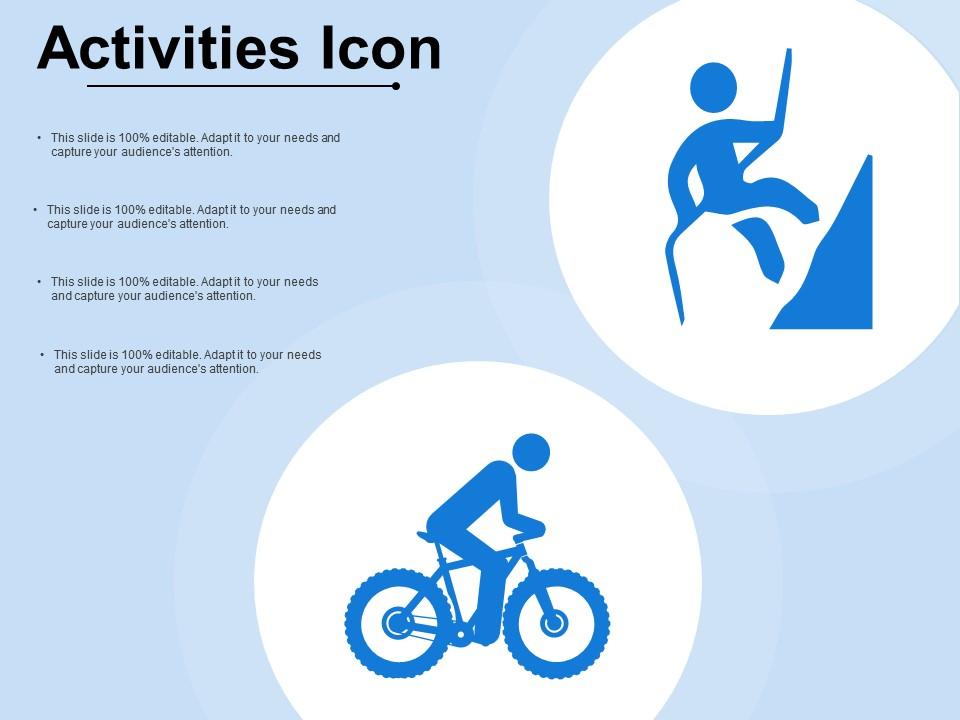
Template 3: Activities Icon
Representing activities, tasks, and to-do lists visually has never been more direct. This icon set captures the full range of actions in a clean, two-stage process format. Each icon delivers instant audience recognition—no ambiguity, no clutter. You can drop these visuals into any body movement analysis or motion detection slide with ease. They anchor complex concepts to clear, memorable imagery that your audience retains. Elevate your activity-based presentations with icons that communicate faster than text. Download this set now and give every task and activity the visual clarity it deserves.
Download this PowerPoint Template
Win Every Activity Recognition Presentation with SlideTeam
SlideTeam's PowerPoint templates are the best in the industry for activity recognition presentations. These content-ready slides help you communicate complex AI-powered motion recognition systems, sensor pipelines, and healthcare monitoring workflows with professional clarity. Use these ready-made PowerPoint slides to turn technical depth into audience-friendly narratives. Deploy these custom-made templates to save time, impress stakeholders, and drive your project forward with confidence.
FAQs on Activity Recognition
How does activity recognition differ between supervised and unsupervised learning approaches?
Supervised learning trains models on labeled activity data—each movement has a known tag. It performs well when labeled datasets are large and clean. Unsupervised learning finds patterns in raw sensor or video data without labels. It suits scenarios where labeling is costly or impractical, such as discovering new activity types. In practice, most deployed systems use supervised methods for known activities and unsupervised clustering to flag anomalies.
What role does sensor fusion play in improving the accuracy of activity recognition systems?
Sensor fusion combines data from multiple sources—accelerometers, gyroscopes, cameras—to reduce individual sensor errors. A single accelerometer misreads stillness as movement; adding gyroscope data corrects it. Fusing wearable inertial measurement unit data with video frames covers blind spots each sensor has alone. The result is higher accuracy across activity types, especially in real-time detection where a single-sensor miss can matter.
How do wearable devices compare to camera-based systems for real-time activity recognition?
Wearable devices capture motion data directly on the body, making them accurate for personal physical activity monitoring and fall detection. They work in low-light or occluded spaces where cameras fail. Camera-based systems, however, recognize multi-person activities and full-body poses without requiring the user to wear anything. Cameras raise privacy concerns; wearables raise battery and compliance concerns. The right choice depends on the deployment context and user acceptance.
What are the primary challenges in recognizing complex, multi-person activities in crowded environments?
Crowded environments introduce occlusion—people block each other from sensors or cameras. Models struggle to assign actions to the correct individual when bodies overlap. Activity labels also become ambiguous: two people handing off an object looks like different things from different angles. Most current models are trained on single-person datasets and generalize poorly to group scenarios. Dedicated multi-person datasets and improved pose estimation pipelines are the active areas of work here.
How does transfer learning address the issue of limited labeled data in activity recognition?
Transfer learning takes a model pre-trained on a large dataset and fine-tunes it on a smaller, domain-specific one. For activity recognition, a model trained on a broad HAR dataset can be adapted to a niche medical or industrial context with far fewer labeled samples. This cuts annotation cost significantly. It works best when the source and target activities share similar movement patterns or sensor types.
What distinguishes skeleton-based activity recognition from RGB video-based methods?
Skeleton-based activity recognition works on joint coordinates extracted from a body—angles, distances, and velocities between key points. It is lightweight, privacy-preserving, and robust to clothing or lighting changes. RGB video-based methods process raw pixel frames, capturing richer context like object interactions and scene cues. Skeleton methods perform better in controlled settings; RGB methods handle complex real-world scenarios where context matters beyond body movement alone.
How do convolutional neural networks process temporal data for sequential activity recognition?
Convolutional neural networks process temporal activity data by treating a sequence of frames or sensor readings as a spatial grid. A 1D CNN slides filters over time-series accelerometer data to detect local movement patterns. For video, 3D CNNs extend spatial filters across the time dimension, capturing motion between frames. The network learns which temporal patterns correspond to which activities, without manual feature engineering. Paired with LSTM layers, they handle longer activity sequences effectively.
What ethical concerns arise when deploying activity recognition systems in public surveillance?
Deploying activity recognition in public spaces raises consent and surveillance concerns first. People in public are not aware they are being analyzed, and their movement data can reveal sensitive behavior. Misidentification risks are real—a model flagging someone's gait as suspicious causes direct harm. Data retention and who accesses the logs are also live questions. Any public deployment needs a clear legal basis, transparent disclosure, and strict limits on data use.