

 0 Comment
 Customer Reviews

The proposal's been sitting in drafts for two days.
Not because the research isn't solid. It probably is. But somewhere between the technical specifications for the scanning equipment and the budget justification for the detection algorithms, someone has to make all of it sound like a fundable, credible project—not just a list of hardware requirements.
That's the gap. Not the science. The presentation of the science.
Cargo inspection system research proposals carry a particular kind of weight. You're not pitching a software subscription or a marketing campaign. You're making a case for infrastructure that affects border security, port throughput, and—at the end of the chain—what does or doesn't get through customs. The audience knows the stakes. They've seen the consequences of bad detection systems. What they need from your proposal is confidence: that you understand the problem, that your methodology is sound, and that the investment will deliver a system that actually works.
That's harder to write than it sounds. The technical people on your team can detail the non-invasive cargo scanning technology or the AI-powered detection logic down to the algorithm level. But turning that into a structured document—one that flows from problem context to scope to cost to team credentials—is a different skill. And most teams don't have time to figure out the formatting while also building the technical case.
So the templates exist. Because this isn't a unique problem. Research teams, security technology vendors, and port authorities have all faced the same blank page when it's time to submit. Someone, eventually, made a framework. Then another framework. Then a set of pre-designed layouts that handle the structure so the team can focus on the content.
SlideTeam's cargo inspection system research proposal templates are built for exactly this—ready-made frameworks that cover everything from the plan of action to the contract terms. They're content-ready, which means the architecture is already there. You fill in what your team knows, which is the part only you can do.
Here are the templates worth looking at.
Template 1: Cargo Inspection System Research Proposal Example Document Report DOC PDF PPT
Winning a cargo inspection contract starts with a well-structured, credible proposal document. This PPT template covers the full scope of a professional bid response. It opens with project context and client requirements, then moves into deliverables and a clear plan of action. The scope, timeframe, and key software features are each given dedicated space. Cost tables make the investment case transparent and easy to evaluate. A company overview section, team profiles, and client testimonials build credibility fast. Previous work samples and a pre-built statement of work close the document professionally. For teams building a cargo inspection system research proposal, this deck handles the structural heavy lifting. The template is 100% editable and customizable.
[product_image id=422782]
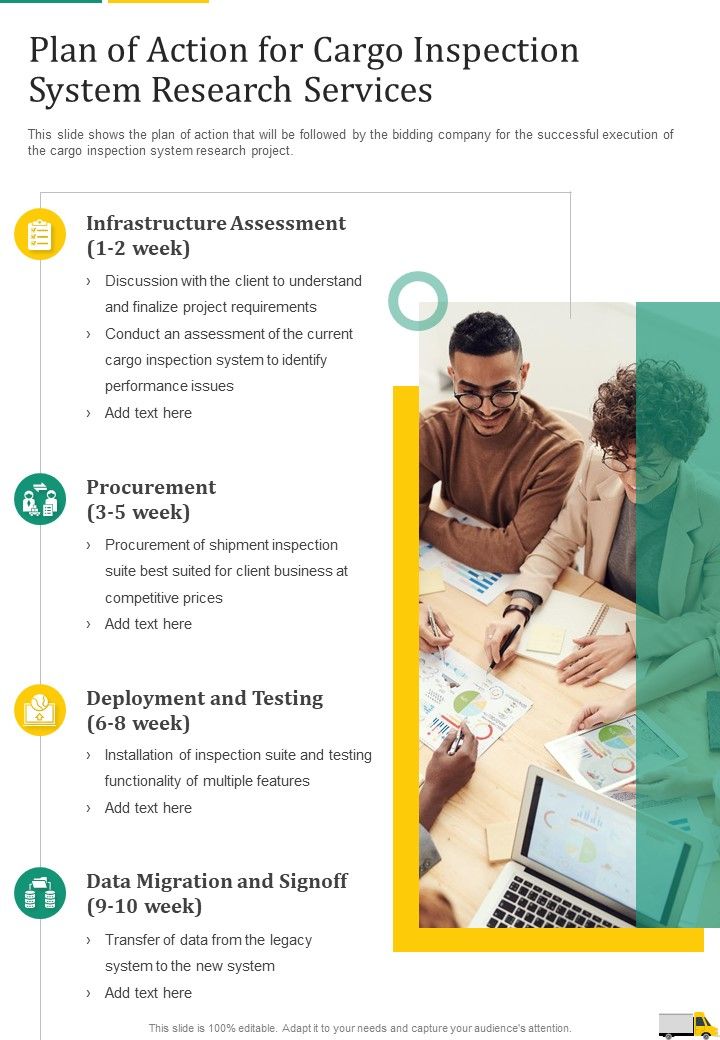
Template 2: Cargo Inspection System Research Services Plan of Action for One Pager Sample Example Document
Condense your entire cargo inspection research services action plan into one powerful, scannable page. This one-pager drives instant stakeholder alignment by presenting your plan in a single, professional layout. Bold visual hierarchy ensures decision-makers absorb key phases and milestones without navigating multiple slides. The structured format transforms complex timelines into a clear, sequential roadmap your audience can follow at a glance. You can present Cargo Inspection System Research milestones, scope boundaries, and delivery checkpoints with precision. Transform your action planning documents today. Download this dynamic template now and unlock faster stakeholder sign-off on your inspection research services.
Download this PowerPoint Template
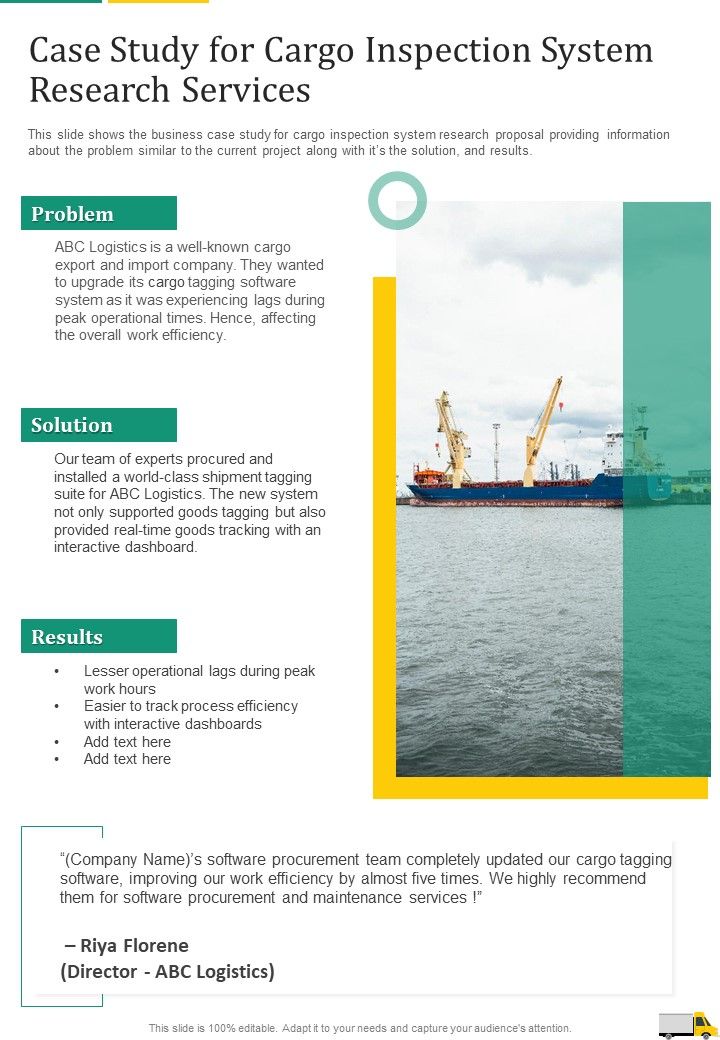
Template 3: Case Study for Cargo Inspection System Research Services One Pager Sample Example Document
Case studies are where proposals stop being theoretical and start being convincing. This one-pager PPT is built for practitioners who need to present a real-world cargo inspection project outcome clearly and fast. Whether you're demonstrating a successful port security inspection deployment or a customs cargo examination system implementation, the slide structures your narrative around results. For vendors responding to RFPs, this PPT is a credibility anchor—concise, visual, and built to be read in under two minutes. Find more ready-made layouts in this cargo inspection proposal template collection. The template is 100% editable and customizable.
Download this PowerPoint Template
Template 4: Cargo Inspection System Research Proposal Table of Contents One Pager Sample Example Document
First impressions in a proposal often come down to how well-organized the document looks before anyone reads a single section. This one-pager delivers a polished Table of Contents that signals structure, professionalism, and thoroughness from page one. The clear layout guides reviewers through your Cargo Inspection System Research Proposal with confidence. Each section header anchors the reader's expectations, making your proposal easier to evaluate. You can map out the full proposal arc—from methodology to contract—inside a single, impactful page. Transform your proposal opening documents today. Download this dynamic template now and unlock a stronger first impression with every submission.

Download this PowerPoint Template
Win Cargo Inspection Proposals with SlideTeam
SlideTeam's PowerPoint templates are the best in the industry for cargo inspection system research proposals. These content-ready slides give you professional structure—from scope and methodology to cost tables and contract terms—so you spend time on substance, not formatting. Whether you're addressing port security inspection research or automated cargo screening solutions, these ready-made frameworks keep your submission credible and competitive. Deploy these PowerPoint slides to secure funding, win contracts, and move your inspection research forward.
FAQs on Cargo Inspection System Research Proposal
What are the most critical parameters that a modern cargo inspection system must evaluate to ensure comprehensive threat detection?
A modern cargo inspection system must evaluate physical density and material composition to flag anomalies. It should also screen for radiation signatures, chemical traces, and organic compounds associated with contraband. Equally important is identity verification—matching container manifests against actual contents. Systems that combine these checks—imaging, spectroscopy, and manifest reconciliation—catch what single-method approaches miss.
How do non-intrusive inspection technologies like X-ray and gamma-ray imaging compare in terms of penetration depth and resolution for dense cargo loads?
X-ray systems use lower-energy photons and work well for lighter cargo loads with good image resolution. Gamma-ray imaging penetrates denser materials—steel-shielded containers, heavy machinery—but produces lower spatial resolution. In practice, high-density freight demands gamma-ray penetration depth, while X-ray delivers cleaner images for mixed or lighter loads. Many ports use both in sequence for layered verification.
What role does artificial intelligence play in automating anomaly detection within cargo scanning systems?
AI processes scan imagery faster than human operators and flags deviations from known cargo profiles automatically. Machine learning models trained on labeled threat data reduce operator fatigue and response lag. In real-time cargo surveillance systems, AI prioritizes containers by risk score, directing human review only where the model detects genuine anomalies. This cuts screening time without reducing detection sensitivity.
How can a research proposal effectively balance cost-efficiency with advanced detection capabilities in cargo inspection system design?
Start by tiering detection requirements—not every cargo stream carries equal risk. A risk-based cargo inspection framework lets you allocate advanced sensing (AI imaging, radiation detection) to high-risk lanes and use lighter screening elsewhere. Proposals that quantify cost-per-detection-event against threat probability tend to fare better with funding reviewers. Show the math, not just the technology list.
What are the primary regulatory frameworks governing cargo inspection systems at international ports and border crossings?
The World Customs Organization's SAFE Framework sets baseline cargo security standards globally. The International Maritime Organization's ISPS Code governs port-level security. In the USA, CBP enforces the 24-Hour Advance Manifest Rule and C-TPAT standards. EU ports follow Regulation (EC) No 648/2005 on customs security amendments. Any proposal submitted for international deployment should cite the applicable framework explicitly.
How does the integration of multi-sensor fusion improve the accuracy of contraband detection in heterogeneous cargo environments?
Single sensors misread heterogeneous cargo because different materials confuse individual detection modalities. Multi-sensor fusion—combining X-ray imaging, gamma-ray, and chemical trace detection—cross-validates signals before flagging a threat. When two or more sensors agree on an anomaly, false positives drop sharply. IoT-based cargo monitoring systems extend this by adding real-time container telemetry to the detection picture.
What methodologies are most effective for evaluating the performance metrics of a proposed cargo inspection system during the research phase?
Benchmark against standardized threat libraries during controlled trials before field testing. Key metrics include detection rate, false positive rate, throughput speed, and system downtime. Blind-test protocols—where operators don't know which containers hold test items—give the most reliable performance data. Document all conditions: cargo density, container material, and scan duration, so results can be replicated and peer-reviewed.
How can researchers address the challenge of minimizing false positive rates while maintaining high sensitivity in cargo screening algorithms?
False positives drop when training data is diverse and well-labeled—garbage-in means bad models out. Calibrate detection thresholds using stratified test sets that reflect real cargo mix, not just threat items. Ensemble models that require agreement from multiple classifiers before flagging reduce noise. Regular retraining on new cargo profiles keeps sensitivity high without inflating alarm rates over time.