

 0 Comment
 Customer Reviews

The business plan's been sitting in a Google Doc for two weeks. Tabs open. Notes scattered. A rough number scribbled on a sticky note that may or may not still be accurate.
Starting an errand service sounds simple enough. Pick things up, drop things off, handle what people can't get to. But writing the plan—actually committing to paper how this works, what it costs, who it serves, how it grows—that's where most people stall. Not because they don't know their business. Because putting it into a structured document feels like a different job entirely.
The discomfort is specific. You know your target market. You have a rough sense of pricing. But then someone asks about your errand service revenue model, your competitive analysis, your operations plan. And suddenly you're building spreadsheets instead of a business.
It gets worse when you factor in what the plan is actually for. Not just for you—for lenders, partners, maybe investors. The person reading it doesn't know your neighborhood, your clients, or why this works. They're reading cold. And a half-finished doc with bullet points doesn't hold up to that kind of scrutiny.
There's also the format problem. Even people who know exactly what they want to say often don't know how to say it in a way that looks like a real business plan. Structure matters. Flow matters. A pitch that reads like a memo loses credibility before the numbers even come up.
That's why errand service business plan templates exist. Not because the ideas are hard—they're not. But because packaging those ideas into something coherent, professional, and readable takes a kind of effort that isn't about the business itself. It's about presentation. And most people aren't starting from that kind of scratch voluntarily.
SlideTeam's pre-designed templates handle exactly this gap. They give you the structure—executive summary, market analysis, financial highlights, competitive positioning—so you can drop in what you know without building the scaffolding yourself.
Here are the templates worth using.
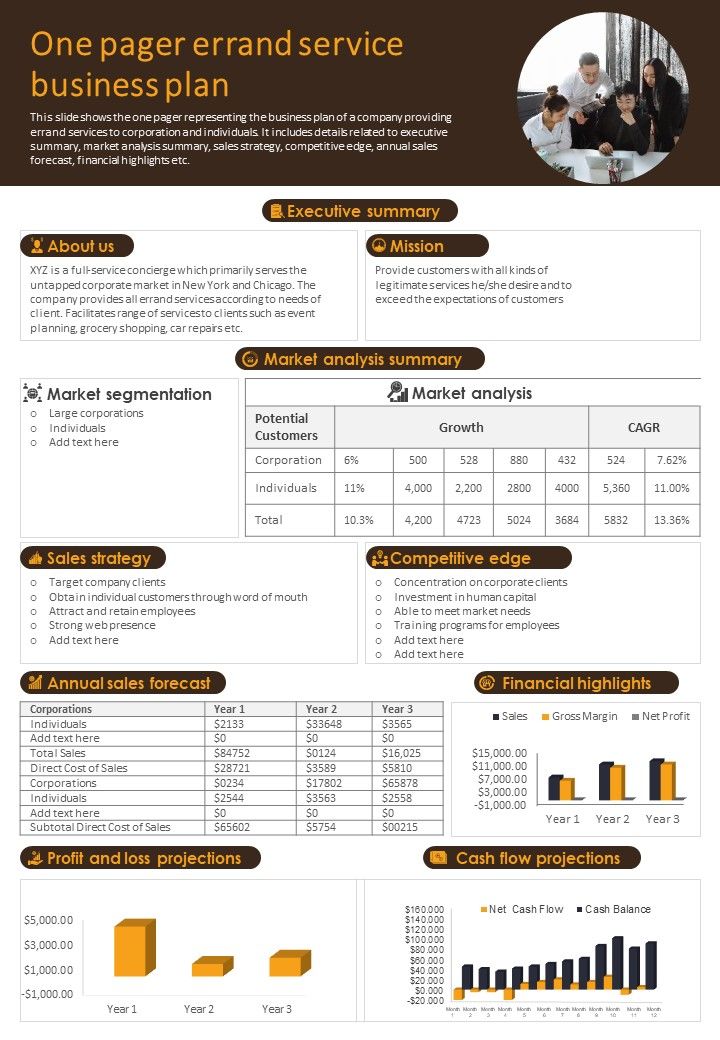
Template 1: One Pager Errand Services Business Plan Presentation Report Infographic PPT PDF Document
A one-page business plan for an errand service needs to do a lot in a small space. This PPT preset handles that well, covering the executive summary, market analysis summary, sales approach, competitive edge, and key financial highlights in a single cohesive slide. It's the kind of view a lender or partner scans first. For anyone building a personal errand service startup plan, this deck gives a credible, structured starting point. The template is 100% editable and customizable.
Download this PowerPoint Template
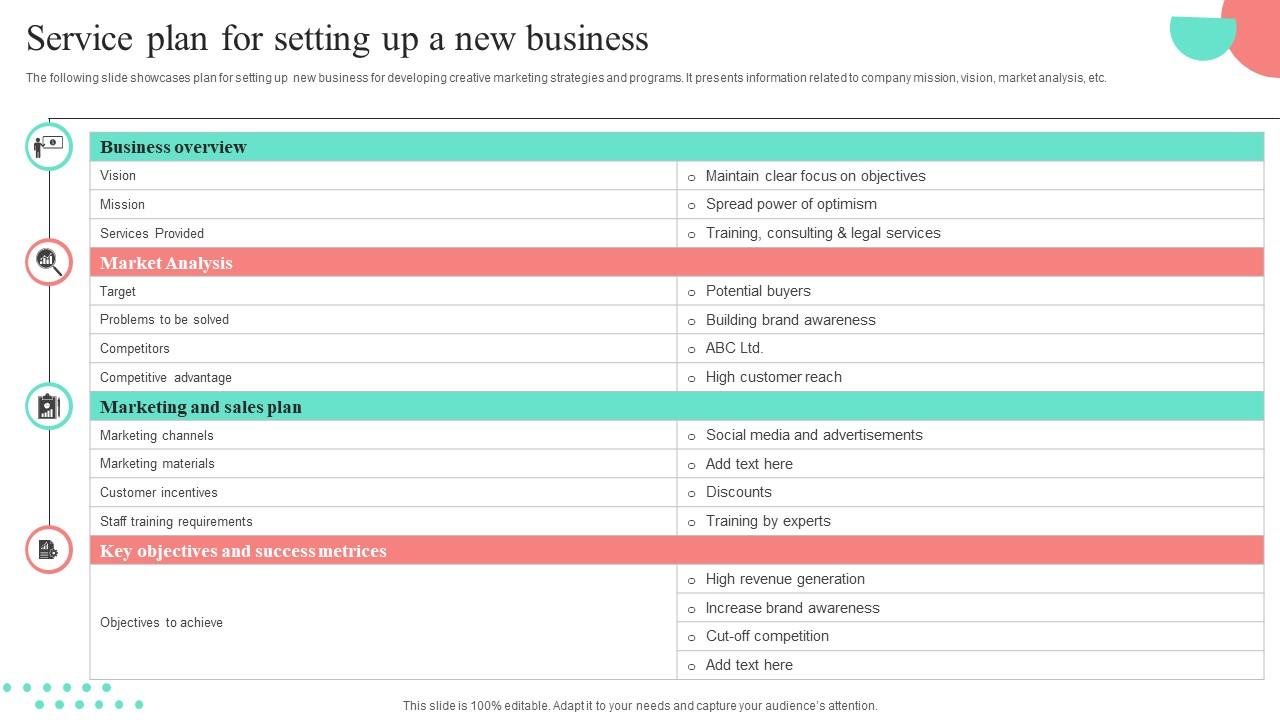
Template 2: Service Plan for Setting Up a New Business
Structured business setup starts with a clear plan—mission, vision, and a market analysis that actually holds together. This slide drives that clarity by presenting your company's foundation alongside market context and success metrics in one cohesive framework. The intuitive layout converts complex planning details into accessible, professional slides. You can anchor your errand service marketing plan and business goals within a proven structure. Build compelling Service Plan presentations that command stakeholder confidence immediately. Transform your business launch presentations today. Download this dynamic template now and unlock your service planning potential.
Download this PowerPoint Template
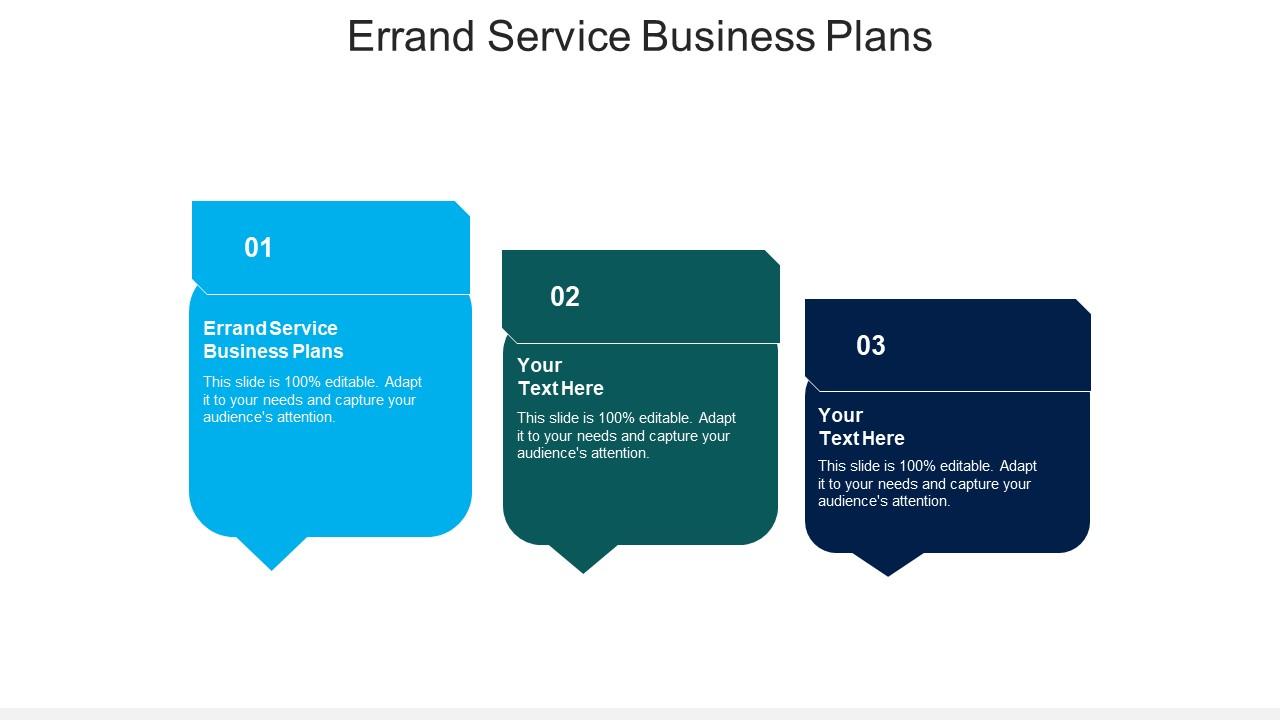
Template 3: Errand Service Business Plans PPT PowerPoint Presentation Ideas Deck
Capturing an errand service business plan across three focused stages gives stakeholders exactly what they need to follow your thinking. This presentation deck delivers that structure—breaking down your errand running business plan into a logical, persuasive narrative that builds confidence slide by slide. The flexible framework lets you tailor each stage to your local errand service business context and client base. Present your errand service business proposal with the professional polish that serious planning demands. Transform your business plan presentations today. Download this dynamic template now and unlock your path to funding and growth.
Download this PowerPoint Template
Win Every Pitch with SlideTeam
SlideTeam's PowerPoint templates are the best in the industry for building a compelling errand service business plan. These content-ready slides give you professional structure for everything from your errand service financial plan to your competitive analysis—saving hours of formatting work. Use these ready-made PowerPoint slides to present your business with clarity and credibility. Deploy these templates today and turn your errand service vision into a plan that wins.
FAQs on Errand Service Business Plan
What are the most effective pricing models for an errand service business, and how should they vary based on service type and client demographics?
Hourly rates work well for general errands; flat fees suit defined tasks like grocery runs or prescription pickups. Seniors and corporate clients often prefer subscription packages for predictability. Adjust pricing by neighborhood demand, delivery distance, and task complexity. Premium pricing holds for same-day or after-hours requests. Start with two or three clear tiers, test them with early clients, and revise based on actual completion time and margin.
How do you conduct a competitive analysis for an errand service business in a saturated urban market?
List every direct competitor—apps, independent runners, concierge services—within your service radius. Compare pricing, turnaround time, and the tasks they cover. Identify what they consistently miss: speed, personal touch, elderly client support. Read their reviews for recurring complaints. In a saturated market, the gap is usually reliability and communication, not price. Build your positioning around the specific failure your competitors repeat most often.
What legal structures are most suitable for launching an errand service business, and how does the choice impact liability and taxation?
A sole proprietorship is the fastest to launch but offers no liability protection. An LLC separates personal assets from business risk—important when handling client property or entering private spaces. An S-Corp makes sense once profit grows enough to justify payroll. For most errand service startups, an LLC is the practical default. It keeps taxes straightforward while shielding personal liability from client disputes or accidents.
Which target customer segments generate the highest lifetime value for an errand service business?
Seniors with limited mobility generate the highest lifetime value—they need consistent, recurring help and rarely switch providers. Corporate clients and busy dual-income households come next, offering volume and predictability. Clients recovering from surgery or managing chronic illness also represent high-retention segments. Focus acquisition spend on seniors and corporate accounts first. Retention cost is low; one good relationship compounds into referrals across the same community.
How should an errand service business plan address insurance requirements to protect both clients and employees?
General liability insurance covers property damage or injury during a job. Commercial auto insurance is mandatory if runners use personal vehicles for client tasks. Workers' compensation applies the moment you hire staff. Some clients—particularly corporate accounts—will ask for proof of coverage before signing. Address all three in your business plan. A single uninsured incident can wipe out early-stage margins entirely.
What technology platforms and apps are essential for streamlining operations in an errand service business?
Booking and dispatch tools like Jobber or Housecall Pro handle scheduling and client communication. Route optimization apps like Circuit cut drive time on multi-stop days. Payment processing through Stripe or Square keeps transactions clean. For team operations, Slack or a simple group messaging tool handles coordination. Start with booking and routing—those two directly affect capacity and cost per job, which is where margin is won or lost.
How do you calculate startup costs and initial working capital requirements for an errand service business?
List fixed startup costs: business registration, insurance premiums, vehicle expenses, and any software subscriptions. Add variable costs for the first 60 days: fuel, supplies, and marketing. Working capital should cover three months of operating expenses before revenue stabilizes. Most solo errand service startups launch for under $3,000. The bigger risk is underestimating insurance and vehicle costs—price those first before estimating anything else.
What key performance indicators should be tracked to measure the operational efficiency of an errand service business?
Track jobs completed per day, average revenue per job, and on-time completion rate. Client retention rate tells you whether the service is actually working. Cost per job—fuel, time, and overhead combined—determines real margin. Watch cancellation rate closely; high cancellations usually signal a booking or communication problem. Four or five clear numbers reviewed weekly give you more control than any dashboard with twenty metrics.