

 0 Comment
 Customer Reviews

The culture deck's been sitting in the shared drive for six months. Nobody's opened it.
Not because the organization doesn't have a culture problem—it probably does. But because diagnosing culture feels like trying to describe water. Everyone's in it. Nobody agrees on what it is. And when leadership finally asks "so what kind of organization are we, exactly?"—the silence that follows is very specific.
That question is harder than it sounds. Most teams reach for words like "innovative" or "collaborative" and then spend the next hour arguing about whether that's aspirational or accurate. The gap between what a culture claims to be and what it actually rewards is where change efforts quietly die.
There's also a second problem. Even when a team agrees on the diagnosis, they can't agree on what to do next. Culture change without a frame is just vibes. And vibes don't survive a budget meeting.
That's why the Competing Values Framework exists. Robert Quinn and Kim Cameron built it as a practical diagnostic—four quadrants, two axes, real tradeoffs. It doesn't pretend culture is one thing. It acknowledges that every organization holds internal tensions: between flexibility and control, between internal focus and external positioning. The CVF doesn't resolve those tensions. It maps them. And mapping them is how you start having the actual conversation.
The model surfaces four culture types—Clan, Adhocracy, Hierarchy, Market—each with its own logic, strengths, and blind spots. Leaders use it to run Organizational Culture Assessments, build change management cases, and structure leadership development. It works because it's concrete. You can score it. You can chart it. You can show it to a room of skeptical executives and they'll point to where they disagree—which is the whole point.
SlideTeam's pre-designed CVF templates handle the part most people skip: building the actual presentation layer around the diagnostic. These are content-ready frameworks that let you stop wrestling with formatting and start focusing on the conversation.
Here are the templates that do that work.
Template 1: Competing Values Framework of Organisational Culture
Four fundamental culture models come together in one structured visual. This template maps the Human Relations Model, Open System Model, Internal Process Model, and Rational Goal Model across a clear two-axis grid. The Flexibility-Control and Internal-External dimensions deliver instant analytical clarity. Each quadrant translates competing organizational priorities into a single, compelling visual argument. You'll communicate the full Quinn Competing Values logic without losing your audience mid-slide. Professional structure ensures your diagnosis lands with authority and precision. Transform your Organizational Culture Assessment presentations with this powerful framework. Download this dynamic template now and unlock sharper cultural diagnosis for your leadership team.

Download this PowerPoint Template
Template 2: Competing Values Framework of Organizational Efficiency PPT Presentation
Sustainable organizational effectiveness isn't a single value—it's a balance of four. This template captures the Competing Values Framework for Organizational Efficiency across human relational, open system, internal process, and rational goal dimensions. Each stage translates directly into a measurable performance conversation. The clean, four-stage layout drives focus and keeps stakeholders anchored to what matters. You'll frame complex culture dynamics in a way that sparks action, not debate. It's purpose-built for leaders presenting the Cameron Quinn Framework to cross-functional audiences. Transform your organizational effectiveness presentations with this expertly designed slide set. Download now and make your CVF Management Framework case with confidence.
[product_image id=1233663]
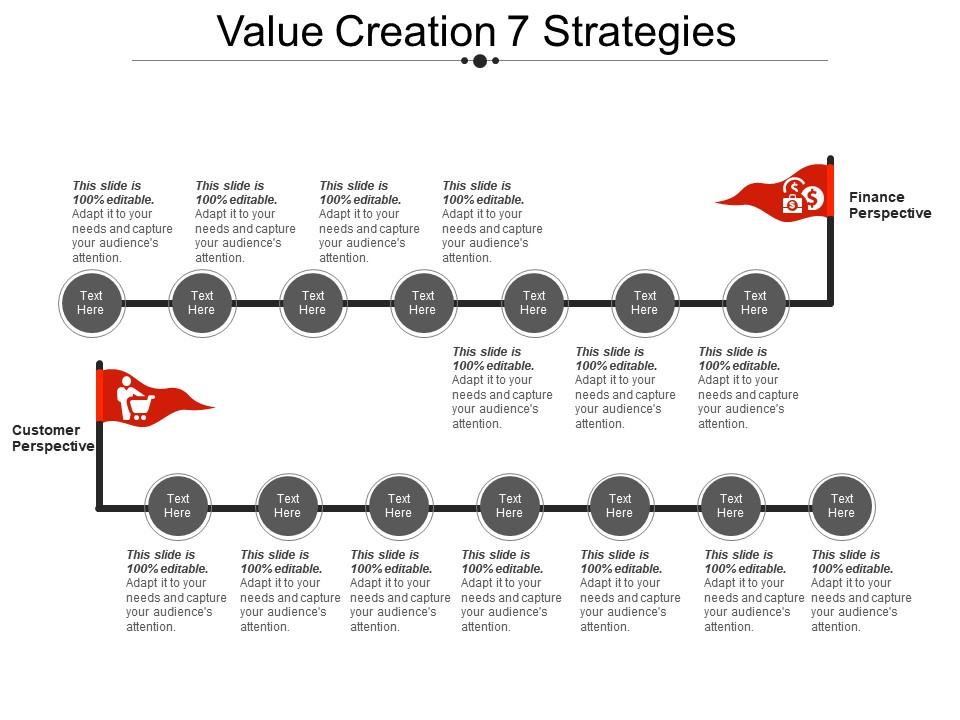
Template 3: Value Creation in 7 Strategies
Fourteen distinct stages of value creation are distilled into one coherent presentation arc. This template spans surplus creation, profit creation, and the full breadth of value generation logic your stakeholders need to see. Each stage builds on the last, creating a persuasive forward momentum in your presentation. The structured layout ensures your audience tracks every strategic layer without losing the thread. You'll present complex multi-stage value models with the clarity of a seasoned practitioner. Effortless customization gives you complete control over emphasis and sequencing. Transform your value creation strategy presentations today. Download this dynamic template now and unlock your most persuasive business case yet.
Download this PowerPoint Template
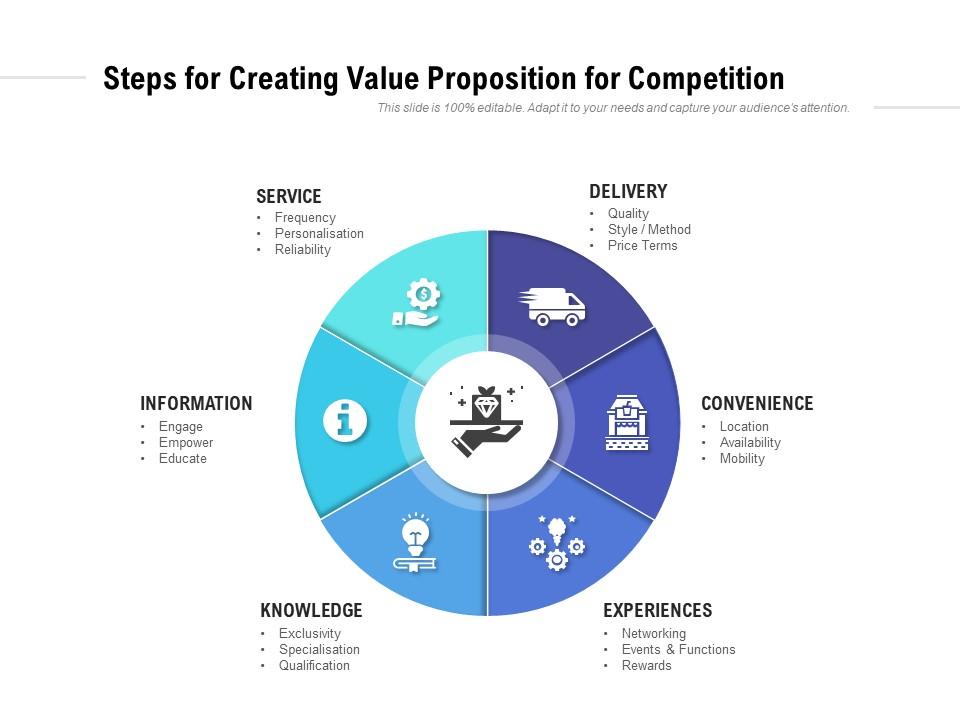
Template 4: Steps for Creating Value Proposition for Competition
Six concrete stages—Convenience, Experiences, Knowledge, Information, Service, Delivery—build a complete value proposition for competitive positioning. Each stage anchors your pitch in what customers actually care about, not abstract claims. The progressive structure guides your audience from problem awareness to differentiated solution. You'll move from insight to argument without a single wasted slide. This template is ideal for teams preparing competitive positioning decks, B2B proposals, or market entry cases. Crisp visual hierarchy ensures the most critical value drivers stand out immediately. Transform your competitive value proposition presentations today. Explore more Competing Values Framework PPT templates and download this slide set now to present with real conviction.
Download this PowerPoint Template
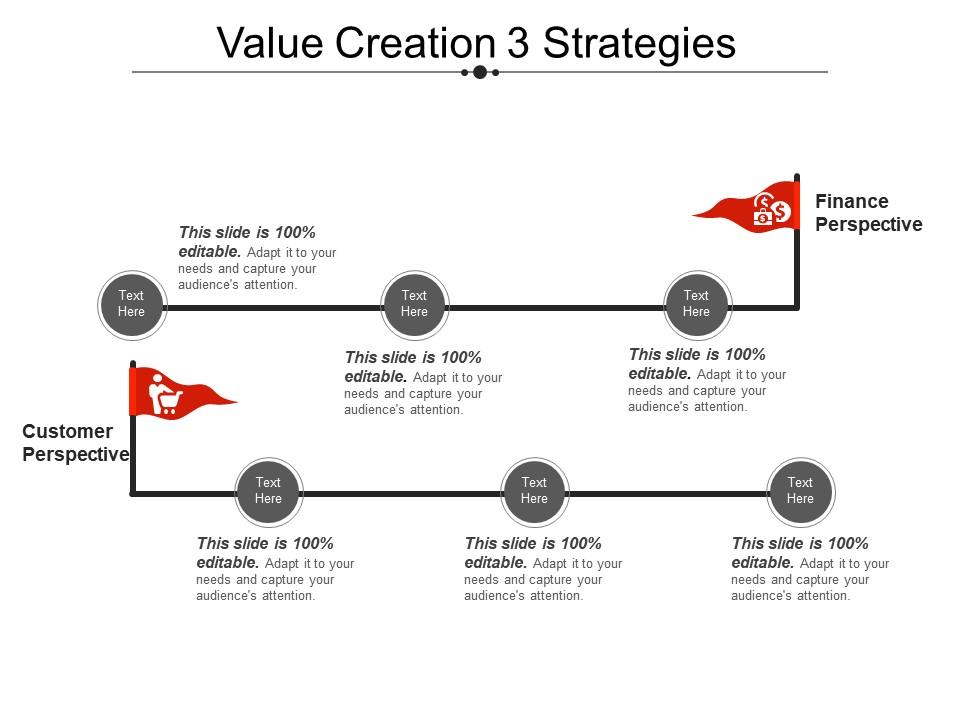
Template 5: Value Creation 3 Strategies
Three focused value creation pathways translate into a tight, executive-ready presentation structure. Each strategy strand is laid out with precision, giving decision-makers exactly the clarity they need to act. Charts and graphs integrate naturally into the layout, turning data into a persuasive narrative. The minimal, focused structure keeps your audience on the argument rather than the decoration. Use this template for board-level value strategy reviews, investor updates, or leadership planning sessions. Every visual element reinforces the core message without visual noise. Transform your value creation presentations today. Download this dynamic template now and deliver a strategy story that actually sticks.
Download this PowerPoint Template
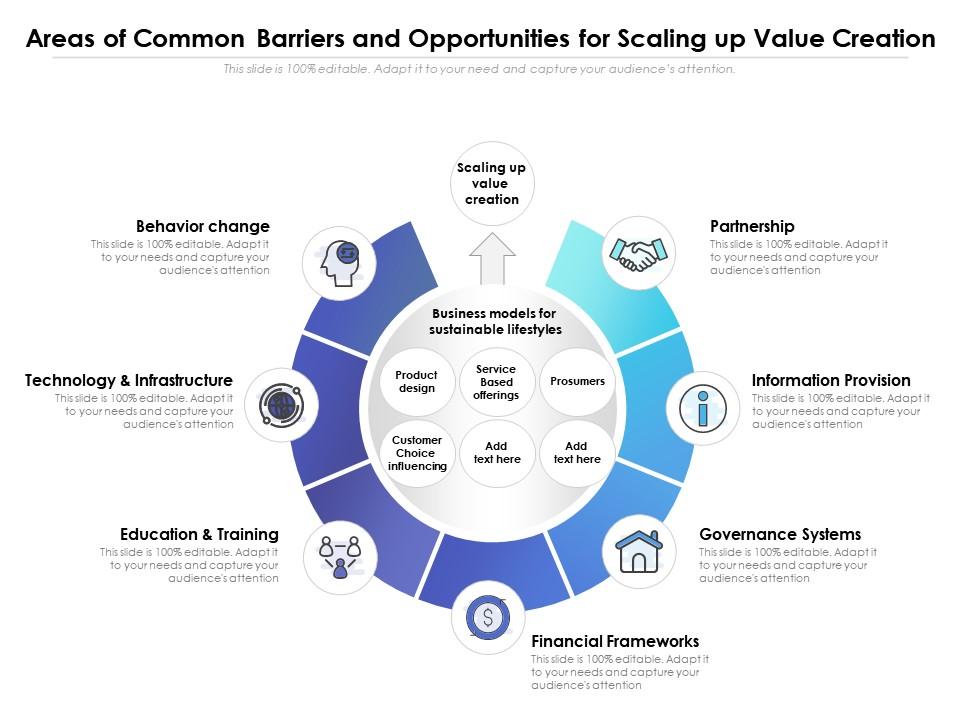
Template 6: Areas of Common Barriers and Opportunities for Scaling Up Value Creation
Scaling value creation runs into real friction — funding gaps, weak infrastructure, missing skills, and information asymmetry all compound. This PPT preset maps seven common barriers and opportunities across Information Provision, Financial Frameworks, Infrastructure, Technology, and Education. It gives practitioners a structured surface for honest gap analysis. Use it in organizational development reviews or HR culture assessment workshops where surface-level diagnostics won't do. The template is 100% editable and customizable.
Download this PowerPoint Template
Template 7: Types of Organizational Culture Competing Values Framework
Organizational culture rarely fits one label — and this slide makes that visible. The PPT template lays out the core Organizational Culture Types from the Competing Values Framework, including Adhocracy Culture and Clan Culture, alongside their behavioral drivers. It's the kind of slide a culture lead or HR partner reaches for when running a cultural change workshop or a cross-functional alignment session. For context, the two-axis structure keeps the discussion grounded without turning into a lecture. The template is 100% editable and customizable.
[product_image id=1157365]
Template 8: Competing Value Systems PowerPoint Presentation Ideas
Prioritizing competing tasks inside a complex organization is genuinely hard to visualize. This PowerPoint slide uses a five-stage structure to map how value systems interact when teams face conflicting demands. It's useful for leaders running Organizational Change Management conversations or presenting a Balanced Leadership Model to a mixed audience. The deck keeps the discussion concrete — which is what rooms full of skeptics actually need. The template is 100% editable and customizable.

Download this PowerPoint Template
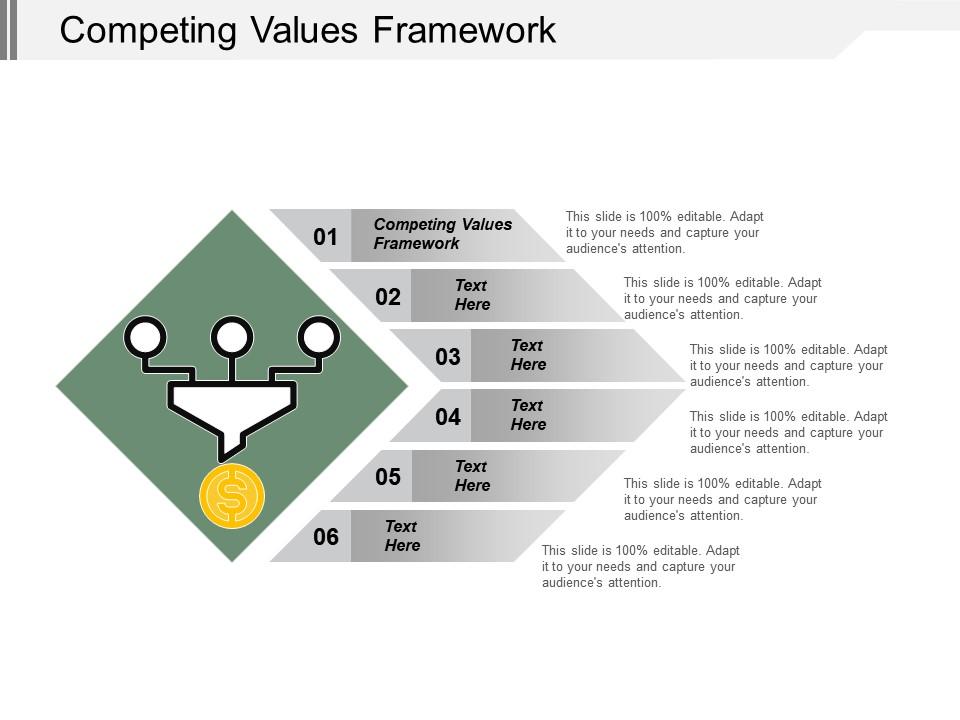
Template 9: Competing Values Framework PowerPoint Presentation Ideas Professional
Some frameworks need six clear stages to tell the full story — and this one earns every stage. This PPT template is built for presenting the Competing Values Framework in its complete form, covering the full arc from cultural diagnosis to leadership alignment. Consultants and HR leads use it when the audience needs more than a two-by-two grid. It supports deep CVF Organizational Assessment conversations without losing visual coherence. The template is 100% editable and customizable.
Download this PowerPoint Template
Template 10: Competing Values Leadership Presentation Graphics
Nine leadership dimensions rarely fit on one clean slide—this template makes it work. Competing Values Leadership roles are mapped across a nine-stage structure that drives immediate comprehension. Each stage corresponds to a distinct leadership behavior, anchoring abstract CVF theory in practical role expectations. The layout empowers HR teams and executive coaches to present Leadership Competency Framework assessments with authority. You'll connect leadership style to organizational performance outcomes in a single, compelling visual. This template is purpose-built for CVF leadership development and culture alignment presentations. Transform your leadership assessment presentations today. Download this dynamic template now and deliver clarity your executive audience will actually act on.

Download this PowerPoint Template
Elevate Your Culture Conversations with SlideTeam
SlideTeam's PowerPoint templates are the best in the industry for presenting the Competing Values Framework with structure and credibility. These content-ready slides save hours of design time while delivering professional-grade visual clarity across all four CVF quadrants. Use these PowerPoint slides to run sharper Organizational Culture Assessments, align leadership, and build change management cases that actually land. Deploy these ready-made frameworks to drive organizational effectiveness and turn culture diagnostics into decisive action.
FAQs on Competing Values Framework
How does the Competing Values Framework help leaders diagnose organizational culture before initiating change?
The CVF gives leaders a scored map of where the organization currently sits across four culture types: Clan, Adhocracy, Hierarchy, and Market. Before initiating change, run the Organizational Culture Assessment Instrument (OCAI) survey with key stakeholders. Plot the results on the two-axis grid to see the current culture profile versus the desired one. The gap between those two profiles is your change agenda — concrete, visual, and defensible to a skeptical room.
What are the core tensions between the Collaborate and Compete quadrants in the CVF, and how can leaders balance them?
The Collaborate quadrant prizes trust, internal cohesion, and long-term people development. The Compete quadrant prioritizes market share, results, and external positioning. These two sit on opposite ends of the CVF's internal-external axis, which creates real tension in goal-setting and resource allocation. Leaders balance them by ring-fencing each logic — using Clan culture norms inside teams while driving Market culture norms in customer-facing functions. Structural separation, not compromise, is the practical answer.
In what ways does the CVF differ from other organizational culture models like the Denison Culture Survey or McKinsey 7-S?
The CVF is a quadrant model built on two axes — flexibility vs. control, internal vs. external focus — giving it a clean diagnostic geometry. The Denison Culture Survey measures culture through twelve practices mapped to involvement, consistency, adaptability, and mission. McKinsey 7-S is not a culture model at all; it maps organizational alignment across seven interdependent elements. CVF is faster to score and easier to present; the others go deeper into specific behavioral or structural drivers.
How can a company use CVF assessments to align HR strategy with organizational goals?
Run the CVF assessment to identify the dominant and desired culture types. Then map each HR practice — hiring criteria, performance metrics, learning programs, reward structures — to the culture type it currently reinforces. Where HR practice and desired culture type diverge, you have a misalignment to fix. For example, a company wanting Adhocracy culture but rewarding only rule compliance is running a Hierarchy HR system. That gap is the HR strategy brief.
What role does leadership style play in determining which quadrant of the CVF dominates an organization?
Leaders don't just reflect culture — they actively reproduce it through what they measure, reward, and tolerate. A leader who consistently rewards rule-following and process compliance pulls the organization toward the Hierarchy quadrant. One who champions experimentation and risk-taking shifts it toward Adhocracy. The CVF's four leadership roles — Mentor, Innovator, Coordinator, Director — each map to a quadrant. The role a leader defaults to under pressure usually determines which quadrant dominates over time.
How does the CVF apply to ambidextrous organizations that pursue both innovation and operational efficiency simultaneously?
Ambidextrous organizations must hold two CVF quadrants simultaneously — typically Adhocracy for innovation units and Hierarchy or Market for operational core. The CVF frames this not as contradiction but as managed tension. In practice, this means separating the structures, metrics, and leadership roles of each function rather than expecting one culture to serve both. The CVF assessment can map each unit independently, making the ambidexterity visible and discussable rather than a source of unresolved conflict.
Can a single department within an organization operate under a different CVF quadrant than the rest of the company?
Yes — and this is more common than most culture models acknowledge. A product R&D team may operate with strong Adhocracy norms while the finance function runs on Hierarchy logic. The CVF explicitly supports subculture analysis at the department level. Running unit-level OCAI assessments reveals these differences. The practical risk is when subculture differences become invisible, creating cross-functional friction that looks like a people problem but is actually a culture mismatch.
How does organizational life cycle stage influence the dominant values in the CVF model?
Early-stage organizations typically sit in the Adhocracy or Clan quadrants — flexibility and internal cohesion dominate when survival depends on speed and team trust. As scale increases, Hierarchy culture tends to emerge naturally: processes, controls, and role specialization become necessary. Mature organizations often shift toward the Market quadrant as competitive pressure intensifies. The CVF is most useful at transition points — when the life cycle stage shifts and the old dominant culture starts creating friction rather than results.