

 0 Comment
 Customer Reviews

If you have ever been part of the diverse crowd that forms around a performing troupe, you know how difficult it can be for a short person to see anything. Before the shorter individual wrestles his way to the front of the crowd, the show ends. In this case, there is no societal loss.
Imagine, however, this scenario repeating at a workplace. A short-statured employee, unable to clearly see a presentation from the boss, subsequently misses out on a shot at a high-visibility project. Attrition, dissatisfaction, and water-cooler gossip are the result. Is such an organization diversity-friendly and equity-promoting?
What is the solution to this problem?
In a related poser, your business might be paying women less than men. Check — could this be true? Are there areas your business is violating the fundamentals of diversity and equity without conscious realization?
Most businesses around the world today need a diversity and equity action plan to meet the challenges of employee demand and legal mandates.
SlideTeam, the world leader in presentation design services, provides you with world-class PPT Templates on most business topics, with special focus on diversity and equity.
Our templates are best-in-class and a top choice for Fortune 500 companies.
These 100% editable slides cover practical solutions and resources. SlideTeam guides you from objective setting to stakeholder engagement.
We cover inclusive policy development with an emphasis on equity and diversity. Progress tracking appears on a separate SlideTeam slide. Communication strategies and best practices ensure a strong finish.
Firm up your diversity and inclusion plan with these SlideTeam Templates that show you the way.
Take the next step towards diversity and equity excellence—explore our templates now and empower your organization!
Template 1: Action Plan PPT Template for Diversity and Equity
Design a complete end-to-end action plan to make your business 100% diversity and equity compliant. The SlideTeam PPT Template, a complete deck in 28 slides, takes you through the journey. Users of the slide begin with setting clear objectives for the action plan, deciding on assessment metrics, and evaluating whether the action plan was delivered. We end with the next steps and moving forward as the final offering in this package.
[product_image id=1487592]
Template 2: Setting Clear Objectives for Action Plan PPT Template
SlideTeam highly recommends that you treat this PPT Slide as the resource you refer to time and again. It has all the ingredients for a diversity and inclusion plan to be successful. Clearly defining measurable outcomes to achieve within the timeframe is step 1 on the slide, followed by the cycle. This includes resource allocation and outlining clear methods to promote diversity and equity initiatives. Finally, we evaluate success based on predefined metrics and stakeholder feedback.

Download this PPT Template Now!
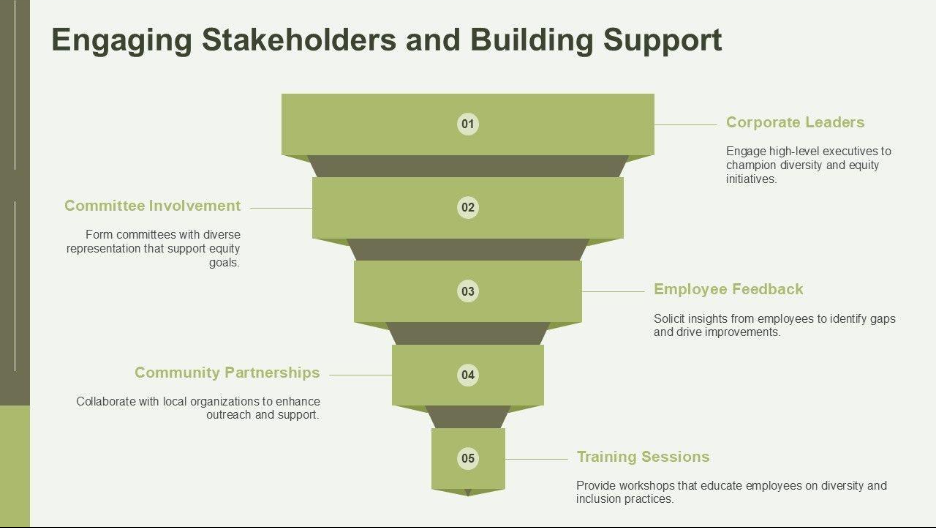
Template 3: Engaging Stakeholders and Building Support Slide Training Sessions
The slide showcases a five-step framework to engage stakeholders. A visual pillar illustrates levels of training from the bottom up, followed by community partnerships and employee feedback to identify gaps and improve. At the corporate level, committee involvement with diverse representation supports equity goals, while top management champions these initiatives.
Download this PPT Template Now!
Template 4: Developing Inclusive Policies and Practices PPT Slide
With this slide, you receive clear ways to measure progress (benchmarks) on diversity initiatives that your organization implements. SlideTeam’s uncluttered design provides structure, starting with policy review, staff training, recruitment strategy, feedback mechanisms, and inclusivity metrics.

Download this PPT Template Now!
Template 5 Communication Strategies for Equity Initiatives PPT Slide
Train staff on understanding diverse perspectives and backgrounds with this PPT Layout. The tools SlideTeam suggests to achieve this are on this comprehensive slide as well. It includes active listening, clear messaging, and the use of inclusive platforms. Regular feedback is the breakfast of champions, and something user businesses must do as a priority.

Download this PPT Template Now!
Template 6: Assessment Metrics for Equity Progress PowerPoint Slide
As the diversity and equity action plan gets into motion, tracking its performance in real-time is a must. Do that with ease with this SlideTeam Template. Among other things, the slide tracks hiring processes to ensure diverse candidate pools are considered. Retention rates, promotion metrics, and training participation are tracked. The slide also outlines how measuring participation rates in diversity and equity training programs offered is critical to assess the action plan.

Download this PPT Template Now!
Template 7: Budgeting for Diversity Programs PPT Presentation Template
Without money, nothing moves on the ground. When budgeting for diversity programs, this PPT lists what to consider and measure. SlideTeam has chosen the four columns as allocated funds, expenses, return on investment, and impact assessment. There are insights listed as well, which go into increased funding, such as giving 20% funding growth yearly. High ROI and positive feedback are other tangible benefits that are linked to the budgetary allocation.

Download this PPT Template Now!
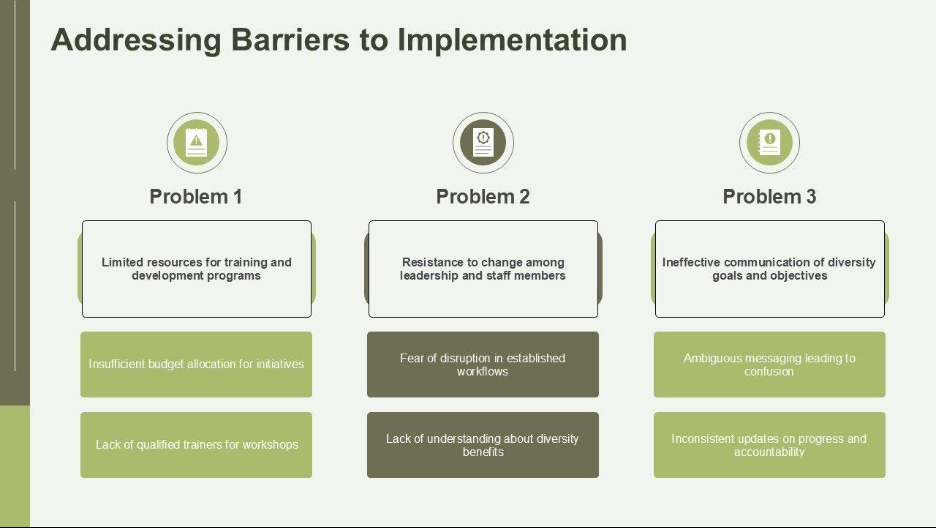
Template 8: Addressing Barriers to Implementation PPT Template
With an action plan, especially on diversity and equity, inconsistent update on progress and accountability is the greatest barrier. This SlideTeam Template depicts the other barriers, which are limited resources for training and development programs and the fear of disruption in established workflows. This is not an exhaustive list. Find the complete list with a download of the slide below.
Download this PPT Template Now!
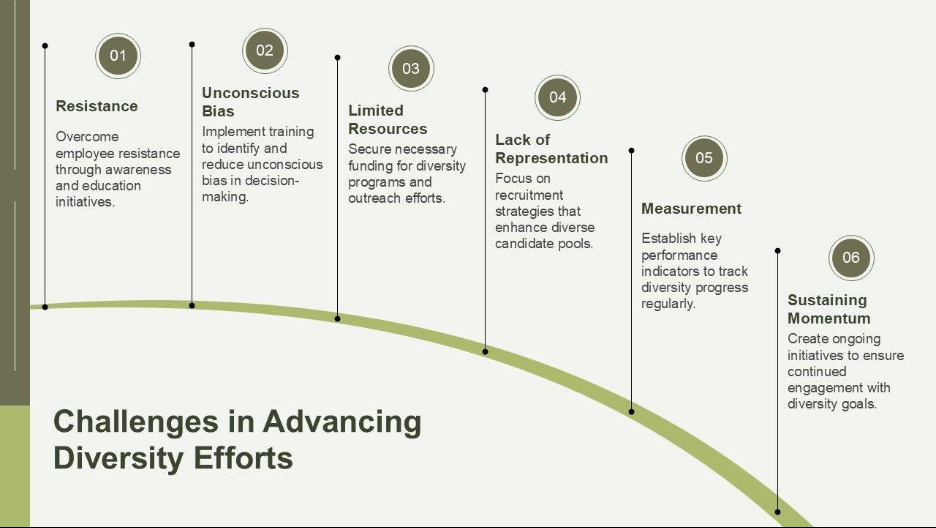
Template 9: Challenges in Advancing Diversity Efforts PowerPoint Template
Resistance to change, unconscious bias, limited resources, and measurement of change in diversity act as challenges. Focusing on recruitment strategies that enhance diverse candidate pools is the best possible solution that SlideTeam suggests to tackle the lack of representation. For more, download the template now!
Download this PPT Template Now!
Template 10: Best Practices from Leading Organizations PPT Template
There are many best practices to follow in a diversity and equity inclusion plan. With this SlideTeam PPT, understand how to tackle the lack of representation in leadership roles. The benefits that will arise will be enhanced diversity and equitable opportunities. The solution itself is highlighted below.

Download this PPT Template Now!
CREATE BRAND EQUITY WITH DIVERSITY ACTION PLAN
In the business world, diversity, equity, and inclusion are the concepts that have the power to make or break a business. With SlideTeam’s diversity and equity action plan templates, you have the opportunity to ensure you create brand equity while doing the right thing. With these templates, we provide you with the blueprint to showcase and amplify your unique initiatives toward building a more diverse and equitable business.
FAQs on Diversity and Equity Action Plan
What is the purpose of a diversity and equity action plan in an organization?
Fostering a culture where all individuals can thrive is the aim of a diversity and equity action plan. The plan stands on three pillars that work together to create lasting change:
- Diversity: This means looking far and wide to bring in talent from every walk of life—across race, ethnicity, gender, sexual orientation, ability, age, and background. The aim is to create a workforce that mirrors the diversity in our society and the customers we serve.
- Equity: Here, the focus is on leveling the playing field. We recognize that each person’s journey is unique, and fairness does not mean a cookie-cutter approach. Practical steps—like pay equity checks, clear promotion paths, and benefits that include everyone—help turn this principle into practice.
- Inclusion: This is creating a workplace where individuals feel respected and valued for who they are. An inclusive culture ensures all voices are heard, and their ideas, on merit, shape the way we do business.
How can diversity, equity, and inclusion (DEI) be defined and measured?
- Diversity is about the human differences present in any group: race, gender, age, ethnicity, sexual orientation, physical ability, background, beliefs, and the unique ways we think.
- Equity is about leveling the playing field. It’s not about handing out identical shoes. Instead, it is about making sure every individual gets a pair that fits just right.
- Inclusion is the final piece—making sure everyone feels welcome, valued, and at home. Inviting people to the party is not enough. You also must ask them to dance, encourage them to share their ideas, and make sure their voices are heard.
In measuring diversity and equity, we need to look at hard numbers and listen to real stories. Track every step of the employee journey—from hiring, to promotions, to when someone decides to move on. Quantitative metrics give us the facts: workforce demographics, pay and bonus comparisons across groups, and the key question—are some groups leaving more often than others? These numbers expose hidden wage gaps and retention issues. Qualitative measures dig deeper, uncovering how people feel and what they experience at work. Inclusion surveys, small group conversations, and one-on-one interviews bring out the stories behind the statistics.
What strategies can improve diverse recruitment and hiring practices?
Conscious, data-driven effort and lots of hard work are needed to be truly diverse and inclusive. The biggest hurdle in improving recruitment is bias and the feeling of complacency. One can start by launching a referral program that invites employees from underrepresented groups to bring in talent from their own diverse circles. Next, ensure every candidate faces the same set of job-related questions in structured interviews, so comparisons are fair and rooted in merit. The hiring team itself must comprise members from varied backgrounds. Such a committee of people kills bias. Finally, SlideTeam recommends tracking KPIs, such as application rates, interview-to-hire ratios, and retention across demographic groups.