

 0 Comment
 Customer Reviews

Imagine handing over your house keys to someone, trusting they would not peek into your drawers or snoop around. That is exactly how customers feel when they share their personal data with companies. They expect privacy, respect, and security. But what happens when businesses do not even know where the sensitive data is stored or who has access to it? That is where a GDPR risk assessment steps in.
The General Data Protection Regulation (GDPR) is a set of rules that help in protecting data. For many organizations, it revealed that data protection was more of an afterthought than a priority. A proper GDPR risk assessment helps shine a light on the blind spots, such as outdated systems, unclear data access, and accidental leaks.
Need more information on GDPR gap analysis? Don’t worry, we have got you covered. Click here now!
When done right, this assessment can help improve internal processes, boost customer trust, and build a healthier data culture in the workplace. Somewhere along the way, businesses realise that it is their responsibility to make sure their customers' data is protected at all costs.
To learn more about the GDPR project plan, click here!
If you are willing to conduct a GDPR risk assessment for your organisation, then this is the right blog for you. Our pre-designed PPT templates are 100% editable and customisable. Professional designers design these and include high-quality graphics and images, helping you showcase your information clearly.
Let’s delve into these interesting slides!
Template 1: Risk Assessment and Ethics in Non-Repudiation for GDPR Compliance
The pre-designed template provides the details on data protection risk assessment. It covers topics such as ethics, overview, understanding principles, importance of non-repudiation in GDPR, and GDPR compliance requirements. These topics showcase how to ensure data protection for consumers, identify potential risks, and work on fixing them. If your team is willing to conduct an information security assessment, then this is the right template for you. Download this today!
[product_image id=1437593]
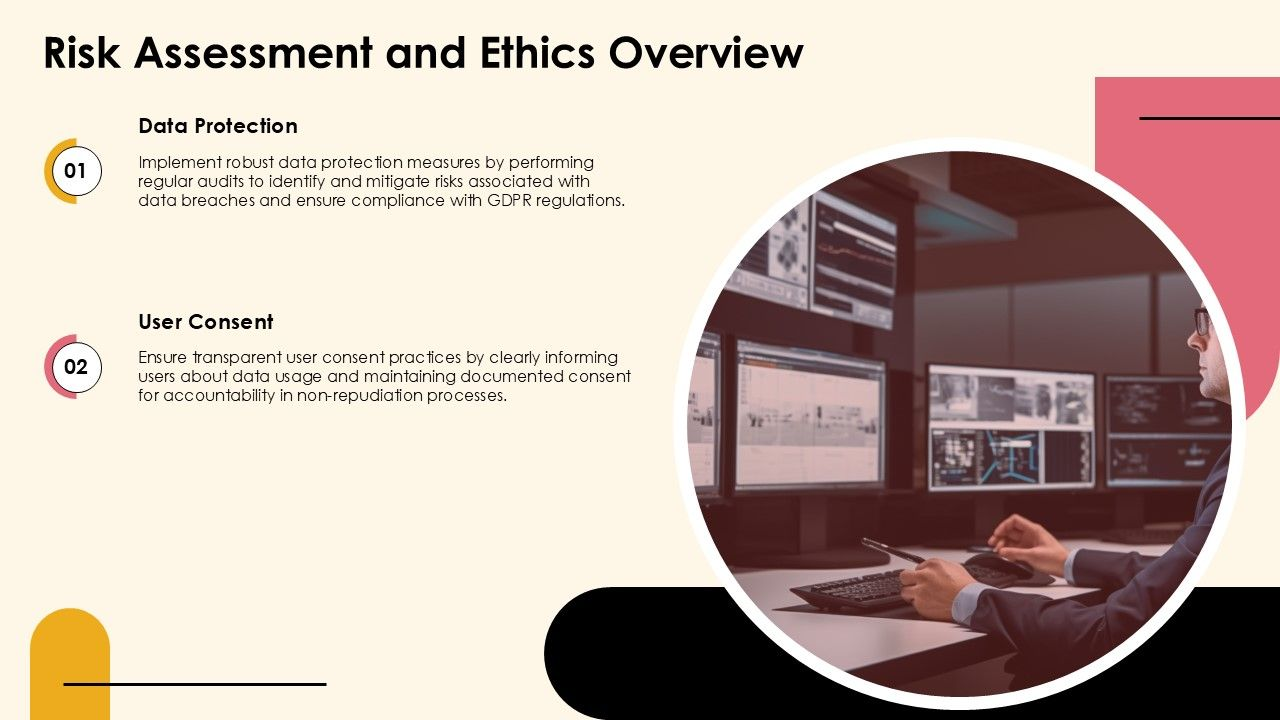
Template 2: Risk Assessment and Ethics Overview
The PowerPoint slide showcases an overview of risk assessment and ethics. It includes that a Privacy Impact Assessment (PIA) must be implemented with robust data protection measures by performing regular edits to identify risks. It also highlights that a data processing risk review must be done to ensure transparent user constant practices by informing users about data usage. This slide can help your team understand the importance of ethics within GDPR risk assessment. Download this PPT template now!
Template 3: Understanding Non-Repudiation Principles
This ready-made PPT slide showcases an understanding of GDPR compliance audit in detail. This includes data, integrity, access control, audit trails, digital signatures, regular training, incident response, and compliance checks. This slide can help you prepare a full-fledged GDPR compliance checklist, and you can also educate employees on the importance of non-repudiation measures. Download this PPT template today!

Template 4: Importance of Non-Repudiation in GDPR
Here is another top-notch PowerPoint slide that provides the importance of non-repudiation in GDPR gap analysis. This includes proof of concept, data integrity, audit trails, legal defence, user trust, and regulatory compliance. By using our content-ready slide, you can get an overview of data subject rights risk review, and your team can learn what role consumer confidence and data management practices play in GDPR assessment. Download this PPT template now!

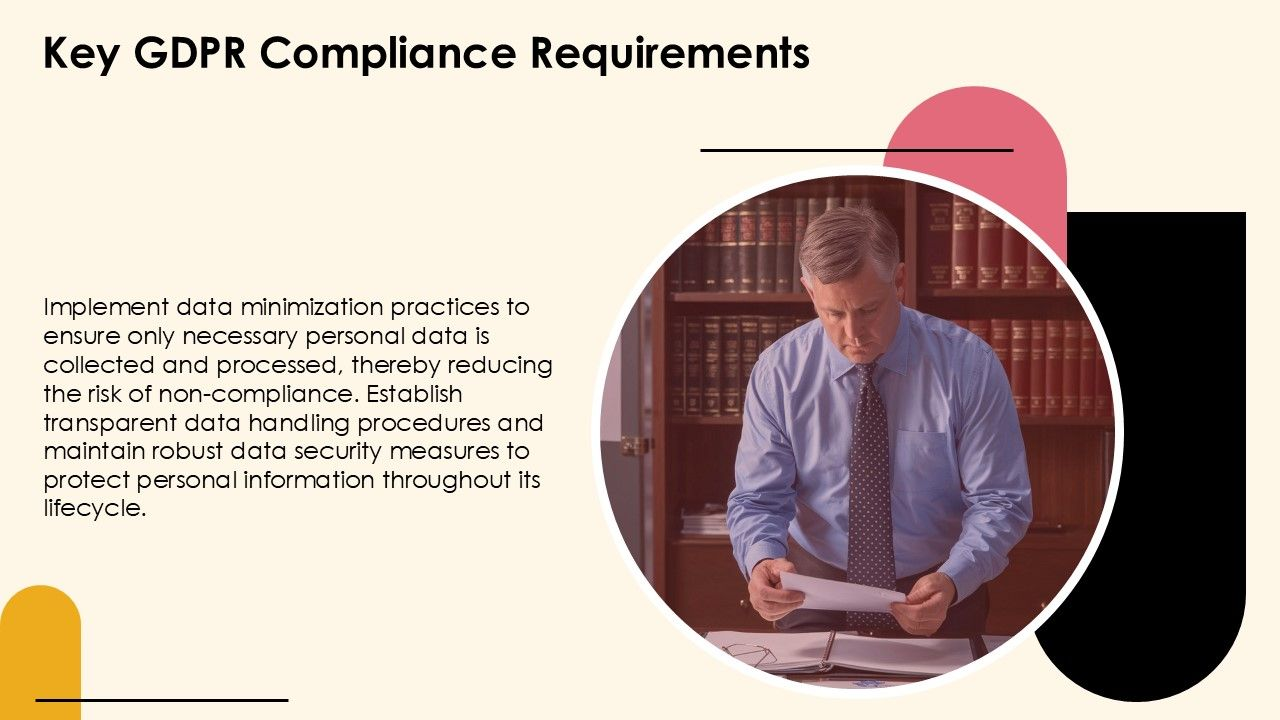
Template 5: Key GDPR Compliance Requirements
The following PPT template highlights the Key GDPR compliance requirements for personal data risk evaluation. It states that data minimization practices should be implemented to ensure that the necessary data is collected. Personal data is collected and processed, thereby reducing the risk of non-compliance. Transparent data handling procedures and maintaining robust data. Security measures should be established to protect personal information throughout its life cycle. With the help of this template, your team can gain knowledge on compliance requirements, and it can help you with conducting an error-free GDPR readiness assessment. Download this PPT slide today!
Template 6: Data Protection Impact Assessment Process
This pre-built PowerPoint layout showcases the data privacy risk assessment process. It consists of five steps. First is identifying the need for a data protection impact assessment. The second is describing the nature and purpose of the data processing. Third is assessing the necessity and proportionality of the processing. Fourth is consulting with stakeholders regarding data protection. Last is identifying potential risks to data subjects during processing. By leveraging our content-ready slide, you can implement this evaluated process in your risk assessment to ensure the right solution is used for any kind of issue. Download this PPT template today!

Template 7: Identifying Risks in Non-Repudiation
This pre-designed PowerPoint framework highlights how to identify risks in non-repudiation. First is ensuring that GDPR data mapping is accurate and up-to-date for compliance. The second is maintaining comprehensive logs of all data-related activities. Third is utilizing strong encryption methods to protect data from unauthorized access. Fourth is implementing strict access controls, and last is verifying that explicit user consent is obtained before processing personal data. This slide can help your team evaluate any kind of risk prevailing in the GDPR risk assessment. So make sure you download this PPT template today!

Template 8: Ethical Considerations in Data Handling
Here is another top-notch PowerPoint slide, which showcases some ethical considerations in data handling. These include user consent, data minimization, transparency, data security, access control, training, audit trails, and incident response. By leveraging this PPT slide, you can make sure that your organisation keeps a check on these ethics while presenting a GDPR risk assessment. Download this PPT slide today!

Template 9: Best Practices for Data Integrity
The following ready-to-use template provides a glimpse of best practices for data integrity. The first is conducting systematic audits to ensure data accuracy, completeness, and compliance with GDPR requirements. Encryption techniques include implementing strong encryption methods to protect sensitive data both at rest and in transit to prevent unauthorized access. The last is enforcing strict access controls to limit data access to authorized personnel based on their roles and responsibilities. With the help of this template, you can introduce your team to some of the best practices that they can use while conducting a GDPR assessment. Download this PPT template today!

Template 10: Implementing Non-Repudiation Mechanisms
This ready-made PowerPoint slide showcases how to implement non-repudiation mechanisms. The first solution is digital signatures, using cryptographic algorithms for securing documents. Second is audit trails, maintaining logs to track data and changes. The last is secure transactions, ensuring all transactions are authenticated and verified. If you follow these solutions within your organization, you can safeguard the customer's data and make sure there are no risks of data breaches. Download this PPT template now!

Key Takeaway
A GDPR risk assessment helps businesses move from reacting to data issues to preventing them altogether. Instead of waiting for a breach or complaint to highlight weak spots, companies can take control early by identifying gaps in their privacy practices, training, and technology.
One of the key takeaways is that GDPR compliance is a continuous process. As systems evolve, so do the risks. That is why ongoing assessments are important. They help you adapt to changes in how data is collected, stored, and shared, ensuring your business stays ahead of potential problems.
To learn more about risk analysis, click here.
If you think your organization needs a well-planned GDPR risk assessment, then you must refer to our PPT slides for the same. These templates can help you analyze the reports and make sure the rules are followed by your team effortlessly. Download these PPT templates now!
FAQs on GDPR Risk Assessment
Why is GDPR risk assessment important for data protection?
GDPR risk assessment is important because it helps organizations find out where personal data might be at risk. It is like doing a safety check to make sure that nobody’s private information can be lost, misused, or exposed. This process helps businesses understand what kind of data they collect, how they store it, and who has access to it.
What are the key steps in conducting a GDPR risk assessment?
Conducting a GDPR risk assessment means checking how well your company protects people’s personal data and spotting areas that could lead to a privacy breach. First, identify what personal data you collect, use, and store. Next, look at who has access to it and whether it is properly secured. Then, check if you have permission to use that data if you are following GDPR rules. After that, spot any weak points that could put the data at risk. Finally, fix those issues, document everything, and keep reviewing your process regularly to stay compliant and avoid penalties. This will help you stay safe and transparent.
How is personal data identified and categorized during assessment?
Personal data is identified by looking at any information that can be used to recognize a person, like their name, email, phone number, or things like location and IP address. During an assessment, teams go through all the data a company collected and ask, “Does this tell us who someone is?”. Once identified, the data is grouped into types such as contact information, financial details, health records, and online behaviour. This helps in understanding how sensitive each piece of data is and ensures that it is handled properly and used for the right reasons by following privacy rules.