

 0 Comment
 Customer Reviews

Technology is everywhere. It is almost impossible to segregate work and its technological aspects. The benefits that technology offers are immense. That is how it has found its place in every sphere of business. Logistics and information technology are amalgamations that have brought benefits to organizations. Not only does it enhance the flow of management, but it also reduces the scope for errors, improves communication, and has a positive impact on shipping and logistics.
There has been a major shift of work from manual maintenance to automation, and that has impacted supply chain, transportation management, smart warehousing, and inventory management systems. If you want to automate logistics, including E-commerce logistics, and grow your working model, these templates will help you plan it better.
So, let’s dig deeper into how these slides can make your automation in logistics planning easier.
Access world-class templates on warehousing and logistic planning here.
Let’s explore!
Template 1: Requirement for Automation PowerPoint Template
A company can face a lot of challenges. It is important to take note of these difficulties so that necessary action can be taken to bring about improvements. This template helps in highlighting the reasons why a company should focus on automation. There can be a fall in the productivity of employees owing to a large amount of time spent on routine tasks, leaving less room for complex issues. There can be complications in communications that lead to loss of translation. Physical operations lead to a fall in quality; this comes from a larger room for errors. There may be a lack of task management and operational instability - losing records, etc. This comes from inconsistency in operations.

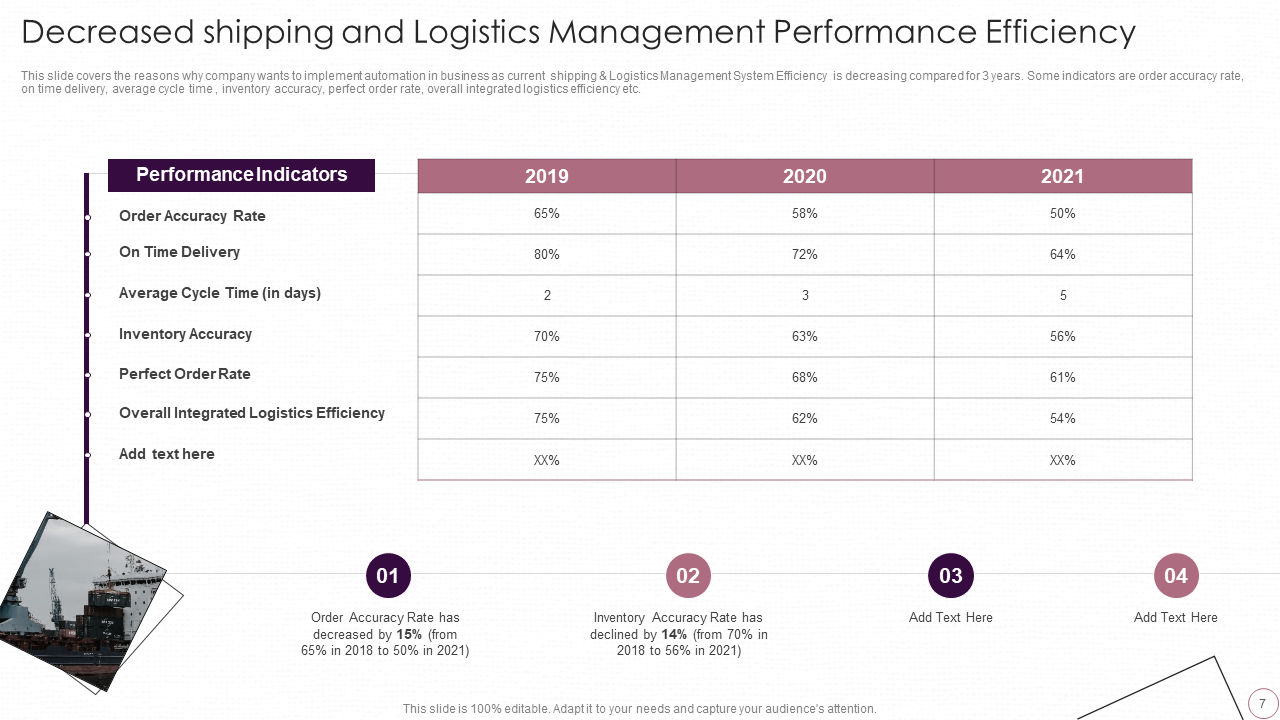
Template 2: Decreased Shipping and Logistics Management Performance Efficiency PPT Template
This slide focuses on why automation implementation is vital for any business that's dealing with shipping and logistics. A few performance indicators have been studied. These are order accuracy rate, on-time delivery, average cycle time, inventory accuracy, perfect order rate, and overall integrated logistics automation efficiency. The data for multiple years can be presented in tabular form against these indicators.
Template 3: Shipping and Logistics Ultimate Business Goals PowerPoint Slide
Every business has its own goals. For the shipping and logistics business, these can be - minimizing expenses around supply chain technology, and availability of inventory is a must - this offers immense variety to the clients to choose from. It is important to create value for customers, not just focus on cost efficiency. There should be standardization in the process in order to maximize resource utility, remove duplicates and minimize inventory levels. There should be an efficient distributed order management technology to ensure timely order completion. A data-driven supply chain, as illustrated in the slide, makes work much easier.

Template 4: Opportunities in Going Fully Autonomous in Shipping & Logistics PPT
Businesses thrive well on proper use of opportunities. With automation, companies can have rapid operational readiness, efficient route planning, reduction of operational cost, energy efficiency, longer operation time, improvement of safety, sustainability, change of job profiles, and reduction in transport time. It shows what impact will happen on shipping and logistics if automation is applied fully, partially or not. Using this data, one can see if automation is benefiting work. Key takeaways can be drawn from the data, and more opportunities can be explored accordingly.

Template 5: Choosing Right Strategy to Increase Efficiency PPT Template
Every business should identify the right strategies to increase its efficiency. Companies can use these strategies to implement automation in business processes. This slide covers the details of the strategy and related costs that would be involved in implementing the strategy. These could include using automated software technologies, such as modern tools, integrated logistics, etc. Optimizing warehouse management systems through automation helps the company enhance the efficiency of its integrated logistics. Ensuring efficient transportation systems through automation and redefining standard operating procedures are other strategies whose details should be clearly mentioned. The cost involved in implementing these strategies helps the company get a picture of its finances.

Template 6: How Robotic Process Automation Will Work PPT Template
This slide covers the working strategy of robotic process automation in automating procurement and inventory processes, speeding invoicing by integrating systems with customer portals and enhancing customer responsiveness with automated order/inventory tracking. When it comes to procurement, adequate material is needed for customer satisfaction. Speed invoicing eliminates re-keying, cutting, and pasting. Enhancing customer responsiveness is crucial for catering to customers. This can be done by using software robots to ask carrier monitoring systems/websites, etc.

Template 7: Automated Software Technologies PowerPoint Slide
Companies need to enhance their logistics management efficiency, and this can be done by using automated software technologies. These can include Multi-shuttle systems, Optical Recognition, Automated Picking Robots, Swarm AGV Robots, and Integrated Management Systems. All technologies are mentioned in a column in a systematic way, and their descriptions help in understanding technologies.

Template 8: Stages of Automation in Shipping and Logistics PPT Template
There is a long chain of steps that follow when implementing automation in shipping and logistics. The slide highlights these. Partly automated is where the driver monitors the system. Highly automated is where the robot takes greater control while the driver is away. In the fully automated stage, the robot takes guidance for a concrete application, while the driver does not monitor the application. Autonomous is when a robot takes control of full guidance and functions, whereby the driver is not required anymore.

Template 9: Digital Enablers and Select Implications for Shipping and Logistics Business PPT
This template covers the digital and physical collaboration framework as the data visualization tools make changes in the shipping and logistics business. Sensors and geolocation, robotics, nanotech and 3D printing, Big Data, UI and display innovation, and Cloud services are all part of digital technology enablers. Robotics, for instance, are safe to operate in a close man-machine environment, big data using regressions, predictive analytics, large-scale scenario analysis for demand forecasting, capacity planning, etc.

Template 10: Concepts Concerning Autonomous Transport PowerPoint Template
This template covers concepts around automation, which concern autonomous transports for the shipping and logistics industry. The physical internet network is distinguished by the use of the IOT by standardization, modularity, etc. The idea is implemented via data transmission through IOT. Dynamic refining happens via the internal flow of transport within the network, and new business models are realized through logistic growth.

Automation is the future!
Automation is a game that might look tough to crack, but its immense benefits only make work planning and execution easier. While it will involve a gradual shift from manual efforts to adapting to technology, it will be fruitful in the end.
PS Smart logistic planning is what happens as a result of automation.
FAQs on logistics and information technology
What is logistics in the IT industry?
IT industry logistics involves the entire lifecycle of the assets around IT. It starts from procurement to storage, distribution and in some cases disposing of the assets. This requires a lot of planning, smooth execution and efficiency in operations to be able to manage hardware, software, and all IT related information. The software systems used in logistics provide good online support and help in maintaining and implementing the processes smoothly.
How is technology used in logistics?
Automation holds such an important place in the future. Logistics is being altered by fascinating technology. One can have real-time tracking, analyse data, use the data in predicting capabilities, move to a more efficient work model, reduce cost and contribute to an overall superior customer experience. Robots, self-driving trucks, automated storage and retrieval systems have brought about transformation in logistics. It not only reduces manual labour but enhances work quality and reduces delays.
What is logistics information technology strategy?
IT strategy revolves around using technology to enhance operations, and speed up decision making by using data and automation. It is important to address gaps that are generated due to different priorities. IT strategy does that for you. With a clear set of goals, mission, objectives and metrics, managers are able to assess if everything is going right. Data is always stored at multiple places, and real-time information is needed to make effective decisions. These decisions revolve around demand forecasting, optimizing inventory and checking for any diversions. Thus, IT strategies only help in making logistics more seamless.