

 0 Comment
 Customer Reviews

The document's already been filled out. Sitting in a shared folder somewhere, probably mislabeled.
That's the thing about Material Safety Data Sheets—everyone knows they're supposed to exist. Regulatory auditors know. Floor supervisors know. The new hire who just started on the chemical line definitely doesn't know where to find one. And in the gap between "we have those on file" and "here, read this before you handle that"—that's where incidents happen.
It's not about negligence, most of the time. Companies that work with hazardous materials aren't cavalier about safety. But the paperwork side of chemical safety tends to get built once, badly, and then left alone. An MSDS from 2009 that doesn't reflect GHS formatting. A PDF that nobody can edit. A document that technically satisfies OSHA compliance on paper but communicates nothing useful to the person in PPE who actually needs it.
There's also the composition problem. A properly structured Safety Data Sheet has 16 mandatory sections—first aid measures, fire-fighting procedures, exposure controls, PPE requirements, storage guidelines, emergency response information. Getting all of that into one coherent, readable document, without either burying the critical details or bloating the thing into unusable length, is genuinely hard. Most people who create these aren't trained technical writers. They're safety officers, lab managers, procurement leads. They know the chemistry. They don't always know how to present it.
And that gap matters. A confusing SDS doesn't just fail an audit. It fails the person who inhales something and can't find first aid instructions in time. It fails the warehouse team that stored two flammable materials next to each other because nobody formatted the storage incompatibility section clearly.
So the templates exist. Not because the regulations are too complicated to understand—they're actually pretty clear once you've read them. They exist because building a clean, compliant, legible hazard communication document from scratch takes time most safety teams don't have. Pre-designed frameworks mean the structure is already right. The sections are already in order. The tables are already there.
SlideTeam's material safety data sheet templates handle the part that takes the longest: getting the format right so the content can do its job. These are content-ready, customizable layouts built for manufacturers, construction teams, chemical suppliers, and EHS compliance leads who need professional documentation without starting from a blank slide.
Here are the templates worth looking at.
Template 1: One-Pager Material Safety Data Sheet Presentation Report
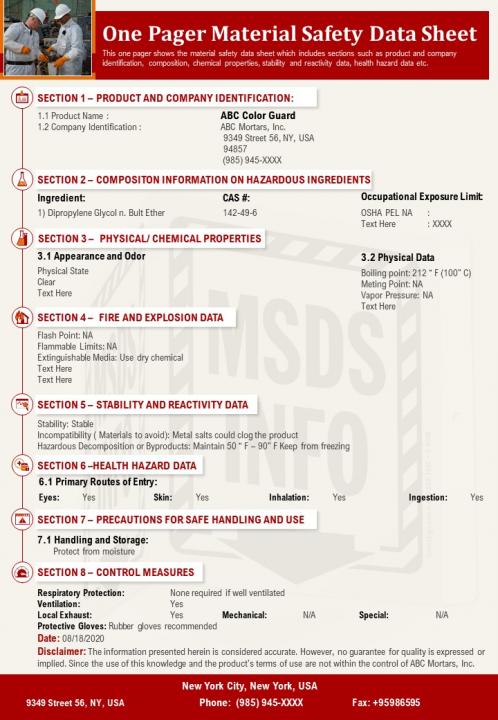
Manufacturers gain a complete, structured hazard communication document in one polished slide. This one-pager captures product identification, composition details, and manufacturer contact information clearly. Integrated tables cover first aid measures, firefighting procedures, accidental release protocols, and storage guidelines. Each section is immediately readable by employees at every level. You can add or remove elements to match your specific product requirements. For a broader look at SDS formatting standards, explore SlideTeam's curated Safety Data Sheet template collection. Transform your hazard documentation workflow today. Download this ready-made one-pager now and deliver clarity where it counts most.
Download this PowerPoint Template
Template 2: Material Safety Data Sheet Paclitaxel PPT Slides
Paclitaxel safety documentation demands precision—and this deck delivers both accuracy and visual impact. Material data safety and first-aid measures are also discussed. Every slide combines chemical hazard information with a design that holds audience attention throughout. Effortless color scheme and element customization align the deck perfectly with your brand identity. Use this template to present complex chemical safety data with confidence and authority. Transform your Paclitaxel MSDS presentations today. Download this fully editable deck now and outperform every compliance review.
[product_image id=1275500]
Template 3: Construction Material Safety Data Sheet PPT
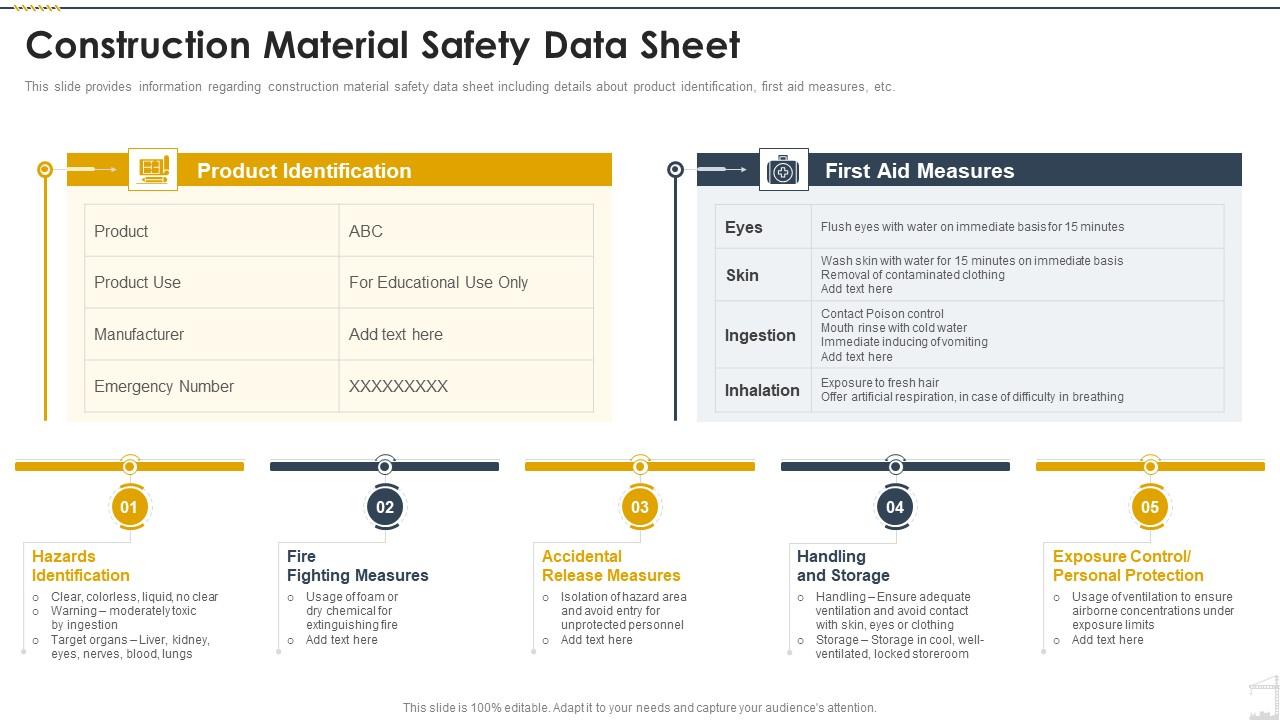
Construction sites carry layered chemical risks—this template maps these with structured precision. Five clearly defined stages walk through product identification, hazards identification, and first aid measures. Fire-fighting measures and accidental release protocols each get dedicated, scannable sections. Exposure control and Personal Protective Equipment requirements are presented with immediate visual clarity. The layout educates site teams and satisfies regulatory reviewers in a single document. Pair this with SlideTeam's material handling safety templates for on-site coverage. Transform your construction safety documentation today. Download this template now and raise your site's compliance standard.
Download this PowerPoint Template
Template 4: One-Pager Product Safety Data Sheet PDF PPT
Product safety communication becomes effortless with this professionally structured one-pager. Manufacturers and suppliers gain a ready-made layout covering hazard identification, composition, and contact details. Integrated tables address first aid, firefighting, accidental release, and handling and storage measures. Every section is designed for clarity so all staff members grasp critical information fast. Flexible element editing lets you tailor the document to any product category or regulatory requirement. Save and export in multiple file formats to meet any submission standard. Transform your product safety data sheet process today. Download this content-ready one-pager now and eliminate documentation delays.

Download this PowerPoint Template
Template 5: One-Pager Hazard Communication Safety Data Sheet Infographic PPT
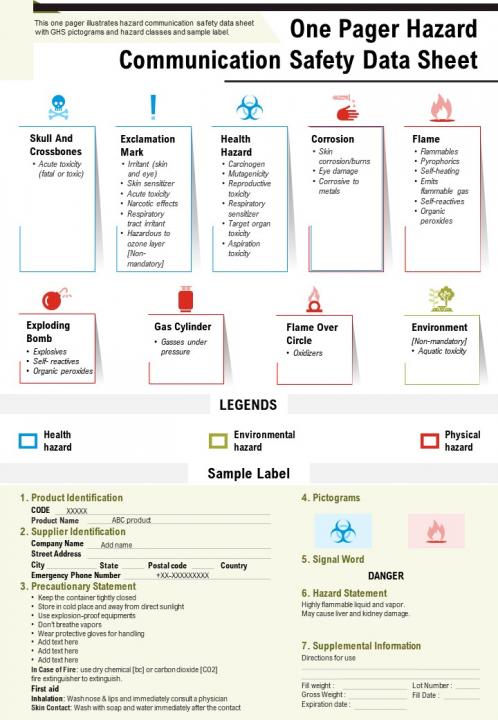
Hazard communication reaches every worker when the format is this clear and structured. This one-pager integrates GHS Pictograms, hazard classes, and sample label data in one organized layout. Passing critical safety information to large groups becomes straightforward—no one-to-one briefings needed. The template's editing simplicity saves both time and effort for EHS compliance teams. GHS Labels and hazard class distinctions are presented with visual hierarchy that prevents misreading. Explore the full material safety data sheet template library on the SlideTeam blog. Transform your hazard communication documentation today. Download this one-pager now and make safety information impossible to miss.
Download this PowerPoint Template
Template 6: Construction Project Safety Data Sheet Guidelines PPT
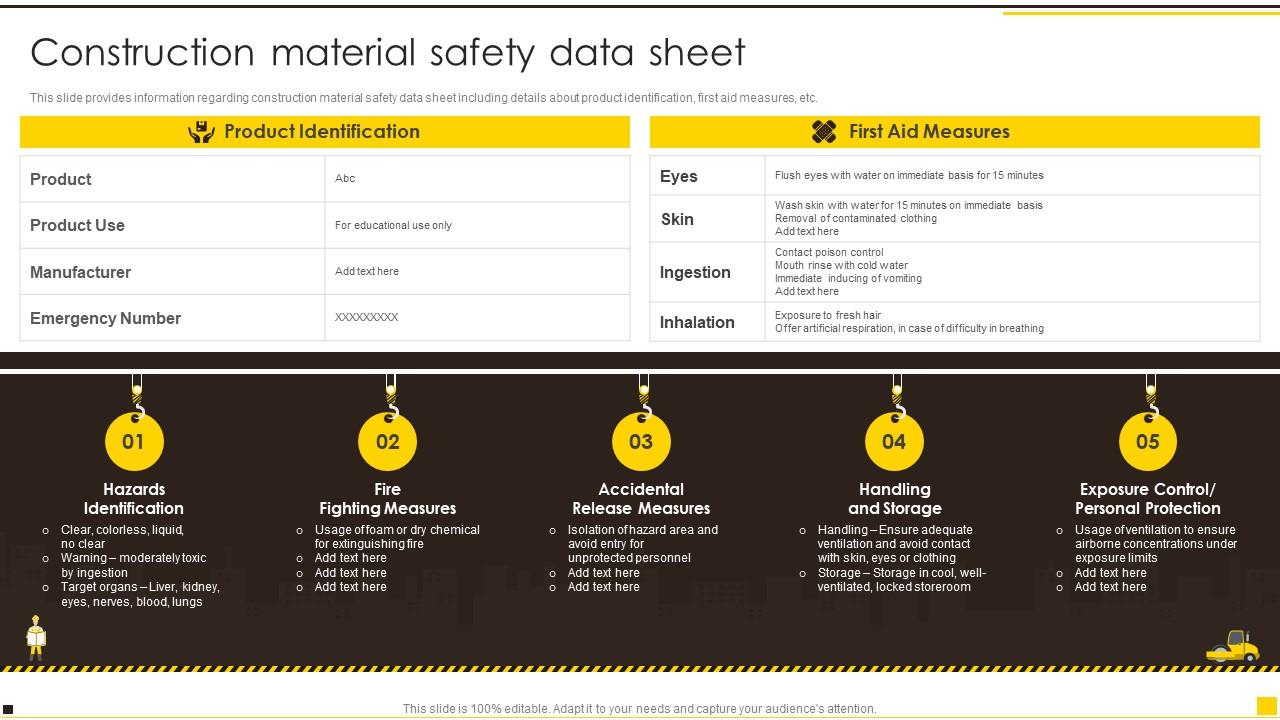
Construction project safety documentation finds a reliable framework in this focused playbook slide. Product identification, first aid measures, and hazards identification are laid out with professional structure. Fire-fighting measures and accidental release protocols are presented in clear, actionable sections. The slide integrates directly into broader construction project guideline decks without formatting conflicts. Full editability means every field adapts to your specific materials and site requirements. Immediate download availability means your compliance documentation is never delayed by design work. Transform your construction project safety guidelines today. Download this template now and keep every stakeholder informed and protected.
Download this PowerPoint Template
Template 7: Construction Material Safety Data Sheet Construction Playbook
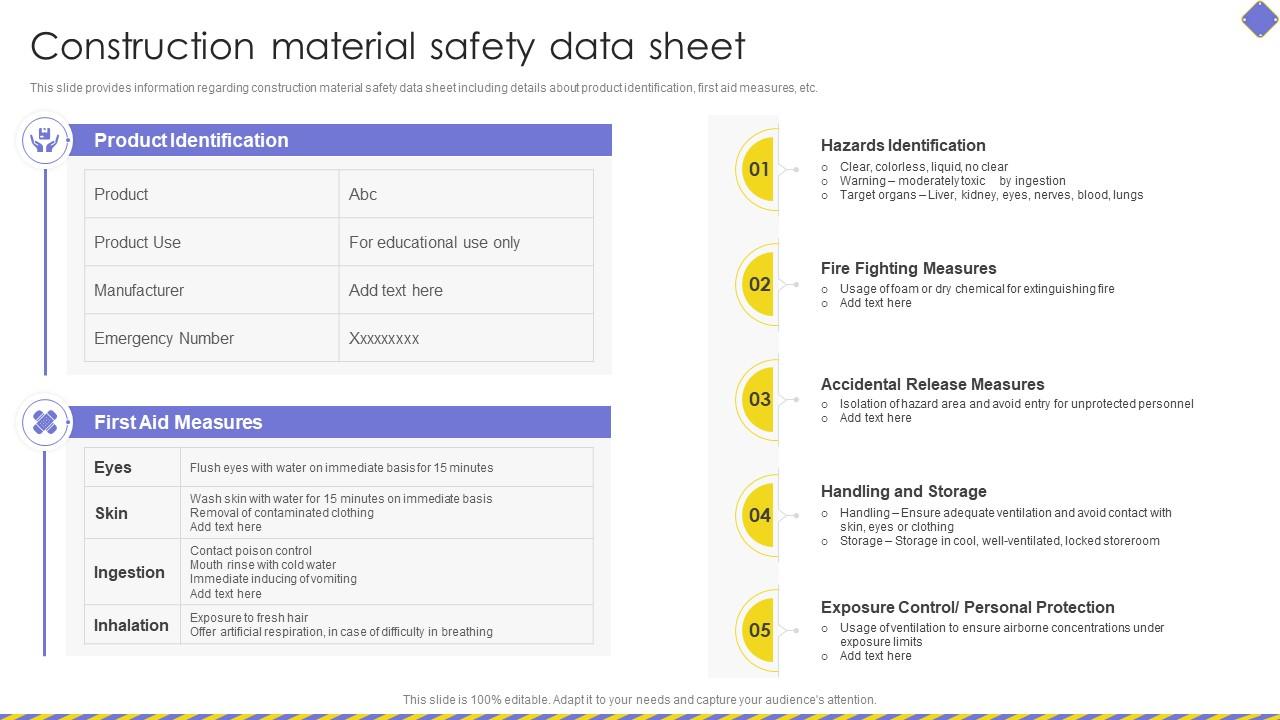
Every construction playbook needs a material safety section that workers actually read—this template delivers that. Hazards identification, accidental release measures, and handling and storage details are structured for fast comprehension. The layout supports chemical storage guidelines by presenting incompatibility and containment information clearly. Personalization options let safety managers adapt content to any construction material or project phase. Professional design ensures the document meets both internal standards and external regulatory scrutiny. Immediate download and full editability remove every barrier. Transform your construction safety playbook today. Download this template now and give your team the clarity they need on-site.
Download this PowerPoint Template
Template 8: Construction Material Safety Data Sheet Construction Playbook One-Pager
A single-page construction MSDS document can carry enormous informational weight when designed well. This one-pager is built with high-quality visuals that remain crisp and readable after editing. The A4 format makes it print-ready for physical site documentation without any reformatting. Editable fields across every section mean the template adapts to any construction material quickly. Immediate download availability ensures your safety documentation is never held up by setup time. Transform your on-site material safety records today. Download this construction one-pager now and standardize your hazardous material documentation.

Download this PowerPoint Template
Template 9: Construction Material Safety Data Sheet Modern Methods PowerPoint
Modern construction methods introduce new materials—and this template keeps safety documentation current. Hazards identification, fire-fighting measures, and release measures are each presented in clear, structured sections. Product identification and first-aid information are formatted for rapid access during emergencies. The slide adapts to any construction material or modern building method your project involves. Full editability ensures every regulatory field reflects your specific chemical inventory and site conditions. Immediate download puts compliant MSDS documentation in your team's hands without delay. Transform your modern construction safety records today. Download this template now and match your documentation to the pace of your build.

Download this PowerPoint Template
Template 10: Risk Identification Example Raw Materials PPT
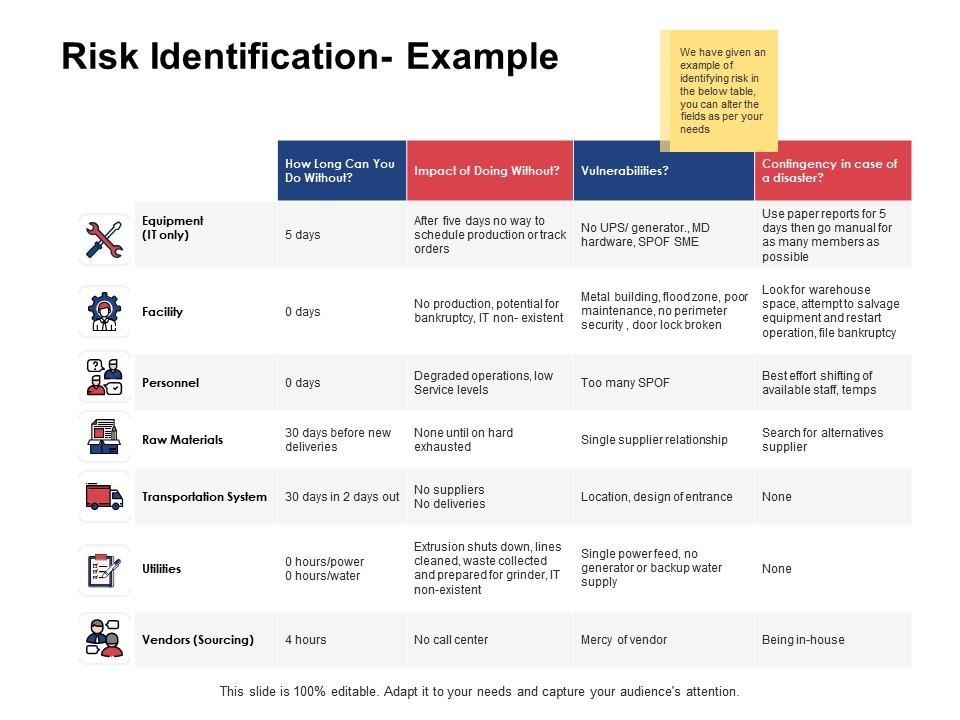
Risk identification across raw materials and equipment starts with a structured, visual framework. This fully editable deck maps risk items, potential failure points, and future problems through brainstorming-driven layouts. Derived risk analysis and equipment-specific hazard data are presented with gallery-quality graphics. Every slide supports clear stakeholder communication around chemical inventory management and material risk. The deck's complete editability means you tailor risk categories to your specific operational context. Professional visuals ensure your risk identification presentations command attention and drive decisions. Transform your raw material risk documentation today. Download this PPT deck now and turn hazard identification into actionable safety planning.
Download this PowerPoint Template
Elevate Chemical Safety Documentation with SlideTeam
SlideTeam's PowerPoint templates are the best in the industry for material safety data sheet documentation. These content-ready slides cover every critical section—from hazard identification to PPE requirements—saving your EHS compliance team significant preparation time. Ready-made layouts ensure your MSDS and SDS documents meet OSHA standards while communicating clearly to every worker. Grab these pre-designed templates today and make workplace safety communication your strongest operational asset.
FAQs on Material Data Safety Sheet
What are the 16 mandatory sections of a GHS-compliant Safety Data Sheet and why is their standardized order critical for emergency responders?
A GHS-compliant SDS must follow 16 fixed sections: identification, hazard identification, composition, first aid, fire-fighting, accidental release, handling and storage, exposure controls, physical and chemical properties, stability and reactivity, toxicological information, ecological information, disposal, transport, regulatory, and other information. The standardized order is non-negotiable. Emergency responders must locate first-aid or fire-fighting data within seconds—not minutes. Consistent section placement across all SDSs makes that possible, regardless of the chemical or manufacturer.
How does the Globally Harmonized System of Classification and Labelling of Chemicals differ from older MSDS formats in terms of hazard communication?
Older MSDS formats had no fixed structure, so section order and content varied by manufacturer. GHS introduced a mandatory 16-section format used globally. GHS also standardized hazard categories, signal words (Danger or Warning), and pictograms. The result is that a worker in any country reads the same hazard communication structure. MSDS documents often lacked pictograms entirely—GHS Labels make hazard identification immediate and visual.
What specific information must appear in Section 8 of an SDS regarding exposure controls and personal protective equipment?
Section 8 must state the occupational exposure limits for each hazardous component—including OSHA Permissible Exposure Limits and ACGIH threshold values. It must specify engineering controls such as ventilation requirements. PPE Requirements must be listed by type: respiratory protection, gloves, eye protection, and protective clothing. Generic statements like 'wear appropriate PPE' are not acceptable. Each control must be specific to the chemical's hazard profile.
How do flash point values listed in an MSDS influence storage incompatibility decisions in multi-chemical facilities?
Flash point determines how easily a substance ignites. In multi-chemical facilities, storing a low-flash-point flammable material near oxidizers or heat sources creates serious ignition risk. MSDS flash point data directly informs segregation decisions—flammables must be stored away from incompatible chemicals. Facilities use these values to assign storage zones, set temperature controls, and meet chemical storage guidelines under OSHA and NFPA codes.
What legal obligations does an employer have under OSHA's Hazard Communication Standard to maintain and provide access to Safety Data Sheets?
Under OSHA's Hazard Communication Standard (HCS), employers must maintain an SDS for every hazardous chemical in the workplace. SDSs must be accessible to workers during every shift—physical binders or electronic systems both qualify. Employers cannot restrict access. They must also train employees to read and use SDS information. Failure to maintain compliant SDSs is a citable OSHA violation carrying significant financial penalties.
How should a chemical manufacturer determine whether a mixture requires a new SDS or can rely on component SDSs?
A new SDS is required for a mixture if testing data exists for the mixture as a whole. If no mixture-level data exists, hazard classification relies on component SDS data using concentration cutoff thresholds. If any component exceeds its cutoff for a given hazard, the mixture inherits that classification. Manufacturers must document this assessment. Relying solely on component SDSs without this analysis does not satisfy GHS or OSHA requirements.
What distinguishes a physical hazard classification from a health hazard classification in the context of SDS documentation?
Physical hazards involve properties of the substance itself—flammability, explosivity, reactivity, or oxidizing potential. Health hazards relate to the effect on the human body—toxicity, carcinogenicity, skin corrosion, or respiratory sensitization. SDS documentation must address both categories separately. A chemical can carry both types simultaneously. The distinction matters because physical hazards drive storage and handling controls, while health hazards determine PPE Requirements and medical surveillance needs.
How are trade secret provisions balanced against worker right-to-know requirements within MSDS regulations?
OSHA allows manufacturers to withhold a specific chemical identity as a trade secret under defined conditions. However, the hazard information itself—health effects, safe handling, PPE—must always be disclosed. Medical professionals can request the withheld identity in emergencies, and the manufacturer must provide it. Workers retain the right to know the hazards even when the exact chemical name is protected. Trade secrecy never overrides safety disclosure obligations.