


 0 Comment
 Customer Reviews

Research has proven that understanding the various stages of child development can improve learning outcomes by up to 25%. Research in developmental psychology shows that children taught according to their corresponding cognitive stage, as put forth by Piaget's theory, demonstrate better problem-solving abilities and achieve long-term academic success.
Cognitive development is always influenced by age, but it also depends on the different stages in which reasoning evolves systematically.
Supporting Cognitive Growth Isn't Age-Related. Rather, it is in Recognizing How Thinking Develops through an Ordered Set of Developmental Stages.
What Measures to Consider to Ensure Better Learning?
Do you find it hard to understand your child's learning patterns? You aren't alone, though. Many parents and educators misalign teaching strategies with the child's developmental stage.
Here, we will discuss all four key stages of cognitive development observed in Piaget’s model and consider their implications for promoting effective engagement and quality learning.
The Piagetian stages of cognitive development inform our understanding of the way children think, learn, and interpret the world around them. On that note, also check out our Teaching Strategies PPT templates, which guide education planning, tailor teaching methodologies to developmental levels, and support improved learning outcomes at all stages of cognitive development.
An easy understanding of your subject through Piaget's different stages of cognitive development can be achieved with SlideTeam's customizable PowerPoint templates. These 100% editable templates help you understand your subject under Piaget's stages of cognitive growth.
Check out our Top 10 Child Development PPT Templates to enhance your knowledge further.
Template 1: Piaget's Concrete Operational Stage
This PowerPoint deck highlights Piaget's concrete operational stages. It explores key principles of cognitive development, including conservation, classification, and transitive inference. The presentation bundle likewise emphasizes the role of language in cognitive growth. The deck also outlines characteristics of concrete operational thinking, offers example activities, and discusses its application in educational settings. Moreover, it also focuses on its limitations. This PowerPoint deck is valuable for educators, child psychologists, curriculum designers, special educators, and academic researchers. Download it now.
Browse our Teaching Methods PPT templates, which feature practical examples, providing a highly organized and effective learning experience.
[product_image id=1353328]
Template 2: Piaget Concrete Operational Stage Teaching Strategies
The presentation deck is based on Piaget's developmental model, specifically the concrete operational stage, a crucial phase in child development theory. It begins with the phases of cognitive growth and the basic characteristics of learners during this period, such as logical thinking and classification. The presentation deck further discusses teaching strategies, including experiential learning, real-world application, collaborative learning, and problem-solving, tailored to meet specific needs. The concepts presented in the deck also enable educators to better assess and understand children's thoughts.
[product_image id=1361039]
Template 3: Piaget Concrete Operational Stage Tests
This PPT deck gives an insightful overview of Piaget's theory of cognitive development, conceiving of a concrete operational stage. The presentation pack addresses crucial points, including logical operations in children, conservation tasks, and classification testing. A further comparison is made among the preoperational stage, the concrete operational stage, and the formal operational stage. The PPT also highlights the limitations of concrete-operational thought, along with more practical instances. It is beneficial for child psychologists, teachers, special education professionals, curriculum developers, and developmental researchers.
[product_image id=1363164]
Template 4: Piaget Concrete and Formal Operational Stages
This PowerPoint outlines Piaget's cognitive development stages. It begins with focusing on the concrete and formal operational stages. The presentation deck defines key characteristics of each stage, such as logical, hands-on thinking, and hypothetical reasoning. Additionally, the PPT bundle includes examples and activities to enhance both levels of thinking, as well as their corresponding developmental limitations. The PowerPoint bundle supports a better understanding of Piaget’s child development framework. Download now.
[product_image id=1361038]
Template 5: Understanding the Concrete Operational Stage
This presentation design focuses on understanding the concrete operational stage. It emphasizes hands-on learning and group problem-solving. It shows that children in this stage benefit from manipulating objects to grasp abstract ideas through real-world experience. It also outlines that group activities further enhance critical thinking, communication, and collaborative learning. The strategies shown in this presentation align with cognitive development principles and support deeper conceptual understanding.

Template 6: Cognitive Development: Key Principles
This PPT template highlights the key principles of cognitive development, emphasizing the attainment of essential cognitive milestones. The purpose of the presentation diagram is to promote analytical thinking built around daily experiences of systematic reasoning and problem-solving. Additionally, real-life and practical experiences facilitate learning through the direct exploration of concepts with tangible materials. It also describes the importance of classification skills by engaging children in sorting and organizing objects, thereby sharpening their analytical skills.

Template 7: Logical Reasoning and Problem-Solving
This PowerPoint layout portrays logic and problem-solving as two important aspects of child development. Critical thinking develops in children when they are encouraged, during group activities, to follow logical lines of reasoning and explain their thought processes. This approach supports deep cognitive engagement. Furthermore, the visuals in the PPT focus on carrying out activities with children using building blocks or puzzles, which will foster real-life problem-solving activities and cooperation. These methods enable children to develop organized thoughts and work effectively as a team.

Template 8: Conservation and the Concrete Operational Stage
This presentation graphic exhibits conservation and the concrete operational stage. It begins with problems where children often struggle to grasp that quantity remains the same despite changes in shape or appearance. It then focuses on a solution, which lies in using hands-on, visual activities to build understanding. Moreover, it also gives value to an approach that involves introducing objects to demonstrate conservation, engaging children in comparisons, explaining the logic behind unchanged quantities, and assessing their grasp through practical tasks. The PPT illustration also highlights the benefits, including enhanced logical thinking and cognitive development.

Download This Presentation Now
Template 9: Example Activities for Concrete Operations
This PPT visual delineates example activities for concrete operations. The activities promote cognitive growth and logical reasoning. These include sorting objects by their attributes, measuring with tools for accuracy, and classifying items such as animals or plants. The slide then includes sequencing events or objects, experimenting to observe cause and effects, and solving puzzles to develop spatial and logical skills. The layout shows that hands-on experience supports children in mastering key cognitive milestones.

Template 10: Applications in Educational Settings
This PowerPoint slide illustrates applications in an educational setting. It underlines peer interaction and higher-order critical thinking via group work and collaborative projects. Through meaningful experiences and real-world problems, children develop the cognitive and social skills necessary for this transition from concrete to abstract thought. This powerful PPT diagram is meant for elementary teachers, curriculum developers, child psychologists, educational consultants, and administrators. This presentation visual allows you to make a significant impact on your audience. You can engage them with your content and involve them in the discussion.

Piaget’s Path to Mental Maturity
Cognitive development is more than just imparting knowledge. It is the journey through stages that develops the child's way of thinking, reasoning, and understanding of the world. Piagetian theory outlines the stages of this developmental process, enabling parents and educators to interact with young minds effectively. Our PowerPoint diagrams, age-stage chart templates, and infographics serve to explain the more intricate concepts of development using animations.
FAQs
1. What are the 4 stages of Piaget's theory?
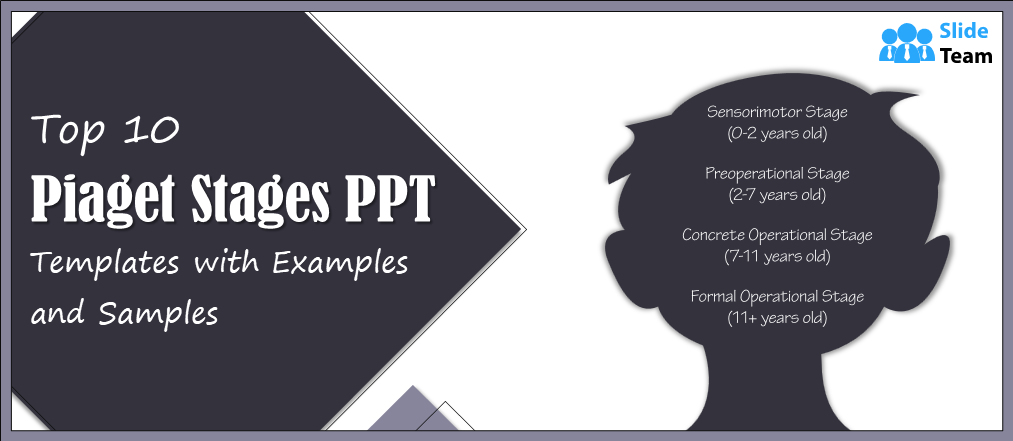
Piaget's theory of cognitive development describes four stages: the sensorimotor, preoperational, concrete operational, and formal operational stages. These different stages provide insight into the changes that occur regarding children's thoughts and understanding of the world as they mature.
2. What are the 5 stages of Piaget?
In Piaget's theory, the four stages are sensorimotor, preoperational, concrete operational, and formal operational. An additional stage is the fifth one, which is informal (post-formal thinking). Some psychologists would argue that there is a "Post-formal Stage" in adulthood where thinking becomes more flexible, realistic, and complex.
3. What is Piaget's theory of child development?
Jean Piaget's Theory of Child Development is the foundation for psychology and education because it explains how children are actively engaged in acquiring knowledge as they grow. It proposed how a child's thoughts undergo maturing stages with different cognitive capabilities.
Core Ideas of Piaget's Theory:
Children as active learners: They are little scientists constantly exploring, inquiring, and experimenting.
Development is stage-like: Cognitive growth proceeds in a series of stages that are universal and age-related.
Schemas: Children construct mental frameworks, or schemas, with which to understand everything in the world. These schemas are modified through:
Assimilation - fitting new information into already existing knowledge
Accommodation - changing their understanding to accommodate new experiences.