

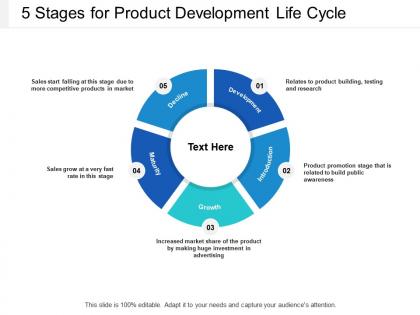
5 stages for product development life cycle




Try Before you Buy Download Free Sample Product
 Impress Your
 Audience
 100%
100% Editable
 Save Hours
 of Time


Take them through the full grind with our 5 Stages For Product Development Life Cycle. They won't come away half baked.
People who downloaded this PowerPoint presentation also viewed the following :
5 stages for product development life cycle with all 5 slides:
Get the grants you desire with our 5 Stages For Product Development Life Cycle. Convince them that your idea is feasible.
FAQs for 5 stages for product
So you've got ideation, research/validation, design, development, testing, launch, and post-launch optimization. But here's the thing - it's way messier than that sounds. Research findings will totally reshape your design. Design drives development. Testing catches stuff before you go live. Then post-launch data sends you right back to the drawing board, which honestly can be frustrating but super valuable. You'll jump around between stages constantly or circle back when something new clicks. Treat it like a cycle, not a checklist. Oh and document everything! Your future self (and team) will thank you later.
Dude, you absolutely need to get feedback before building anything serious. I made the mistake once of skipping this step - total disaster. Start with surveys or just talking to people, even before you have a working prototype. It'll show you what actually bugs users and whether your idea even makes sense. Without real input, you're basically throwing darts blindfolded. Focus groups are kinda old school but they work. The whole thing saves you from wasting months building features nobody wants. Trust me on this one.
Look, prototyping is your sanity check before dumping time and money into something. Test your ideas with actual people first - you'll catch big problems early and figure out if anyone even wants this thing. Honestly, I've watched so many teams skip this step and then hate themselves later. Better to fail quick and cheap than spend months building something nobody uses. Oh and don't obsess over making it perfect - just detailed enough to get real feedback. Start with whatever you're most unsure about first.
Honestly, cross-functional teams are a lifesaver for cutting through all that departmental BS. Instead of marketing making promises engineering can't keep, everyone's actually talking to each other upfront. Each person gets the full picture, not just their tiny corner of it. Issues get spotted early - like when someone realizes a launch date is totally bonkers before you're scrambling last minute. Decisions happen way faster too since you don't need to hunt down five different people later. Just set up regular check-ins where teams share what's happening and what's blocking them. Sounds basic but it actually works.
Honestly, it depends where your product's at. New stuff? Watch engagement and adoption - are people actually using what you built? Once you're growing, revenue and customer acquisition costs become everything. I swear I spend way too much time staring at CAC spreadsheets these days. Mature products are all about retention and lifetime value. If something's dying, focus on cost cuts and getting users moved to whatever's replacing it. Don't track everything though - pick 3-4 metrics max or you'll go crazy with analysis paralysis.
Honestly, it's all about speed. Tech companies can ship updates daily and pivot super fast based on what users actually do. Consumer goods? You're stuck with way longer cycles because of manufacturing, supply chains, all that physical stuff that takes forever. With software you can build quick MVPs and iterate cheap. But physical products need tons of upfront research since changing anything once you're manufacturing is ridiculously expensive. I learned this the hard way at my last job - we spent months just on regulatory approval alone. Your planning has to account for these constraints or you'll get burned.
Ugh, product testing is such a pain because you're always fighting unrealistic deadlines and never have enough budget. Scope creep will destroy you too - suddenly everyone wants to test fifty new things. Getting decent feedback is another nightmare since half your testers don't even match your actual users. Here's what works: pad your timeline with extra weeks upfront. Define exactly what you're testing before you start (seriously, write it down). Find testers who actually look like your target customers. Run quick tests throughout development instead of one giant testing marathon at the end. Oh, and start planning this stuff while you're still building - don't wait until launch week like I did once. Trust me on that.
Dude, Agile is a game changer for development speed. You break work into these 2-week chunks instead of planning for months only to build the wrong thing. Getting user feedback every sprint means you catch problems early - way better than discovering issues after you've already shipped. Daily check-ins help too, though honestly they can feel repetitive sometimes. The real magic happens when priorities shift (and they will) because you can actually pivot without scrapping everything. Try it on one small project first. You'll be shocked how fast you can test ideas and get stuff out the door.
Honestly, a go-to-market strategy is what separates successful launches from total flops. You're basically figuring out who wants your product, how much they'll pay, and where they'll actually buy it. Plus your messaging and timeline - all that stuff. Don't just build something and pray people find it (trust me, they won't). I learned this the hard way on my first project actually. Start planning this whole thing like 2-3 months before you launch. It's literally the difference between "cool product" and "product that pays your bills." Skip it and you'll be scrambling later wondering why nobody cares.
Honestly, get close to your users first - set up feedback loops through interviews, analytics, support tickets, all that stuff. The real work starts after you launch anyway since people never use your product how you think they will (learned this the hard way). Don't just build what's easiest - prioritize based on actual user impact and business goals. Ship small updates frequently instead of waiting for huge overhauls. You'll need to balance new feature requests with fixing existing problems. Oh, and audit what you already have to find your biggest drop-off points first.
Dude, tech advancement is such a weird paradox right now. You can prototype stuff crazy fast with 3D printing and test things virtually, which is awesome. But then you're competing with companies pushing daily updates while you're still thinking in quarters. It's honestly exhausting sometimes. Your team really needs to ditch that old waterfall approach - agile and cross-functional work is the only way to survive. The trick is picking tools that actually make you faster, not just give you more busy work to track.
Honestly, just bake it into your process from the start - don't try to slap it on later. Pick eco-friendly materials during design phase. Then look at your manufacturing to cut waste and energy (which usually saves cash anyway, so win-win). Your suppliers need to be on board too or you're fighting an uphill battle. Oh, and don't forget packaging - that's where a lot of companies mess up. Track some basic metrics so you know if it's actually working. I'd start with just one sustainable switch per cycle though. Baby steps beat grand gestures that fizzle out.
Honestly start with the basics - grab Jira or Asana for project tracking, then Slack for team chat. For design stuff, Figma's basically taken over (RIP Adobe XD lol). Git's a must for version control, obviously. The tricky part is making sure everything talks to each other - nothing's worse than juggling ten different tools that don't sync. I'd say pick maybe 3-4 core ones first. You can always add Confluence for docs later, plus some analytics tool once you're actually live. The whole landscape changes every six months anyway, so don't stress about finding the "perfect" stack right away.
Honestly, UX/UI can make or break your whole product. Users will ditch you so fast if the interface sucks - doesn't matter how cool your features are. I've watched some genuinely brilliant products tank because nobody could figure out how to actually use them. Good design makes everything feel intuitive, like "oh obviously that's where I click." It's wild how much bad UX can hurt adoption rates. Get designers involved from day one, not when you're scrambling at the end. Trust me on this one - fixing design later is a nightmare.
Dude, get marketing involved from the start - seriously. They're not just there to hype up your finished product. Early on, they'll do market research and help you figure out if your idea actually makes sense. While you're building, they can work on positioning and messaging. The products that really crushed it? Marketing was baked in the whole time, not slapped on later. They'll also prep your launch strategy and keep gathering feedback once you're live. Oh, and they're weirdly good at spotting things you missed during development. Bottom line: bring them into your planning meetings now, not when you're about to ship.
No Reviews