


Three stages of product commercialization





Try Before you Buy Download Free Sample Product
 Impress Your
 Audience
 100%
100% Editable
 Save Hours
 of Time


Influence their feelings with our Three Stages Of Product Commercialization. Get folks to consider alternate approaches.
People who downloaded this PowerPoint presentation also viewed the following :
Content of this Powerpoint Presentation
Description:
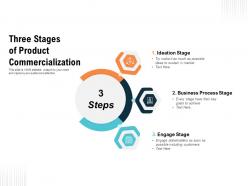
This image depicts a presentation slide titled "Three Stages of Product Commercialization," indicating that it is designed to guide viewers through the critical phases of bringing a product to market. The slide asserts its adaptability, emphasizing that it is 100% editable to meet the needs and capture the attention of the audience.
The text elements included on the slide consist of three main points titled "Ideation Stage," "Business Process Stage," and "Engage Stage":
1. Ideation Stage:
This point urges viewers to generate as many ideas as possible to sustain in the market, implying the importance of creativity and expansive thinking in the initial development of a product.
2. Business Process Stage:
It suggests that every stage has its key goals to achieve, which signifies the necessity of having strategic objectives at every step of the product development and business strategy.
3. Engage Stage:
It emphasizes the importance of engaging stakeholders, including customers, as soon as possible, pointing to the value of stakeholder feedback and involvement for a successful product launch.
Use Cases:
These stages are central to any product commercialization endeavor and, as such, are highly relevant across multiple industries:
1. Technology:
Use: To outline the stages of developing and launching new tech products.
Presenter: Product Manager
Audience: Development Team
2. Pharmaceuticals:
Use: Describing the process of bringing new drugs or medical devices to market.
Presenter: Head of R&D
Audience: Investors
3. Manufacturing:
Use: Explaining the phases of product design, testing, and market introduction.
Presenter: Operations Director
Audience: Production Staff
4. Consumer Goods:
Use: Presenting the roadmap for launching new consumer products.
Presenter: Marketing Executive
Audience: Sales Representatives
5. Automotive:
Use: Discussing the concept to market journey of new vehicles or automotive technology.
Presenter: Chief Engineer
Audience: Stakeholders
6. Energy:
Use: Illustrating the commercialization process for new energy solutions or products.
Presenter: Innovation Manager
Audience: Policy Makers
7. Agriculture:
Use: Demonstrating the steps for commercializing agricultural innovations.
Presenter: Agribusiness Consultant
Audience: Farmers and Distributors
Three stages of product commercialization with all 5 slides:
Get folks to consider alternate approaches with our Three Stages Of Product Commercialization. It helps influence their feelings.


FAQs for Three stages
So basically you've got five main steps: market research, product development, testing, launch planning, and then optimizing after launch. Start by figuring out if people actually want this thing and who your audience is. Build the product while getting feedback - super important. Testing is honestly make-or-break territory (I've seen so many good ideas die here because teams rushed it). Then plan your pricing, distribution, all that go-to-market stuff. After launch, watch the data and keep tweaking. Oh, and push back when people want you to skip testing phases - I know it's tempting but don't do it.
Dude, you NEED to do market research before launching anything. Figure out who'll actually buy your stuff and what they'll pay for it. Skip this and you're basically guessing - I've watched so many startups crash because they thought they knew their customers but didn't. Do surveys for the hard data, but also talk to people one-on-one. Those conversations reveal stuff numbers can't. Oh, and it helps you spot competitors before they blindside you. Which features should you build first? What's your messaging? Research answers all that. Honestly feels like extra work but it's not optional.
Honestly, prototypes are game-changers for testing your idea before you blow a ton of cash on production. Get user feedback early, catch design issues, and show investors something real instead of just talking their ear off. Way more convincing that way. They'll also help you figure out manufacturing costs upfront. My advice? Start super rough and cheap - even cardboard works sometimes lol. Then gradually make nicer versions as you dial things in. Don't overthink it, just build something you can actually touch and test.
Dude, biggest mistakes I see? Companies rush out without testing if people actually want their stuff. Marketing costs will destroy your budget - seriously, that shit gets expensive quick. Pricing is tricky too. Go too cheap and you're broke, too high and nobody buys. Timing matters more than people think - don't launch when Apple's dropping something huge, you know? Also the unsexy stuff like customer service and logistics. Everyone skips it then scrambles later. Honestly? Be brutally real about whether you're actually ready and keep way more cash on hand than you think you need.
Map out your supply chain now and find backup suppliers for everything critical. Don't wait until you're panicking during a crisis - been there, it sucks. Get real-time tracking on inventory and shipping so you can spot problems early. I'd spread suppliers across different regions too, just in case one area gets hit with disruptions. Regular check-ins with your main suppliers are a must. Honestly, the communication piece is what most people mess up. Start building these relationships and backup plans like 6-12 months out minimum.
Look, start with the basics - revenue growth, profit margins, customer acquisition costs. Those matter most. Market share and retention rates show you how you stack up against competitors. But here's the thing - don't ignore the soft metrics. Customer satisfaction and product adoption tell you if people actually give a damn about what you're building. For digital stuff, user engagement is huge too. Honestly though? Pick like 3-5 metrics that really fit your business model first. Get those down solid, then add more later. Way better than drowning in data you can't act on.
Dude, branding makes or breaks everything. I've watched incredible products totally bomb because their branding was garbage - like, nobody could figure out what they were even about. You need your messaging and visuals to actually speak to people's problems, not just look pretty. Without that emotional connection, you're basically invisible. People buy from brands they trust and understand, not random companies that seem sketchy or confusing. Oh, and start this stuff early! Don't just slap a logo on at the end and call it good. Your brand story needs to be solid from day one.
Dude, you've got to play to your strengths - speed and flexibility. Big companies take forever to change direction, so that's where you win. Find those weird little niches they're totally ignoring and just dominate there first. Don't try competing on everything because honestly, you'll get crushed. Instead, pick one specific problem and solve it way better than anyone else. Use social media and digital stuff since it's cheaper than traditional advertising. Oh, and go direct-to-consumer if you can - builds way better relationships. Partner up with brands that complement yours too. Just move fast and don't overthink it.
Honestly, get your IP stuff sorted first - patents, trademarks, whatever applies to your product. Industry regulations and safety standards are a pain but you can't skip them. Product liability insurance is non-negotiable because if someone gets hurt, you're on the hook. Employment law becomes relevant once you start hiring people. Data privacy rules matter if you're collecting any customer info (and who isn't these days?). Partnership contracts and licensing deals need proper paperwork too. Seriously though, do a legal audit now. I've seen too many people try to fix this mess after they're already selling - it's brutal and expensive.
Yeah, digital marketing is honestly a game-changer for launching products. You can target exactly who you want and get instant feedback on what's working. Test your messaging on small groups first - saves you from major disasters later, trust me. The data you get is gold: click rates, engagement, all that stuff. If something flops, you pivot fast. Content marketing lets you build hype while educating people at the same time. Oh, and social proof is huge too. Start by figuring out your main customer types, then run small test campaigns with different pitches. Way smarter than going in blind.
Dude, you HAVE to get your stakeholders on board or you're screwed. Map them out early - investors, customers, distributors, regulators, your own team. Everyone needs to get the value prop and actually care about seeing you succeed. It's like building a coalition honestly. Skip this step and you'll face roadblocks everywhere. Funding problems, market pushback, internal drama - the works. Create some kind of communication plan to keep them looped in and excited as you hit milestones. Trust me, their buy-in can literally make or break the whole thing.
Dude, pricing can totally make or break your launch. I learned this the hard way - went too high on my last product and killed all momentum right out the gate. You don't want to go too low either though, because then people think your stuff is cheap garbage. Research what people actually pay for similar products first (not the fake list prices). Match your pricing to your strategy - go low if you want market share fast, high if you're positioning as premium. Oh and profitability matters too obviously, but you probably already knew that.
Honestly, start with where your customers actually hang out and shop - no point setting up somewhere they'll never find you. Check if the channel can actually handle your volume too. Costs are huge obviously - margins, fees, all that fun stuff adds up fast. Oh, and some channels let you control pricing and how your brand looks, others... not so much. I'd probably map out 2-3 options that make sense for your customers and your wallet. Test small first though! Way better than jumping in with both feet and regretting it later.
Look, customer feedback is basically your cheat sheet for fixing stuff before you go all-in. Run some focus groups or beta tests - maybe even just quick surveys. Trust me, whatever bugs customers the most is probably something you totally missed. Their complaints can help you tweak your messaging, fix features, or even switch up your target market if you need to. Don't chase every single complaint though. Focus on the patterns you keep seeing. Oh, and start gathering this feedback during your pilot phase so you're not scrambling later after you've already blown half your budget.
So scalability really comes down to three big things - can your operations actually handle growth, is there enough market demand, and do your unit economics work? Your systems (manufacturing, distribution, support) can't fall apart when volume jumps. Obviously you need a big enough market to scale into. But here's what kills most companies: margins get worse as they grow instead of better. Tech infrastructure matters too, especially if you've got software pieces. Honestly, just figure out your biggest bottleneck first - production, talent, or cash - then build everything around fixing that. Don't try to solve everything at once.
No Reviews