


Pharmaceutical product development process pharmaceutical development new medicine




Try Before you Buy Download Free Sample Product
 Impress Your
 Audience
 100%
100% Editable
 Save Hours
 of Time


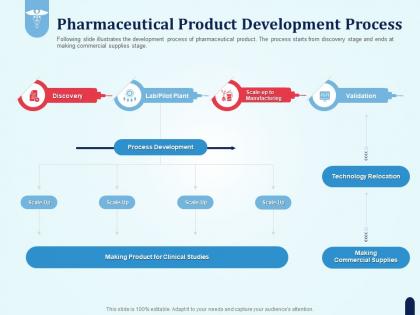
Following slide illustrates the development process of pharmaceutical product. The process starts from discovery stage and ends at making commercial supplies stage.
People who downloaded this PowerPoint presentation also viewed the following :
Pharmaceutical product development process pharmaceutical development new medicine with all 2 slides:
Use our Pharmaceutical Product Development Process Pharmaceutical Development New Medicine to effectively help you save your valuable time. They are readymade to fit into any presentation structure.
FAQs for Pharmaceutical product development process pharmaceutical
So basically there are four stages that build up safety data. First is preclinical - that's all the lab and animal testing. Then Phase I tests safety on small groups of people. Phase II checks if it actually works, and Phase III does massive trials comparing it to current treatments. Each phase gets bigger and stricter. The FDA can literally shut down the whole thing if they spot problems (which tbh happens way more than people realize). Oh and sample sizes get huge by Phase III - we're talking thousands of participants. Bottom line: it's like a series of checkpoints so drugs that make it to market actually work and won't hurt you.
So basically these agencies control every checkpoint in drug development. Before Phase I, you need their green light. Same thing between each phase after that. FDA reviews your protocols, safety stuff, manufacturing details - it's like having someone constantly looking over your shoulder tbh. They can shut you down or ask for way more data if something looks sketchy. Here's the thing though - you really want to meet with them early on. Those pre-submission meetings are clutch for figuring out what they actually want before you waste time submitting the wrong stuff.
Think of clinical trial design as your roadmap for proving your drug works and won't harm people. Patient selection, dosing, endpoints, controls - all that stuff needs solid planning upfront. I've watched brilliant compounds completely fail because of sloppy trial design (so frustrating). Success means defining what "winning" looks like before you even start recruiting. The FDA will pick apart every single choice you made, so get it right from day one. Honestly, spending extra time on design saves you from major disasters later. Short trials can work, but don't rush the critical pieces.
Dude, AI and big data can totally slash drug discovery from like 20 years down to maybe 5-7. Instead of burning through millions testing random compounds, you can actually predict what'll work first. Big data finds patient response patterns that would take researchers forever to spot manually. The crazy thing is AI reads thousands of studies in minutes and connects dots humans miss. Clinical trials get way smarter too when you can forecast outcomes ahead of time. Though honestly, don't go nuts right away - start with something specific like target identification and show it actually pays off before diving deeper.
Manufacturing scale-up will probably kick your ass first. Then there's all the regulatory stuff - your preclinical data looks amazing until you realize human dosing is a completely different beast. CMC documentation has to be perfect or regulators will tear you apart. Oh, and suddenly you're drowning in IRB approvals and informed consent forms (seriously, who knew there were so many ethics hoops?). The paperwork is honestly insane. My advice? Get tight with clinical ops and regulatory people ASAP. They'll save you from making expensive mistakes that take forever to fix.
So pharma companies look at a few key things when picking what to develop. Early trial results matter a lot - does the drug actually work? They also check if there's a real medical need patients will pay big money for. Obviously profit potential is huge since R&D costs are insane. Patent timing is critical too - you need years left to make your money back. Plus they consider how many competitors are already in that space and what regulatory headaches they might face. Honestly, it all comes down to: will this solve a problem people desperately need fixed?
Okay so the main things are informed consent, risk-benefit balance, and protecting vulnerable people. Participants need to actually understand what they're getting into - not just sign some form they didn't read. They can bail anytime too, no questions asked. The paperwork is honestly insane sometimes, but you've gotta communicate clearly anyway. Make sure potential benefits outweigh the risks, and don't prey on desperate patients who'll agree to anything. Oh, and definitely get an independent ethics board to review everything first. That part's non-negotiable.
So pharma patents are basically 20-year monopolies that let companies recoup those insane R&D costs - like billions per drug, it's wild. Without them, generics would swamp the market instantly and nobody would bother innovating new treatments. Pretty smart setup, honestly. Downside? Drug prices stay crazy high until patents run out. Oh, and companies love filing multiple patents on the same drug to stretch that protection longer. If you're ever looking at pharma investments, check the patent situation first - it'll tell you exactly what you're dealing with timeline-wise.
Honestly, these partnerships are pretty smart. Universities have all the brilliant researchers doing wild experiments that companies wouldn't touch - too risky, you know? But then academia hits a wall when it comes to funding those massive clinical trials. That's where pharma swoops in with their deep pockets and regulatory know-how. You end up with faster results since everyone's playing to their strengths. The university gets resources they'd never afford solo. Companies get access to cutting-edge discoveries and fresh talent. Win-win situation. I'd say start by finding academic labs already working in your area.
Dude, patient feedback can totally make or break your whole timeline. FDA pays serious attention to what patients actually report - especially for stuff where quality of life matters just as much as the clinical numbers. I've literally watched companies dump promising compounds because patients couldn't stand the side effects, even with solid efficacy data. Pretty brutal honestly. Your dosing, formulation, everything gets shaped by this feedback. The trick is weaving patient input into your protocol from day one. Don't just slap it on later and hope for the best.
Honestly, it all comes down to what patients actually need and what the market will pay for. Companies chase rare diseases now because even tiny patient populations can justify crazy high prices if there's no other treatment. You can't just copy existing drugs anymore - competition's too fierce. The smart move? Talk to patient groups and doctors way before you're ready to launch, not after you've already spent millions developing something. I've seen too many companies assume they know what people want without actually asking them first. Those early conversations during pipeline planning can save you from building the wrong thing entirely.
So personalized medicine is totally flipping drug development on its head. Gone are the days of one-size-fits-all treatments - now companies are laser-focusing on specific patient groups using genetics and biomarkers. You'll need companion diagnostics from day one, which honestly makes everything more complicated but way more effective. Trial designs have to be flexible since you're working with smaller, targeted cohorts. Success rates are definitely higher though. The downside? Regulatory approval gets messier and costs go up front. Oh, and don't forget to think about biomarker stuff early in discovery - saves headaches later.
So pharmacovigilance is like the safety watchdog after drugs go live. Clinical trials only test on thousands of people, but once a drug hits the real world? You're talking millions of patients. That's when rare side effects actually show up - stuff that was basically invisible in smaller studies. It monitors all that data continuously, updates warnings, sometimes yanks drugs entirely if things go south. Honestly, the system only works if doctors report weird reactions they see. Your random adverse event report could literally save someone else down the line.
Think of biosimilars as generic biologics, but way more complicated to make. You're still looking at 7-8 years development instead of the usual 10-15, which is solid. Manufacturing these things is honestly a nightmare though - you can't just copy the chemical formula like regular generics. The FDA wants proof that your version works the same structurally and clinically. But here's the thing: tons of biologics are losing patent protection right now. If you can actually figure out the production side, there's real money to be made with much less risk than developing something totally new.
Dude, pharma research is insanely expensive - we're talking $1-3 billion per drug, so funding is everything. You've got NIH grants, VCs, big pharma R&D money, and academic partnerships as your main options. VCs are being super picky lately though, which honestly sucks. The key thing? Don't put all your eggs in one basket - diversify early. Oh, and start schmoozing potential funders way before you're desperate for cash. Always have your ROI pitch ready because they'll ask. It's brutal out there but doable if you're strategic about it.
-
The content is very helpful from business point of view.
-
Design layout is very impressive.